Shipping Faster with Feature Flags

- Why feature flags matter now
- Designing flags that don’t become debt
- Rollouts, experiments, and safety checks
- Tooling and architecture choices
- bookmark
Why feature flags matter now
Feature flags have moved from a niche technique to a mainstream delivery practice because software teams are shipping more frequently and to more platforms than ever. A flag lets you merge code into the main branch while keeping the behavior off for most users, which reduces long-lived branches and the painful merge conflicts that come with them. It also changes the risk profile of releases: instead of betting everything on a single deployment window, teams can deploy continuously and control exposure separately. This matters in modern systems where a single change can touch web, mobile, backend services, and data pipelines. When a release goes wrong, the fastest mitigation is often not a rollback but a quick disable. Flags provide that “kill switch” capability without requiring a new build, which is especially valuable for mobile apps where app-store review cycles slow down emergency fixes. Used well, flags support safer experimentation, staged rollouts, and faster incident response.
Designing flags that don’t become debt
The most common failure mode is treating flags as permanent configuration. A healthy flag strategy starts with clear types and lifecycles. Release flags are temporary and exist to decouple deployment from exposure; they should have an owner, a removal date, and a cleanup task in the backlog. Experiment flags support A/B tests and need analytics instrumentation, a hypothesis, and a decision deadline. Operational flags are rarer but legitimate, used for emergency throttling or switching providers; these require strict access controls and audit trails. Naming and scoping matter. Flags should be descriptive, stable, and tied to a product behavior, not an internal ticket number. Scope should be explicit: per user, per account, per region, or per environment. Teams also need guardrails to prevent “flag spaghetti,” where multiple flags interact in unpredictable ways. A practical rule is to avoid nesting flags inside flags, and to cap the number of active flags per service. Finally, every flag should be observable: log when it is evaluated, track its distribution, and alert on unexpected changes in exposure.
Rollouts, experiments, and safety checks
A feature flag is most valuable when paired with a rollout plan. Progressive delivery typically starts with internal users, then a small percentage of real traffic, then wider exposure. This can be done by percentage-based targeting, by cohorts (for example, new accounts only), or by geography. The key is to define success and failure signals before turning anything on: error rates, latency, conversion, support tickets, and business metrics relevant to the feature. Experiments require additional discipline. Randomization must be consistent, ideally using a stable user identifier to avoid users bouncing between variants. Metrics should be pre-registered to reduce cherry-picking, and the experiment should run long enough to capture weekly cycles. Safety checks are not optional: add circuit breakers for downstream dependencies, enforce timeouts, and ensure the “off” path is well tested. Many teams forget to test the disabled state after weeks of development, only to discover that turning the flag off breaks the app. Treat both paths as production code and include them in automated tests.
Tooling and architecture choices
Teams can implement flags with a simple configuration file, a database table, or a dedicated feature management service. The right choice depends on scale and governance. A file-based approach is easy but requires deployments to change exposure, which defeats the purpose for fast mitigation. A database-backed approach supports runtime changes but needs caching, consistency rules, and careful performance design so that flag checks don’t add latency to every request. Dedicated platforms add targeting rules, audit logs, SDKs, and dashboards, but they introduce vendor dependency and cost. If you build in-house, prioritize reliability: the flag system becomes part of your critical path. Most architectures use local caching with periodic refresh, plus a safe default when the flag service is unavailable. Decide whether flags are evaluated server-side, client-side, or both. Client-side flags enable UI experiments but can leak hidden features if not protected; sensitive logic should remain server-side. Finally, integrate flags with CI/CD: require a ticket for new flags, enforce naming conventions, and automatically open cleanup tasks when a flag is turned fully on.
bookmark
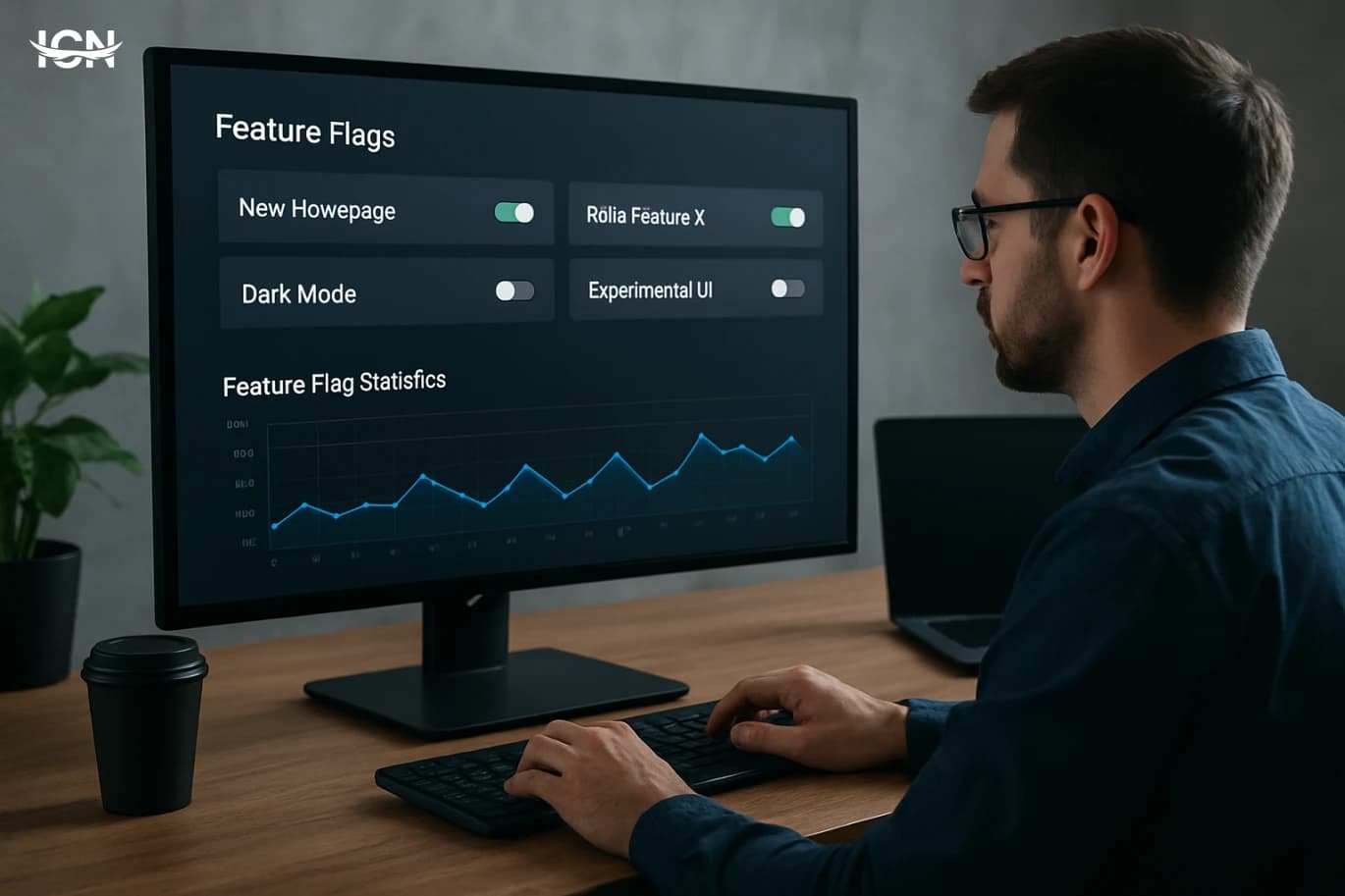
To adopt feature flags without chaos, start with a small, measurable use case: one release flag for a single feature in one service. Define the owner, the default state, the targeting rule, and the removal date on day one. Add a dashboard that shows current exposure and recent changes, and ensure only a limited group can modify production flags. Operationally, document a standard playbook: how to enable a flag, how to ramp from 1% to 100%, what metrics to watch, and how to disable safely. Add automated tests for both on and off paths, and include a lint rule or code review checklist that rejects flags without cleanup plans. After a month, review your flag inventory: remove stale flags, consolidate duplicates, and measure whether incident mitigation and release frequency improved. The goal is not more flags; it is more control over risk while shipping faster.