
Download Our App
Shop your way




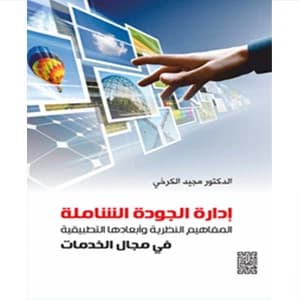
Total Quality Management – Theoretical Concepts and Practical Dimensions in Services
JOD

Get it by 5 Aug | Order in 3 Hours 34 Minutes
- Return Policy
- Warranty Policy
- Shipping Policy
- Non contact delivery
- Personal Receipt
- Return Policy
- Warranty Policy
- Shipping Policy
- Non contact delivery
- Personal Receipt
Number of Pages: 288
Year of Publication: 2015
Binding Type: Hardcover
Edition Number: 1
Print Color: White
Dimensions (cm): 17×24
Weight (kg): 0.490
Barcode: 9789957183295
Introduction
Total quality holds significant importance in management across various fields, whether related to the quality of goods or services. It is intertwined with various economic, social, political, and legal sciences. It plays a crucial role in economic and strategic planning as it is closely tied to achieving the goals, mission, and vision of many institutions.
The subject of total quality is not new in administrative sciences but is relatively recent in managerial thought. It requires further exploration, which prompted us to present this topic in a simplified explanatory manner, combining academic theoretical presentation with simplified conceptual narration.
In the first chapter, we explored aspects related to the total quality tool, which forms a crucial base for the development of industries and services. We discussed the stages of total quality development, its goals, benefits, distinctive characteristics, and techniques.
Chapter two focuses on pioneers of total quality such as Edward Deming, Joseph Juran, Philip Crosby, Armand Feigenbaum, Kaoru Ishikawa, and others.
Chapter three delves into the mechanisms and conditions for obtaining ISO standards, the importance of ISO for institutions, and the application stages and basic principles of ISO 9000 systems.
In chapter four, we discussed the foundations of performance excellence, its concept, requirements, characteristics, and strategy. We explained the concept of providing excellent service and the steps to improve performance.
Chapter five discusses civil society, its concept, organization characteristics, and goals.
Chapter six covers the principles and characteristics of excellent service and the efficiency of its provision.
Chapter seven outlines the quality of social services, their concepts, principles, standards, and the strategic planning for comprehensive quality management.
Chapter eight concludes with questionnaires to measure service quality in non-profit service institutions.
We hope that this book will be beneficial and significant, adding an important volume to the Arabic library.







