
Download Our App
Shop your way




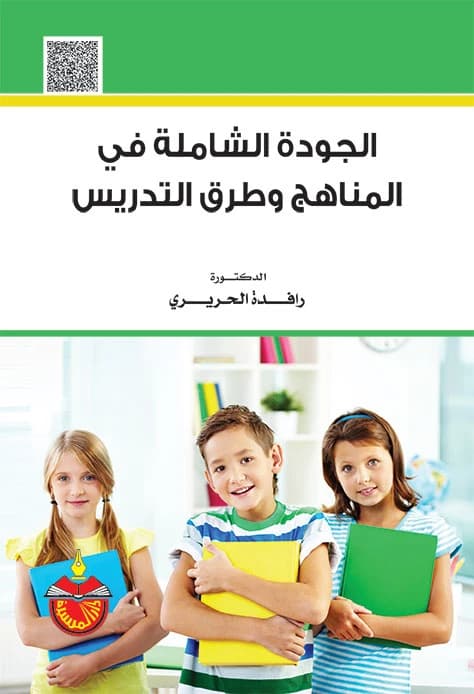
Total Quality in Curricula and Teaching Methods - Dr. Rafida Al-Hariri
JOD

Get it by 5 Aug | Order in 3 Hours 47 Minutes
- Return Policy
- Warranty Policy
- Shipping Policy
- Non contact delivery
- Personal Receipt
- Return Policy
- Warranty Policy
- Shipping Policy
- Non contact delivery
- Personal Receipt
The process of education is based on the community's interests, hopes, pains, problems, aspirations, goals, and philosophy. Educational institutions are community-based entities that strive to prepare, develop, and guide society's members according to future aspirations and visions, and in line with the requirements of total quality. Total quality has become the umbrella under which community institutions of all kinds shelter, seeking distinguished work that ensures high-quality outcomes. This is especially true as we live in the age of the information, communication, and technology revolution, observing rapid changes in all fields of life. This necessitates a reconsideration of the entire educational process to adapt it to these successive developments by applying Total Quality Management in its broad sense to all elements of the educational system. This includes school administration, teacher preparation, curricula, teaching methods, school buildings, equipment, registration and admission systems, class density, student arrangement in classrooms, counseling, guidance, supervision, and the school's relationship with parents and the external community.
Since educational institutions are uniquely responsible for preparing individuals thoroughly and proficiently, enabling them to eventually enter the workforce with confidence, ability, skill, and a strong scientific background, they contribute to the development and growth of society, advance its economy, and improve the outcomes of various professional fields. Therefore, the curriculum and teaching methods are the two elements upon which the outcomes of the teaching-learning process depend. The quality of the school curriculum—in terms of planning, design, content, and evaluation—and the way its content is presented to students, supported by encouraging them to research, read, and learn more, are fundamentals of total quality in educational institutions. This does not mean neglecting other elements, but rather considering the curriculum as the primary vehicle of education in achieving its goals.
This book addresses Total Quality Management in terms of its concept, characteristics, objectives, philosophy, and importance. It then discusses curriculum and teaching methods, linking them to the indicators and requirements of total quality in education.
- Number of Pages: 416
- Year of Publication: 2016
- Binding Type: Hardcover
- Edition Number: 2
- Printing Color: Black
- Dimensions (cm): 17x24
- Weight (kg): 0.800
- Barcode: 9789957067250







