
Download Our App
Shop your way




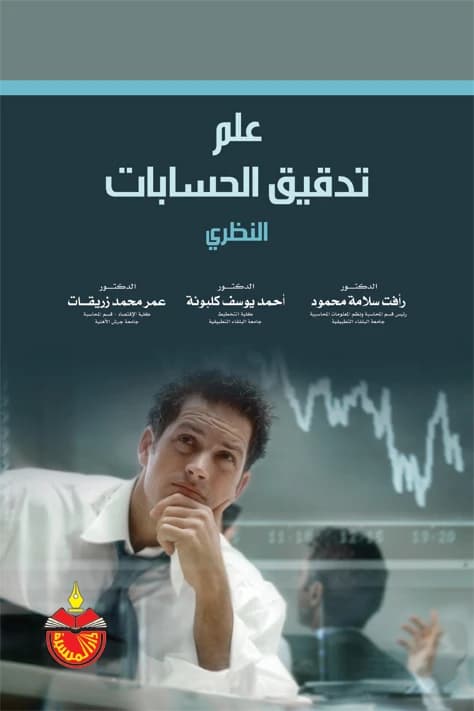
Theoretical Auditing Science (2011) - Dr. Ahmed Yousef Kalbouneh
JOD

Get it by 5 Aug | Order in 2 Hours 35 Minutes
- Return Policy
- Warranty Policy
- Shipping Policy
- Non contact delivery
- Personal Receipt
- Return Policy
- Warranty Policy
- Shipping Policy
- Non contact delivery
- Personal Receipt
Accounting and auditing are the foundation of economic decision-making. Tracing the function of the accounting profession from its inception to the present, it is noted that it began as a bookkeeping system with the primary goal of protecting owners' assets. As a result of technological development and the growth in the size of enterprises, a structured knowledge of internal and financial control became necessary.
Auditing is not a recent invention; it has been known to humanity in a primitive form since individuals began engaging in activities to satisfy their own and others' needs. It started as individual review, where a person would reconsider their work, whether in self-reflection, in relation to the Creator's teachings, or with others, to evaluate the results of their actions and determine the consequences, uncovering any mistakes made. It is an accepted truth that every action an individual takes reflects back on them in some way, potentially bringing benefit or harm. If the outcome is beneficial, they embrace and continue it; if harmful, they seek to correct and rectify it to prevent future occurrences.
In ancient times, auditing was conducted orally. Later, it took another form where each scribe would review the work of another. In the Greek era, auditing was performed by a group of officials called the audit council. In the Roman era, the Senate was responsible for auditing and approving accounts.
The book's chapters cover the following topics:
- Chapter One: Introduction to the science of auditing.
- Chapter Two: Types of auditing.
- Chapter Three: Professional assurance services.
- Chapter Four: Errors and fraud in auditing.
- Chapter Five: Aspects of manipulation in auditing.
- Chapter Six: The auditor.
- Chapter Seven: Audit papers and files.
- Chapter Eight: Internal control.
- Chapter Nine: Gathering evidence and clues in auditing.
- Chapter Ten: The auditor's report.
- Chapter Eleven: The relationship between auditing and the internal control process.
- Chapter Twelve: Auditing of fixed assets.
Book Details:
- Number of Pages: 302
- Year of Publication: 2011
- Binding Type: Cardboard
- Edition: 1st
- Print Color: Black
- Dimensions (cm): 17x24
- Weight (kg): 0.600
- Barcode: 9789957067243







