
Download Our App
Shop your way




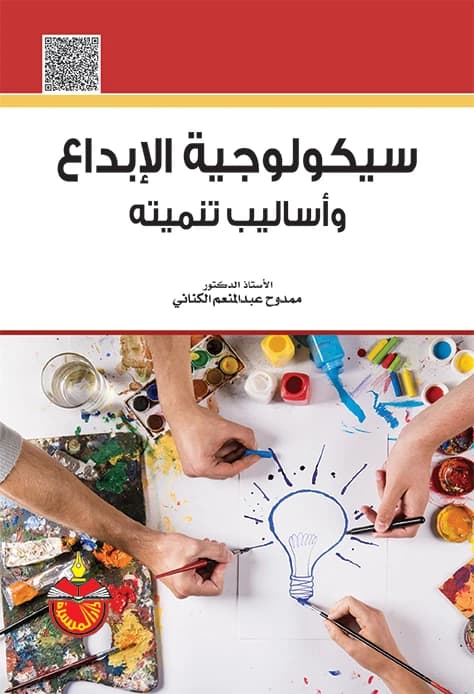
The Psychology of Creativity and Its Development Methods - Mamdouh Abdel Monem Al-Kinani - 2015
JOD

Get it by 5 Aug | Order in 3 Hours 15 Minutes
- Return Policy
- Warranty Policy
- Shipping Policy
- Non contact delivery
- Personal Receipt
- Return Policy
- Warranty Policy
- Shipping Policy
- Non contact delivery
- Personal Receipt
"What is respected in a country, will be planted and grown there" (Plato). This is the phrase with which I begin this book, as I have been explaining and clarifying the nature of innovative thinking and creativity for more than thirty years now, aiming to instill positive attitudes towards this type of thinking and creative performance, and to provide procedures, methods, and strategies for its development in our children, students, as well as workers in various educational and industrial institutions. However, the psychological and educational environment surrounding us does not help to respect and develop innovation and creativity due to its focus on other characteristics and variables that our culture, and indeed our present world, values.
This book includes eleven chapters. Chapter One covers the importance, concepts, types, and levels of innovation and creativity, the social aspect of innovation and creativity, as well as some fallacies associated with old interpretations of creativity. Chapter Two includes theories and approaches to explaining innovation such as classical and modern psychoanalytic theories, as well as behavioral, associationist, cognitive, Gestalt, humanistic, social, and constructivist theories. In Chapters Three, Four, and Five, we discuss the personality of the innovative individual in terms of the predispositions or potentials required for innovation and creativity, the thinking skills necessary for the stages of the innovative process leading to creativity, the difference between the innovative process and the creative product, and we also address the conscious and unconscious motives behind creative output, as well as the personality traits necessary for innovation that may arise from it. In Chapter Six, the author presents a set of criteria and standards for judging an individual's creativity, as well as some scales and tools used to measure innovative abilities and traits and attitudes of the innovative personality, through which an individual's creativity can be predicted. In Chapters Seven and Eight, the author discusses the environment surrounding the innovative individual, which facilitates or hinders their innovation or creativity, focusing on the family and school due to their great importance in the individual's life and educational and professional future, confirming the significant role of parents and teachers. In Chapter Nine, we present a set of methods and techniques used in developing innovation, such as Williams' model, Guilford's matrix, Parnes' suggestions, Davis' program, and Torrance's programs for creativity development. In Chapter Ten, the author focuses on the importance of the role of groups and communities in developing an individual's innovation and creativity, starting with defining the climate of innovation, identifying the features of groups and communities that support their members' innovation, types of leadership and their impact on employees' innovation, and how different cultures evaluate their members' innovation. At the end of the chapter, we discuss discussion groups, providing two examples: brainstorming and synectics. In the eleventh chapter, we address the role of psychological counseling for families and schools in dealing with the problems of the innovator, hoping to avoid these problems or accept them as natural matters for innovators that do not affect our interaction, love, and respect for them.
- Number of Pages: 372
- Year of Publication: 2015
- Binding Type: Hardcover
- Edition Number: 2
- Print Color: Black
- Dimensions (cm): 17x24
- Weight (kg): 0.850
- Barcode: 9789957062545







