
Download Our App
Shop your way




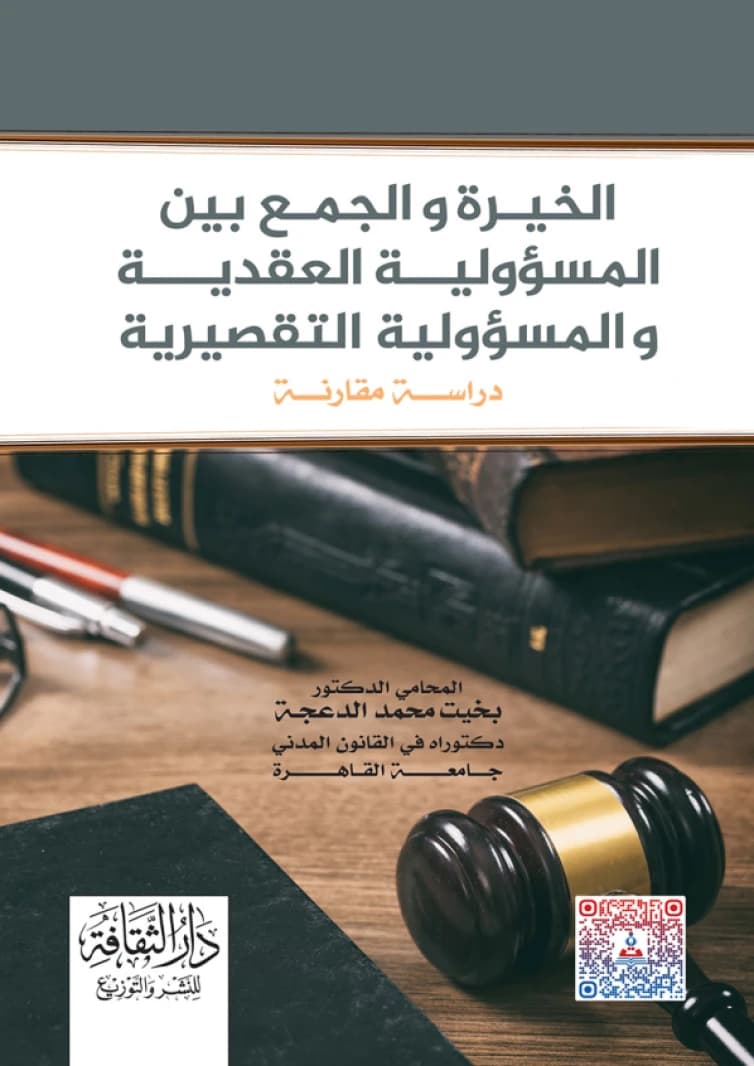
The Option and Combination between Contractual and Tort Liability by Dr. Bakhit Mohammed Al-Da'jah
JOD

Get it by 5 Aug | Order in 3 Hours 12 Minutes
- Return Policy
- Warranty Policy
- Shipping Policy
- Non contact delivery
- Personal Receipt
- Return Policy
- Warranty Policy
- Shipping Policy
- Non contact delivery
- Personal Receipt
Praise be to Allah, abundant, good, and blessed praise, as befits the majesty of His countenance and the greatness of His authority. And peace and blessings be upon the Seal of the Prophets and Messengers, our master Muhammad, the trustworthy Prophet, peace be upon him, and upon his family and all his companions, and those who follow them in righteousness until the Day of Judgment. And so...
Importance of the Study:
The rules of civil liability hold a prestigious position in the legal system; they are the cornerstone of the legal philosophy of civil law, and indeed of the entire law. Although Egyptian and Jordanian law have addressed the concept of liability based on the circumstances prevalent at the time of enacting the legal texts, the revolution of increasing modern developments has created a need for a legal system that ensures protection for individuals, specifically in compensating for damages they may suffer. Industrial progress and the invention of machinery have introduced numerous problems that have led legal thought to seek solutions that keep pace with contemporary changes, thereby placing the concept of personal fault under scrutiny.
The duality of civil liability—contractual and tortious—before this developmental revolution, suffered from issues of scope and the dividing lines between the two liabilities. This situation has become more sensitive in our contemporary era due to technological advancements, prompting legal jurisprudence to delve deeper into the sub-issues arising from this duality, such as qualifying the type of fault and determining the applicable scope of liability. This led to the emergence of the theory of "choice" (Al-Khīrah) and the theory of combining the two liabilities when their elements coexist in the same fault, due to their overlapping jurisdictions and the difficulty in delineating the boundaries between them.
We find that the French legislator has responded to the need to update legal texts to keep pace with new developments, including the sources and general provisions of obligations and proof. It heeded the call of legal jurisprudence for amendment, change, and reform by amending the French Civil Code of 1804, via Decree No. 131 of 2016, published in the Official Gazette of the French Republic, issue 35, on 11/2/2016, which came into force on 1/10/2016. This decree included a larger and more extensive amendment to the core part of the Civil Code.
Therefore, this study addresses the issue of the concurrence of contractual and tortious liability for a single fault, termed the "dual fault." Specifically, it examines the creditor's right to apply the theory of choice or the theory of combination. The same committed fault constitutes a breach of a contractual obligation arising from the contractual relationship between the parties, and at the same time, it is a breach of a general legal duty that the legislator has mandated not to be violated.
In this case, several questions arise about which liability to apply and the correct path for the creditor to base their claim for compensation after a loss has occurred. More precisely: must the creditor exclusively resort to the rules of one liability, either contractual or tortious, or do they have the right to choose to apply the rules of one over the other? Or do they have the right to combine the rules of both liabilities, wholly or partially, or to seek double compensation by presenting both? Are there any practical or legal impediments to this?
These questions lead us to search for a logical solution to the ongoing dispute over qualifying the fault and the type of civil liability applicable in a claim for dual fault. This is done by presenting jurisprudential viewpoints on the unity or duality of civil liability and its sub-issues, such as the theory of choice and the theory of combining contractual and tortious liabilities, by applying the rules of objective liability more broadly and effectively, moving towards the idea of presumed fault, and focusing on the occurrence of damage as the basis for liability, moving away from the debate over the differences and scopes of the two liabilities.
Problem Statement of the Study:
We have indicated that civil liability, in both its contractual and tortious aspects, is one of the most prominent and important topics in civil laws, and it still requires more research and study, especially as it struggles to keep up with continuous social development and industrial, scientific, economic, and technological progress. This raises many questions about the true crisis facing civil liability and its related issues. Perhaps the most important of these questions concern the qualification of fault, compensation for damages, causation, identifying the responsible party, and how to determine the applicable scope of liability when both types exist.
This is due to the jurisprudential disagreement in choosing the applicable civil liability when the elements of both contractual and tortious liability meet in the same fault. Each liability has its independent scope, with contractual liability monopolizing the breach of contractual obligations, and tortious liability arising from unlawful acts outside the contractual relationship. This ostensibly dictates that the two descriptions of liability cannot coexist in the same fault. However, this appearance has not managed to conceal the real crisis surrounding the debate over their scope. The coexistence of both liabilities in the same fault has become an undeniable reality.
This necessitates research into the jurisprudential differences regarding the permissibility of choosing between the two liabilities, discussing the consensus on the principle of not allowing their combination, and examining the approaches of Egyptian, Jordanian, and French legislators. It also requires an examination of the rulings of the Egyptian and French Courts of Cassation and the Jordanian Court of Cassation, where the prevailing trend has been to deny the choice initially and to unanimously agree on not allowing the combination of the two liabilities.
Here, it was necessary to address objective liability, which has eliminated the distinctions between contractual and tortious liability by adopting the idea of damage as the primary axis for establishing liability, even if no personal fault was committed by the responsible party. This is achieved by shifting to the concept of presumed fault, enabling the injured party to obtain compensation without getting into the dispute over qualifying the fault, the scope, and the choice between the two liabilities.
Scope of the Study:
A fundamental aspect of understanding the topic of choice and combination between contractual and tortious liabilities is to address the nature of these two liabilities. This leads us to research the relationship between them, identify their respective elements, review their characteristics, and compare them in terms of points of convergence, differences, and the foundations of each. We take into account comparative Egyptian and Jordanian jurisprudence, as well as the legal reality in those jurisdictions and the established precedents of the Egyptian and Jordanian judiciaries on the subject.
The study presents the topic in a progressive manner, clarifying the foundations for the coexistence of both liabilities for a single fault and the rationale behind researching the permissibility of granting the creditor the right of choice or combination. This is done by presenting scientific facts to the reader about the nature of choice and combination, detailing jurisprudential opinions and comparative judicial trends, and ultimately reaching a conclusion on the permissibility of this right for the creditor.
Based on the above, the research will explore solutions and alternatives to address this issue and the possibility of proposing a framework that reconciles the viewpoints on the unity and duality of civil liability, which gives rise to the issue of choice and combination, by addressing its effect on objective liability.
It was essential to mention that researching this topic requires addressing the French perspective, in addition to legal texts and the established rulings of the Court of Cassation there, in all details of the study, in an effort to present the subject according to comparative jurisprudence and in light of the developments and realities of French studies.
Difficulties of the Study:
The difficulty of the study lies in the scarcity of references that directly address this topic. There are rare and limited references on this matter, which the author managed to obtain with effort, concerning both Egyptian and Jordanian sources. There was also difficulty in extracting information and scientific facts from the available jurisprudential references, as the material related to this study is often found between the lines within a vast number of pages that require thorough scrutiny to obtain comprehensive information. Furthermore, jurisprudential opinions on the issues of choice and combination between the two liabilities are contradictory, divided between opposing and supporting factions, each with its own compelling arguments and viewpoints. On the side of legal texts, the difficulty lies in understanding the direction of Egyptian and Jordanian legislators regarding the permissibility of choice between the two liabilities, as there is no explicit provision in the law that prohibits it, nor is there one that explicitly permits it, nor any conflicting text. The effort was in inferring from the indication of the text. It should also be noted that the judicial rulings in both Egypt and Jordan required lengthy examination to determine the trend on this issue.
Methodology of the Study:
The methodology followed in this study is the comparative method, through collecting, organizing, verifying, and analyzing information, relying on critical analytical inquiry, identifying problems, drawing conclusions, verifying the suitability of hypotheses in light of that, and proposing alternatives or possible solutions, or leaning towards the existing trends that are closest to reality and logic. The approach was to progress from general fundamentals that pave the way for the core of the study, through an introduction that presents the nature of civil liability in general, and contractual and tortious liabilities in particular, with analysis and organization. Then, discussing the issues of choice and combination, drawing conclusions, and searching for solutions, all under the umbrella of a comparative discussion of legal systems and Arab and Western jurisprudential trends. The study used a comparative language between two legal systems—Egyptian and Jordanian—on several phenomena presented, in addition to drawing evidence from the reality of French law and jurisprudence. It relies on previously achieved results, opinions, and jurisprudence to avoid starting the research from scratch. The existence of previous studies that facilitated the task of presenting the core of this research on the issues of choice and combination between contractual and tortious liabilities is acknowledged, given the homogeneity of the comparative laws and jurisprudential trends in both countries. The study cannot uncover deficiencies, gaps, or inconsistencies in the legal system and jurisprudential reality without comparing it to the legal systems and jurisprudential trends of other countries.
Plan of the Study:
The study plan is divided into an introductory chapter on the nature of contractual and tortious liabilities, a first part discussing the theory of choice between the two liabilities, a second part addressing the theory of combination between them, and a concluding chapter on the solution to the conflict in the issues of choice and combination. It was necessary to address the introductory chapter (The Relationship between Contractual and Tortious Liability), as its importance lies in examining the nature of each liability and identifying the dividing lines between them, by outlining their characteristics, their position relative to other civil and non-civil liabilities, and drawing conclusions from comparing their points of convergence and divergence. In addition, it covers the advantages each liability offers to the injured party or creditor, and the points that might weaken the latter's position. This raises the question: which liability is more beneficial for establishing a claim for compensation according to the facts before the court? Since the title of the study is divided into two parts, each part was addressed in a separate section. The first part (Choice between Contractual and Tortious Liabilities) defines the theory of choice and the extent of its permissibility. The second part of this study relates to the combination of the two liabilities. Wherever the issue of choice is researched, it necessitates a discussion of the theory of combination due to its importance, as their elements, conditions, and reality are somewhat identical, leading to similarity and confusion at first glance. It was therefore necessary to distinguish between the two terms, explain their nature, and how they differ from each other. The title of the second part was (Combination of Contractual and Tortious Liabilities), which covered the nature of combination and its permissibility on legal, judicial, and jurisprudential levels. Finally, the concluding chapter addresses attempts to solve the problems of choice between contractual and tortious liabilities by turning to objective liability. The conclusion, which includes findings and recommendations, completes the outline of the study plan as previously stated.
- ISBN: 9789923151068
- Weight: 1.500 kg
- Size: 17x24 cm
- Paper: White
- Pages: 504
- Year of Publication: 2022
- Type: Hardcover







