
Download Our App
Shop your way




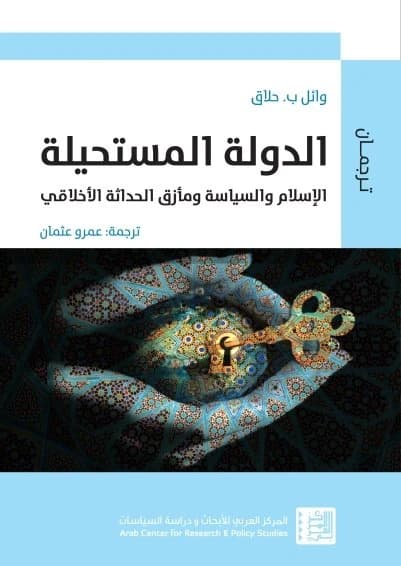
The Impossible State • Author: Wael Hallaq • 2019
JOD

Get it by 5 Aug | Order in 3 Hours 34 Minutes
- Return Policy
- Warranty Policy
- Shipping Policy
- Non contact delivery
- Personal Receipt
- Return Policy
- Warranty Policy
- Shipping Policy
- Non contact delivery
- Personal Receipt
The Impossible State: Islam, Politics, and Modernity's Moral Predicament. The book is presented in seven chapters. The first chapter provides an introduction to the description of exemplary Islamic governance and defines the limits of the model concept as it will be used as a central theme in the book's overall thesis. The second chapter describes the modern state, the 'exemplary modern state,' and identifies the 'form characteristics' that represent the essential qualities of the modern state. It deconstructs these characteristics while acknowledging the concurrent changes and successive variations in the formation of that state. Chapter three (Separation of Powers: Rule of Law or Rule of the State) discusses the concepts of sovereign will and the rule of law in relation to the principle of separation of powers, aiming to review the constitutional frameworks and structures of both the modern state and Islamic governance, and to highlight the constitutional differences between these two systems of rule. Based on these differences, Chapter four, 'The Legal, the Political, and the Moral,' explores the meaning of law and its relationship with ethics. This philosophical presentation primarily emphasizes the qualitative differences between the ethical concept of the modern state and Islamic governance. In its second part, this presentation will shift to a political nature. These legal-ethical disparities will be reinforced by political disparities, revealing another area of incompatibility between the modern state and Sharia. Chapter five, 'The Political Subject and the Ethical Technologies of the Self,' argues that the modern nation-state and Islamic governance tend to produce two different domains of subjectivity formation, and that the subjects produced by these two exemplary domains differ significantly, leading to two different types of ethical, political, cognitive, psychological, and social worldviews. These deep differences between individuals of the modern nation-state and their counterparts in Islamic governance represent the micro-level manifestations of the macro-level material, structural, and constitutional differences, as well as the philosophical and intellectual ones. Chapter six, 'A Besieging Globalization and a Moral Economy,' argues that modern forms of globalization and the state's position within these increasingly powerful forms are sufficient to make any form of Islamic governance either impossible to achieve or unsustainable in the long term, if it could be established at all. In other words, the author concludes that, when all factors are considered, Islamic governance cannot persist given the prevailing conditions of the modern world. The author concludes with Chapter seven, 'The Central Domain of the Moral,' examining modern moral predicaments with reference to their epistemological and structural foundations as the origin of the moral crises faced by modernity in all its Eastern and Western forms. The author argues that the impossibility of the idea of Islamic governance stems directly from the absence of a conducive moral environment that can meet its minimum standards and expectations. He sees this impossibility as another manifestation of several other problems, not least of which are the steady collapse of organic social units, the emergence of despotic economic patterns, and, more importantly, the massive destruction of natural habitats and the environment.
- Author: Wael Hallaq
- Translator: Amr Osman
- Publisher: The Arab Center for Research and Policy Studies
- Edition: 1
- Year of Publication: 2019
- Pages: 352
- Parts: 1
- Binding: Paperback
- ISBN: 9786144453032







