
Download Our App
Shop your way




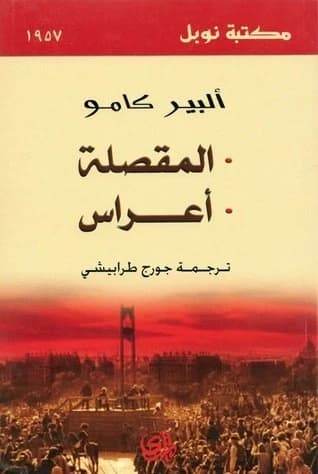
The Guillotine, Nuptials • Author: Albert Camus • 2014
JOD

Get it by 5 Aug | Order in 5 Hours 18 Minutes
- Return Policy
- Warranty Policy
- Shipping Policy
- Non contact delivery
- Personal Receipt
- Return Policy
- Warranty Policy
- Shipping Policy
- Non contact delivery
- Personal Receipt
Cain did not kill, though humanity has looked upon him with condemnation over the centuries: this is, in any case, the parable we ought to draw from the Old Testament, and all the more so from the Gospels, rather than drawing crude examples from Mosaic law. Nothing, in any case, prevents our country from undertaking an experiment, limited in time (for ten years, for example), if our parliament is still unable to atone for its pro-alcohol votes with the great civilizing measure of permanently abolishing the death penalty. If public opinion and its representatives cannot truly abandon this lazy law that merely liquidates those it cannot reform, let us at least strive, while awaiting a day when serious and true life dawns, to abolish this "ceremonial slaughterhouse" that pollutes our society.
The death penalty as it is applied, however infrequently, is a disgusting massacre, an insult to the human person and body. This severing of the neck, this living, severed head, and these long fountains of blood, date back to a barbaric era that believed it could terrorize the people with humiliating spectacles. Today, as this vile death is carried out in secret, what meaning is left for this torment? The truth is that we kill in the atomic age just as we killed in the age of the scales. There is no person of normal sensitivity who is not nauseated by the mere thought of this crude surgery. If the French state is unable to overcome itself in this matter and to offer Europe one of the remedies it needs, let it at least begin by reforming the method of applying the death penalty. Science, which is useful for killing in large numbers, can at least be useful for killing with decency. An anesthetic that transports the condemned from sleep to death, remains available to them for at least a day to use freely, and is imposed upon them otherwise if they refuse or their will fails them—such an anesthetic would guarantee death, if we insist on it, but it would add a measure of decency to a process that today is nothing but a vile and obscene display.
I suggest such a compromise to the extent that we must sometimes despair of seeing wisdom and civilization impose themselves on those responsible for our future. To know the death penalty for what it is and to be unable to prevent its application is unbearable and spine-chilling for some people. They are more numerous than one might think. They too suffer from this penalty, in their own way, and without any justice. Let us at least alleviate the burden of these filthy images under which they labor, and society will lose nothing by it. But this too, in the end, is not enough. There will be no lasting peace, neither in the hearts of individuals nor in the morals of society, until death is outlawed.
In 1955, Arthur Koestler launched a press campaign demanding the abolition of the death penalty in England. Shortly after his campaign, the British House of Commons approved its abolition, but the conservative House of Lords prevented it. In 1957, Albert Camus wrote this study on the death penalty to add his voice to Koestler's, demanding the abolition of the death penalty in France. Year of Publication: 2014







