
Download Our App
Shop your way




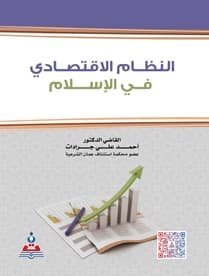
The Economic System in Islam by Judge Dr. Ahmed Ali Jaradat
JOD

Get it by 5 Aug | Order in 3 Hours 19 Minutes
- Return Policy
- Warranty Policy
- Shipping Policy
- Non contact delivery
- Personal Receipt
- Return Policy
- Warranty Policy
- Shipping Policy
- Non contact delivery
- Personal Receipt
Praise be to Allah, Lord of the worlds, and peace and blessings be upon the master of messengers and the leader of economists, and upon his family and companions.
Wealth is the material artery of developmental life, just as Sharia is the spiritual artery of life. Wealth holds a special place and greed in the human soul, and if not controlled by the balance of Sharia, it can lead its owner to a state of frenzy. The love for wealth flows through a person's body like blood in the veins, as Allah Almighty says: 'And indeed he is, in love of wealth, intense.' (Al-Adiyat: 8) and also: 'And you love wealth with immense love.' (Al-Fajr: 20).
From this perspective, people compete diligently to acquire this wealth. However, the validity or corruption of this pursuit depends on the good intention and the source, or both. Wealth is a double-edged sword; for the people of Islam with good intentions, it is a blessing: 'Those who spend their wealth by night and by day, secretly and publicly - they will have their reward with their Lord. And no fear will there be concerning them, nor will they grieve.' (Al-Baqarah: 274). And for the disbelievers, it is a source of regret and affliction, no matter how numerous its sources. Allah says: 'And let not those who disbelieve ever think that [because] We extend their time [of enjoyment] it is better for them. We only extend it for them so that they may increase in sin.' (Aal-Imran: 178).
One of the indicators of the importance of wealth in the lives of individuals is its mention in the Quran, both in praise and condemnation, in more than eighty places.
Islamic Sharia came to encourage the development and economic prosperity of the earth as a means to fulfill the rights of Allah. In this regard, the Prophet (PBUH) said: 'If the Hour is established and one of you has a seedling in his hand, if he can plant it before it is established, he should do so.' (Al-Adab Al-Mufrad 1/168, No. 479).
Hence, Islam was keen to provide guarantees and pillars to achieve and sustain this economic development, most notably achieving economic independence for the Muslim community to be a leader, not led, and followed, not a follower.
Economic independence inherently means negating dependency on foreigners, and consequently, the Muslim community's control over its economic resources without foreign interference. The loss of control over its economic resources is a prelude to losing political, military, cultural, and social control.
The Islamic nation in this era is scorched by the flames of economic chaos and lives in economic corruption that infiltrates from time to time through its main channels in Muslim societies, namely individual and organized institutional infiltration. The expansion of such channels is sufficient to cause severe backwardness in the financial market, hinder growth, and cause a grave weakness in the economy.
Many modern studies confirm an inverse relationship between economic corruption and growth. If the Islamic nation had adopted the true meaning of the Islamic economy, it would not have strayed from the right path and would not have lived in the chaos of floundering and chasing financial temptations by rushing to stock markets and international murabaha transactions not governed by Sharia frameworks.
True progress in the study of economics comes primarily from linking it to Islamic values and principles and preserving the character that Allah intended for it. This is evidenced by the fact that Islam views economic activity related to the use and disposal of property as being defined by the law of Allah. He says: 'O you who have believed, fear Allah and give up what remains [due to you] of interest, if you should be believers. And if you do not, then be informed of a war [against you] from Allah and His Messenger. But if you repent, you may have your principal - [thus] you do no wrong, nor are you wronged.' (Al-Baqarah: 278-279). Furthermore, the Prophet (PBUH) clarified that the corruption, humiliation, weakness of Muslims, and the dominance of their enemies over them are due to their violations in the financial market. He said: 'When people become stingy with the dinar and dirham, engage in 'inah' transactions, follow the tails of cattle, and abandon jihad, Allah will inflict upon them a humiliation that He will not remove until they return to their religion.' (Al-Mu'jam al-Kabir 12/433, No. 13585).
Islamic economics, in its revival from its stumble, needs the efforts of sincere, specialized scholars and their serious contributions to finding the golden key to a sound Islamic economy.
The contemporary applications in Islamic financial institutions in the fields of banking and insurance need the awareness of societies, governments, and regulatory authorities of their value and the positive impact of supporting and directing them. If we want to fuel such economic activity, we must not neglect two important elements in this field: Zakat and Waqf (endowment), as they provide unlimited support to achieve economic and social security for the nation.
- ISBN: 9789957168834
- Weight: 1.150 kg
- Dimensions: 17×24 cm
- Paper: White
- Pages: 656
- Year of Publication: 2015
- Binding: Hardcover







