
Download Our App
Shop your way




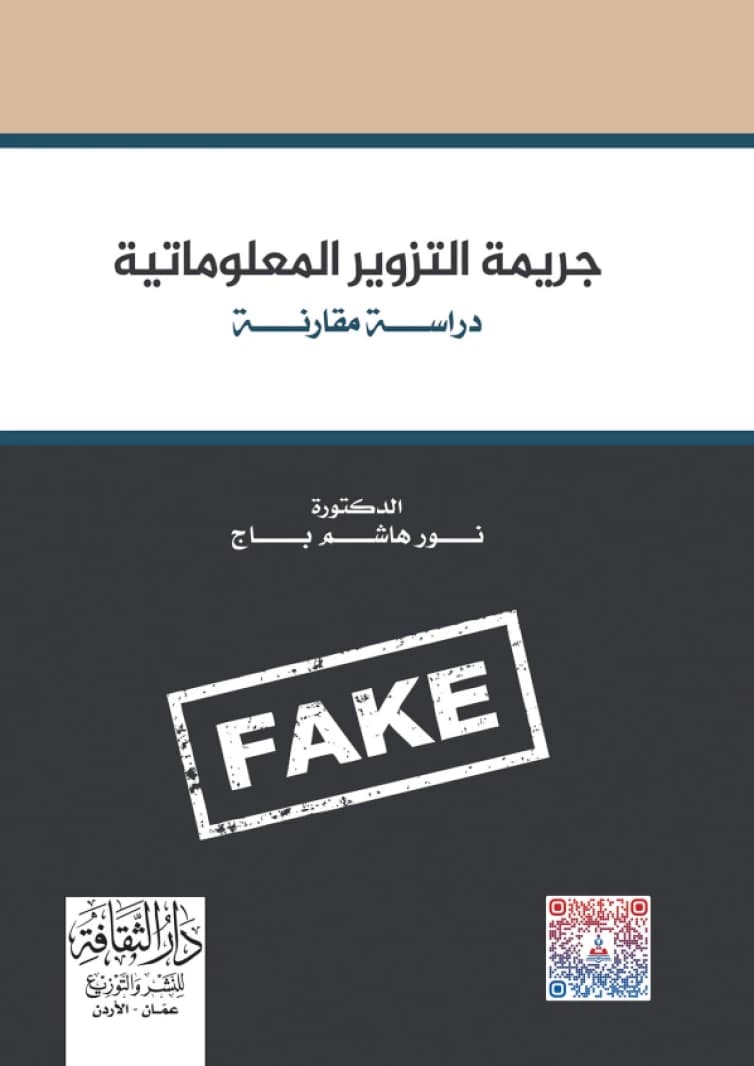
The Crime of Information Forgery - Dr. Nour Hashem Baj
JOD

Get it by 5 Aug | Order in 3 Hours 16 Minutes
- Return Policy
- Warranty Policy
- Shipping Policy
- Non contact delivery
- Personal Receipt
- Return Policy
- Warranty Policy
- Shipping Policy
- Non contact delivery
- Personal Receipt
The evolution of the information world has transformed the working mechanisms and environments of institutions, government departments, and individuals in society. It represents a radical shift in how information is collected, stored, processed, distributed, and presented. Initially, information technology was not widespread or extensively used; its application was limited. However, with its development and proliferation, it has become an essential part of people's lives, spanning multiple fields such as business, education, health, and facility and corporate management.
The emergence and expansion of the information world and modern technology have directly facilitated the lives and work of individuals and institutions. Through computers and information technology, individuals can now extract information from various entities in society. The information world has come to represent and correspond to the physical world of an individual in terms of their name, address, information, and everything related to them. The use of these technologies has become the norm, and people conduct their various transactions through them. They are responsible for creating, processing, and storing individuals' information in their respective information systems, allowing us to say that the physical world now has an informational form and container.
Despite the numerous benefits offered by technology through the digital world, it has been accompanied by many new challenges and abusive behaviors that constitute an assault on the digital life of these institutions and on the privacy of individuals. For instance, technological theft has emerged, where an offender might hack into someone else's bank account and steal money using software and information applications. This behavior constitutes a breach of the bank's information system and an assault on the individual's private funds in the information container. Additionally, individuals might breach an institution's information system to access its confidential information, among other behaviors that manipulate legal statuses and undermine public trust in institutions.
The emergence of these behaviors has drawn the attention of various legislations to lay the groundwork for criminalizing these actions, prosecuting offenders, and imposing penalties, as they ultimately constitute an assault on individuals and institutions in their informational entity.
International efforts have focused heavily on cybercrime, leading to the Council of Europe's Convention on Cybercrime in 2001, known as the Budapest Convention. It focused on the risks arising from the use of computer networks and electronic information for committing crimes and the need for international cooperation to combat them. Subsequent efforts led to the approval of several Arab international agreements focusing on electronic and information crimes, such as the Arab Convention against Transnational Organized Crime and the Arab Convention on Combating Information Technology Offences. The international role has paved the way for national legislations to enact laws concerning electronic and information crimes, including the crime of information forgery.
Legislators have intervened by addressing criminal behavior and determining the prescribed punishment within a specific legislative framework. Most legislations have enacted new specialized laws for information crimes, placing these crimes in a legislative framework to reduce and limit their widespread nature, as they are borderless; an offender in one country can commit a crime in another. It is also known as a 'quiet crime' due to its commission in the information world, unlike traditional crimes. The choice of the term 'physical crimes' aligns with the study's objective. For example, a murder results in a victim and blood at the crime scene, often accompanied by sounds, especially if a firearm is used. These physical aspects of traditional crimes are unimaginable in the information world, which consists of numbers, symbols, and phrases transmitted through computer networks and the internet. Returning to the example of stealing from a bank account, the victim learns of the theft through text messages about money being transferred. It is conceivable that the offender could hack the victim's phone, making it impossible for them to know the crime has occurred.
The legislative response to crimes in the information world is a clear and positive step. It receives great attention and is a top priority for legislatures to keep pace with all informational developments and to codify crimes by imposing appropriate punitive texts.
Jordanian legislators, along with Arab legislators such as those in the UAE and Qatar, have focused their attention on information and electronic crimes. They have legislated against crimes that affect and constitute an assault in the information world by outlining the forms and elements of each and imposing the necessary criminal penalties. The UAE legislator enacted Federal Decree-Law No. (34) of 2021 on Combating Rumors and Cybercrime, and the Qatari legislator enacted Law No. (14) of 2014 issuing the Law on Combating Electronic Crimes.
The Jordanian legislator has kept pace with these challenges and enacted a special law criminalizing behaviors in the technological and informational framework through the Electronic Crimes Law No. (17) of 2023. Additionally, it took a significant step in developing the Penal Code, which deals with crimes in their traditional physical form, by adding an informational aspect to it. This is evident in the amendments to the Jordanian Penal Code of 2022, which gave the crime of forgery an informational character by updating the text of articles to suit the nature of this crime, unlike the Emirati and Qatari legislators who only criminalized these behaviors through special laws.
The Jordanian legislator updated its punitive texts within articles (260, 262, 263, 265) regarding the crime of forgery and introduced a new subject for this crime existing in the information world: the data of the official information system. It outlined forms of criminal activity that align with the nature of information crime, which in turn creates a new, information-based forgery crime. This bold and strong step by our legislator makes it one of the first to update its traditional texts for the information container, which is why our interest is focused on the subject and the newly established criminal behavior.
Therefore, we will focus our attention on the Jordanian legislator's establishment of the crime of information forgery by clarifying and explaining the nature of the crime's subject, which is characterized by its digital nature. Additionally, this book aims to address the criminal behaviors added by the legislator to align with this digital character.
- ISBN: 9789923153505
- Weight: 0.750 kg
- Size: 17×24 cm
- Paper: White
- Pages: 200
- Year of Publication: 2026
- Type: Hardcover







