
Download Our App
Shop your way




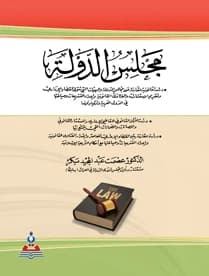
The Council of State: A Comparative Legal Study - Dr. Ismat Abdul Majeed Bakr
JOD

Get it by 5 Aug | Order in 5 Hours 11 Minutes
- Return Policy
- Warranty Policy
- Shipping Policy
- Non contact delivery
- Personal Receipt
- Return Policy
- Warranty Policy
- Shipping Policy
- Non contact delivery
- Personal Receipt
The modern organization of the contemporary state requires the distribution of competencies among ministries, departments, and institutions, with each entity dedicated to accomplishing its assigned tasks. Consequently, scientific and technical expertise can be concentrated in specific entities to handle work requiring particular skills and specialization. In this context, a scientific and technical institution was established to prepare, draft, and interpret legislation, and to provide legal counsel to the state on all legal issues it faces. Added to this is the practice of administrative justice; if a person is wronged by a powerful opponent like the administration, there must be a refuge to which they can turn and file their complaint. There is nothing more dignified for the administration and more preserving of its status than to stand with its opponent in a court of law, to either grant or receive justice. This is closer to truth and justice and better maintains respect and authority, as the late scholar Dr. Abdul Razzaq Al-Sanhuri stated. The Council of State is the legal advisor to the state on legislation and legal opinions (fatwa), the drafter of government-prepared legislation, and the state's consultant on legal challenges. It is the judge in administrative disputes between individuals and administrative bodies, and the protector of public rights and individual freedoms. Therefore, nations have moved to establish a Council of State (or State Shura Council) or a similarly named body to undertake these significant tasks. The circumstances of each country and its legal and historical development all play a role in the variations among the laws governing the Council of State's work, organization, and competencies.
Since Islamic law, prior to modern legislation, had established the concepts of legislation, its sources, legal opinions, and the adjudication of grievances (wilayat al-mazalim), this study attempts to explore the position of Islamic law on these tasks and competencies.
Before delving into the details of the Council of State's work, competencies, functions, and the legal framework for its members, it is worthwhile to examine the historical and legislative development of the council in the countries included in this study, based on available sources. It is known as the (State Shura Council) in Iraq and Lebanon, or the (Shura Council) in Turkey. Some countries have an independent administrative judiciary with administrative courts separate from ordinary courts, alongside departments that draft legislation and provide legal consultations, as in Saudi Arabia, Oman, Jordan, and Morocco. In other countries, administrative justice is handled by administrative divisions within ordinary courts, as in Kuwait, Qatar, the UAE, Bahrain, Yemen, Sudan, Libya, and Palestine, with other bodies handling legal consultations and legislative drafting. In this regard, we note the important recommendations from the First Seminar on Law and Political Science held in Cairo (October 23-27, 1960), organized by the (Supreme Council for the Sponsorship of Arts, Literature, and Social Sciences) in Egypt. A key recommendation, titled (Strengthening the Link between the Functions of Administrative Judiciary, Fatwa, and Legislation), states: 'Given the close connection between the function of the administrative judiciary and the functions of legal opinion and drafting, the General Assembly of the seminar recommends that Arab countries work to consolidate the bodies of judiciary, fatwa, and legislation into a single entity.'
ISBN: 9789957166960, Weight: 1.300, Size: 17×24 cm, Paper: White, Pages: 768, Year of Publication: 2012, Binding: Hardcover







