
Download Our App
Shop your way




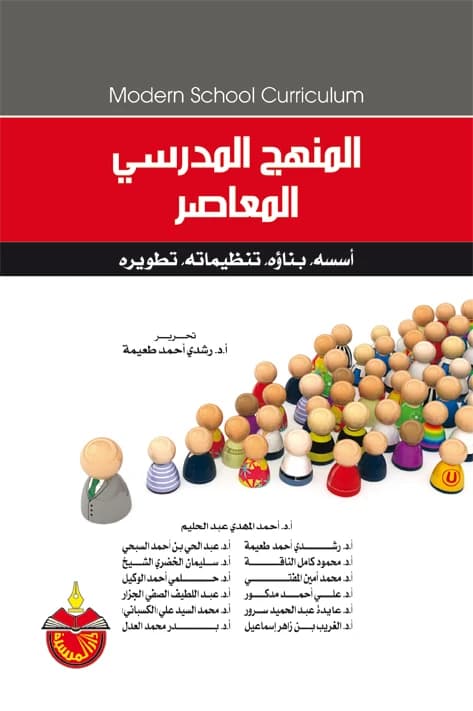
The Contemporary School Curriculum: Foundations, Construction, Organization, and Development - Ahmed Al-Mahdi Abdulhalim
JOD

Get it by 5 Aug | Order in 5 Hours 13 Minutes
- Return Policy
- Warranty Policy
- Shipping Policy
- Non contact delivery
- Personal Receipt
- Return Policy
- Warranty Policy
- Shipping Policy
- Non contact delivery
- Personal Receipt
Contemporary Arab educational literature is witnessing an abundance, even a surge, in books on curricula and teaching methods, to the point where the question that arises with each new publication is: What is new in this book? This same question is posed about this book. Perhaps the main justification for publishing such a book is what it adds to the field, making the reader feel they are facing a work that may share things with others, but more importantly, differs from and adds to them in other aspects.
So, what's new in 'The Contemporary School Curriculum'? It can be summarized as follows:
- 1. Its alignment with the study plans for curricula and teaching methods courses in a large number of education colleges and teacher training institutes in several Arab countries, which helps meet the needs of their students, especially at the undergraduate level.
- 2. The presentation of results from a significant number of contemporary psychological and educational research studies, opening the door for researchers and university professors for further study and investigation of what is mentioned therein.
- 3. The availability of distinguished Egyptian and Arab expertise in writing the chapters of this book. Most of them have left indelible marks in the field of school curricula in terms of foundation, history, planning, and evaluation, which gives the content of this book great significance as it is the culmination of accumulated experience from a generation of Arab pioneers in the field of curricula and teaching methods.
- 4. Coverage of basic concepts in the field of curricula and teaching methods, with a focus on precise operational definitions for many of them, providing examples and applications that transform these concepts from abstract ideas to tangible realities.
- 5. Comprehensive coverage of aspects related to the school curriculum, whether in terms of its foundations, construction mechanisms, organizations, theories, or its evaluation and development. The team of authors believed that discussing the contemporary curriculum is incomplete without addressing its foundations and mechanisms. As it is said, what is necessary to complete a duty is itself a duty. The past, as we know, is a dimension of the present, and it is a fundamental component in shaping the future. Therefore, we cannot understand and absorb the new without understanding the old and appreciating its position in shaping the reality we live in.
- 6. A presentation of the most important trends in curriculum development in a sister Arab country (the Kingdom of Saudi Arabia) as a model for national educational work in formulating curricula.
- 7. Keeping pace with technological progress and investing it in reformulating curricula, and clarifying the technological dimensions of the contemporary school curriculum and how it can be an inseparable part of the curriculum's structure, not just an embellishment as teaching aids once were.
- 8. Discussion of some modern trends in psychology, such as multiple intelligences and creativity issues, and explaining their applications in the field of school curricula in terms of planning, implementation, and evaluation.
- 9. Incorporating the largest number of curriculum organizations and theories, both old and new, with reference to the scientific foundations behind each, whether in our educational heritage or contemporary literature.
- 10. Inclusion of the National Standards for the School Curriculum document in Egypt, which was worked on by a large team of experts and researchers in Egypt within the framework of the National Standards preparation project in 2003.
- 11. Inclusion of an appendix that we see as particularly important for those working in school curricula, which is the Curriculum Evaluation Standards document issued by the Jordanian National Commission for Education, Culture and Science in its periodical newsletter (Issue 15, December 2005).
In light of the above, the book is divided into six parts containing twenty chapters, as follows:
- Part One: The Problem of Concepts, which includes one chapter presenting the most important concepts related to the curriculum and its stages of development.
- Part Two: Foundations of the Curriculum, which includes four chapters revolving around the creedal, philosophical, cultural, cognitive, and psychological foundations of the curriculum.
- Part Three: Mechanisms of Curriculum Building, which includes five chapters on the five components of the school curriculum: objectives, content, teaching strategies, school activities, and evaluation.
- Part Four: Curriculum Organizations and Theories, which includes three chapters on common curriculum organizations such as the separate-subject curriculum, the integrated curriculum, the merged curriculum, and others, as well as the unit-based curriculum and the most important curriculum theories such as the encyclopedic, pragmatic, and Islamic theories.
- Part Five: Curriculum and Technology, which includes two chapters on the use of technology in the school curriculum and the electronic curriculum.
- Part Six: Contemporary Trends in Curriculum Development, which includes five chapters on the foundations and mechanisms of curriculum development, with a presentation of some contemporary trends such as multiple intelligences and national curriculum standards.
This book has been prepared to serve a large segment of educators, most importantly:
- 1. Education College Students: Those studying a course on curricula and teaching methods, regardless of their specific academic specializations. As is known in educational literature, the curriculum course includes general principles applicable to any scientific discipline.
- 2. Curriculum and Teaching Strategy Experts: As it provides them with the scientific foundations for building curricula in terms of planning, implementation, and evaluation.
- 3. Curriculum Development Experts: As it provides them with the general methodological foundations for curriculum development and the mechanisms used in development processes. Curriculum development, as defined in educational literature, is the deliberate attempt to improve the teaching and learning process in terms of its objectives, content, methods, evaluation, material, and the internal organization of teaching. Our book has been keen to cover all of this, briefly in some parts and in detail in others.
- 4. Teachers: As they are the first line of defense in the educational process. A good teacher is one who constantly asks himself: Who am I teaching? Why am I teaching? What am I teaching? How do I teach? And how do I evaluate what I have taught? These, as we know, are the basic elements of any curriculum, which requires their familiarity with the curriculum they use and the foundations upon which it is based. Teaching is not a craft that anyone can perform; it is a profession with its own principles and guiding tenets.
- 5. Educational Supervisors: Educational supervision is not just a fleeting visit by the supervisor to some classes, followed by a meeting with teachers to provide guidance that amounts to little more than scattered experiences gathered from here and there. True educational supervision is a planned, systematic, scientific process. Before visiting any school, the supervisor must precisely determine what they want and where to find it. They must know the elements of the curriculum they are evaluating in terms of its objectives, content, and evaluation methods.
- 6. Researchers: As it opens up fields of scientific research for them in many issues of education in general, and curricula and teaching methods in particular. The final word in science has not yet been spoken. Scientific research will always be needed as long as there is a need for development and a necessity to solve problems.
Product Details:
- Number of Pages: 576
- Year of Publication: 2011
- Binding Type: Hardcover
- Edition: 3
- Printing Color: Black
- Dimensions (cm): 17x24
- Weight (kg): 1.000
- Barcode: 9789957064518







