
Download Our App
Shop your way




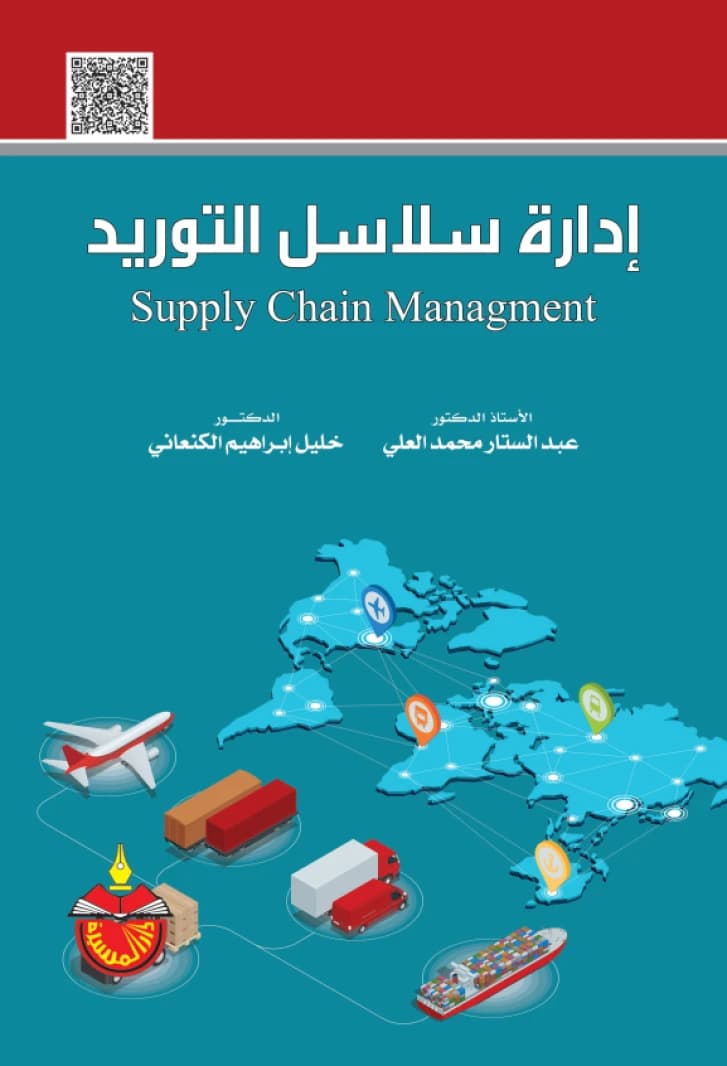
Supply Chain Management - Abdul Sattar Muhammad Al-Ali
JOD

Get it by 5 Aug | Order in 0 Hours 41 Minutes
- Return Policy
- Warranty Policy
- Shipping Policy
- Non contact delivery
- Personal Receipt
- Return Policy
- Warranty Policy
- Shipping Policy
- Non contact delivery
- Personal Receipt
All organizations aspire to maximize their profitability and increase their production efficiency. Many methods have been used to enhance the effectiveness of these organizations to increase their market share and create greater benefits for consumers and users. However, these methods have had limited success. Consequently, organizations have returned to creating a competitive advantage, the most important of which is cost reduction to increase customers' purchasing power by lowering prices.
To achieve this, organizations found it necessary to revisit their marketing mix and identify controllable elements to reduce costs and increase efficiency. It is well-known among specialists that the marketing mix consists of four basic elements, known as the 4Ps: Product, Price, Promotion, and Place. The element of Place refers to physical distribution, the costs of which include:
- Transportation costs
- Warehousing costs
- Order processing and information-related costs
- Retailing-related costs
- Inventory handling and transportation costs
The product intended for distribution, from raw materials to finished goods, undergoes manufacturing processes, transportation, and storage, with costs playing a significant role in determining the price per unit. The manufacturing process is not isolated; various individuals and departments within the company or organization participate in functions like purchasing, selecting suppliers, and choosing appropriate wholesalers and retailers to reach the customer. These roles include:
- Customer Relationship Management
- Customer Service Management
- Demand Management
- Manufacturing Flow Management
- Procurement
- Product Development and Commercialization
- Returns Management
These seven management areas collectively form Supply Chain Management. Generally, all organizations face numerous problems related to managing both logistics and supply chains, not to mention the comprehensive understanding of these topics among the educated. This book will address some elements of these tools, particularly related to understanding logistics terminology and analyzing some supply chain elements. These elements and their handling are fundamental to generating a competitive advantage, allowing the organization to reduce its prices and increase its market share.
Organizations, especially in developing countries, suffer from many problems related to inventory maintenance, purchasing issues, and modern knowledge of supply chain and logistics management. This requires these organizations to develop effective methods to control inventory and use these effective management practices in all areas. Therefore, various organizations (retail, small, and large industrial organizations of all types) need good inventory management for several reasons that ensure customer satisfaction, including:
- Inventory assets represent a large volume of the financial resources, capital, and other investments in the organization. For example, in industrial organizations, inventory of materials alone constitutes more than half of the total operational cost.
- Inventory levels typically affect all dimensions of the organization's daily operations.
- Inventory is a powerful weapon in the world of competition used by many organizations.
- Inventory is one of the most important issues that must be controlled in many organizations.
Inventory management and its handling costs have received great care and attention in all organizations, especially industrial ones, in the present time. The zero-inventory policy has become the most common phase among organizations and the most important goal, particularly in industrial organizations since the 1980s. To achieve this, it is required to reduce inventory levels during production processes by decreasing the amount of raw materials, purchased parts, and assembled units through direct supply from suppliers using effective logistics and supply chain tools, as well as reducing the amount of work-in-process between production stages. This is achieved by using methods like Just-in-Time scheduling, in addition to reducing the quantity of finished products in warehouses by expediting their shipping and delivery to the end consumer through logistics management.
The performance evaluation of inventory management departments currently relies on the Inventory Turnover standard, defined as the annual cost of sales divided by the average value of inventory. For example, Toyota in Japan achieved about 35 inventory turns per year compared to General Motors in the US, which only achieved eight. Toyota achieved this by using the Just-in-Time production philosophy in managing its inventory assets.
Given the significant changes in the approaches and methods used by inventory management today, this book will discuss in detail the issues related to logistics and supply chain management and their related decisions through relevant chapters. These concepts have become so important that they have been included in the curricula and study plans of most universities worldwide, and we hope our developing world will pay attention to them. We have made efforts to make this book easy to read for our students, scholars, and researchers in this field by simplifying the explanation and clarification of the concepts it contains.
- Number of Pages: 536
- Year of Publication: 2023
- Binding Type: Hardcover
- Edition: 6
- Printing Color: Black
- Dimensions (cm): 17x24
- Weight (kg): 0.950
- Barcode: 9789957064679







