
Download Our App
Shop your way




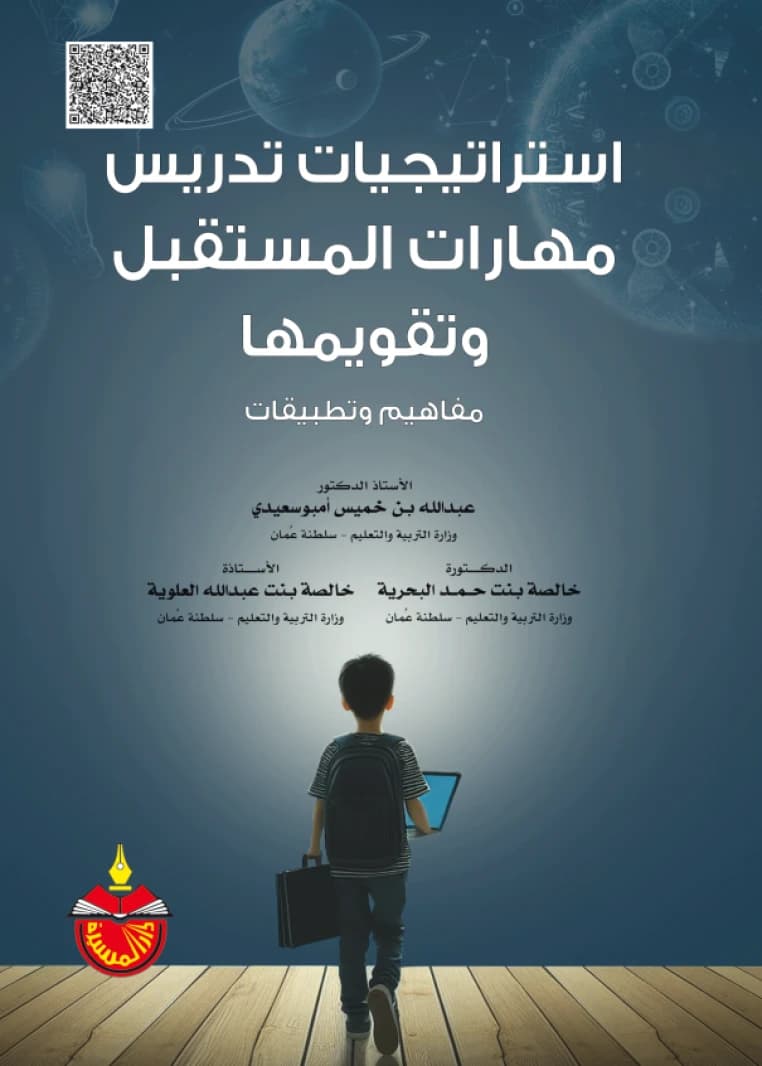
Strategies for Teaching and Evaluating Future Skills: Concepts and Applications - Abdullah bin Khamis Ambusaidi - 2024
JOD

Get it by 5 Aug | Order in 3 Hours 11 Minutes
- Return Policy
- Warranty Policy
- Shipping Policy
- Non contact delivery
- Personal Receipt
- Return Policy
- Warranty Policy
- Shipping Policy
- Non contact delivery
- Personal Receipt
This book consists of five chapters, combining theoretical knowledge with practical applications presented in two forms: proposed strategies in teaching and evaluation, and integrated lesson models from various subjects.
Chapter One provides an introduction to education and future skills, covering topics such as the challenges facing educational systems in the 21st century, the characteristics of 21st-century teachers and learners, the driving forces for 21st-century competencies and skills, the forces of learning in the 21st century, and the five minds for the 21st-century learner. The chapter also touches upon individual and institutional efforts to classify 21st-century and future skills.
Chapter Two reviews the supporting elements for teaching and evaluating 21st-century skills, including curricula and teaching methods, the learning environment, teacher roles and professional development, and finally, the evaluation process. Each element is presented with sufficient information for the reader to understand how it can support students in acquiring future skills.
Chapter Three presents 40 proposed teaching strategies for equipping students with future skills. Each strategy is detailed with a focus on the skills it develops, an overview of the strategy, implementation steps, suggestions for teachers on integrating technology, and a learning assessment for the student. The strategies are designed with examples from school curricula.
Chapter Four offers 30 evaluation strategies, discussed by focusing on the skills they measure, an overview of the strategy, implementation steps, general guidelines, suggestions for teachers on using technology, reflection on the strategy, and one or two examples.
Chapter Five provides four integrated lessons from different subjects that incorporate future skills, allowing educational practitioners to see a holistic picture of how to integrate these skills into lesson plans.
What distinguishes this book?
This book stands out from others on future skills due to its activities and applied lessons combined with the appropriate theoretical dose. It doesn't just discuss these skills theoretically; it accompanies them with practical applications from the actual curricula students study. This is what the educational practitioner (the teacher) needs to see these skills translated into a tangible reality. The book is also distinguished by its focus on strategies for evaluating students in future skills, enabling practitioners to assess the extent to which their students have acquired these skills after learning the strategies to teach them.
- Number of Pages: 544
- Year of Publication: 2024
- Binding: Hardcover
- Edition: 1
- Printing Color: Black
- Dimensions (cm): 17x24
- Weight (kg): 1.100
- Barcode: 9789957972295







