
Download Our App
Shop your way




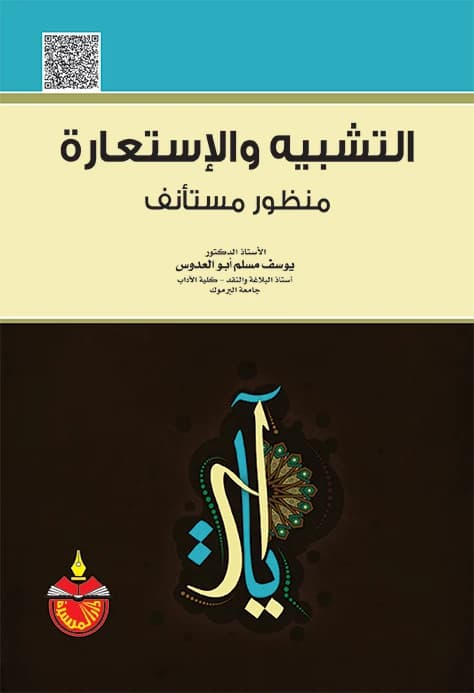
Simile and Metaphor: A Renewed Perspective - Yousef Muslim Abu Al-Adous
JOD

Get it by 5 Aug | Order in 3 Hours 17 Minutes
- Return Policy
- Warranty Policy
- Shipping Policy
- Non contact delivery
- Personal Receipt
- Return Policy
- Warranty Policy
- Shipping Policy
- Non contact delivery
- Personal Receipt
Simile and metaphor have received significant attention from rhetoricians, critics, philosophers of various schools, linguists, and scholars of semantics, semiotics, pragmatics, and syntax. Consequently, numerous classifications and divisions of simile and metaphor have emerged, largely reflecting the cognitive approaches these scholars rely on. Their importance was also immense among poets, which led ancient Arab rhetoricians and critics to use them as a standard for comparing poets.
This study explores the interest of rhetoricians and critics in simile and metaphor from a renewed perspective, built upon the studies of ancient Arab rhetoricians and modern Western rhetoricians who benefited from the works of Aristotle, Quintilian, and others.
The study is divided into two main parts:
Part One: Simile, which contains three chapters:
- Chapter One: Discusses the concept of simile in the research of ancient Arab critics and rhetoricians, covering its definition, elements, types, and purposes, with examples from poetry, the Holy Quran, and the Prophet's Hadith.
- Chapter Two: Addresses the structural forms of simile, focusing on the following issues: tools of simile, types of simile, classification based on sensory vs. intellectual aspects, classification based on singularity vs. composition, classification based on multiplicity, and compound and multiple similes.
- Chapter Three: Is dedicated to the aesthetics of simile, illustrated with examples from the Holy Quran and poetry.
Part Two: Metaphor and Approaches to Its Study, which includes four chapters:
- Chapter One: Explores the rhetoricians' interest in metaphor concerning grammatical structure, analyzes the verbal metaphor complex and its patterns in poetic discourse, analyzes some of Abu Tammam's metaphors, and concludes with a discussion of metaphor in light of generative transformational theory.
- Chapter Two: Deals with the philosophical approach to metaphor from the perspective of Muslim and Western philosophers, who viewed metaphor not merely as a linguistic phenomenon but as a fundamental principle of thought and action.
- Chapter Three: Discusses the anthropological approach to metaphor, explaining how a language's metaphors subconsciously reflect specific realities and how natural systems shape the source of metaphor across all peoples and ages.
- Chapter Four: Examines metaphor from a Gestalt perspective, presenting key issues raised by George Lakoff in his important book "Women, Fire, and Dangerous Things," discusses the views of Johnson and Palmer, and analyzes the topic of "Anger" as one of the significant subjects treated by Lakoff.
Book Details:
- Number of Pages: 318
- Year of Publication: 2015
- Binding: Paperback
- Edition: 3
- Print Color: Black
- Dimensions (cm): 17x24
- Weight (kg): 0.650
- Barcode: 9789957063382







