
Download Our App
Shop your way




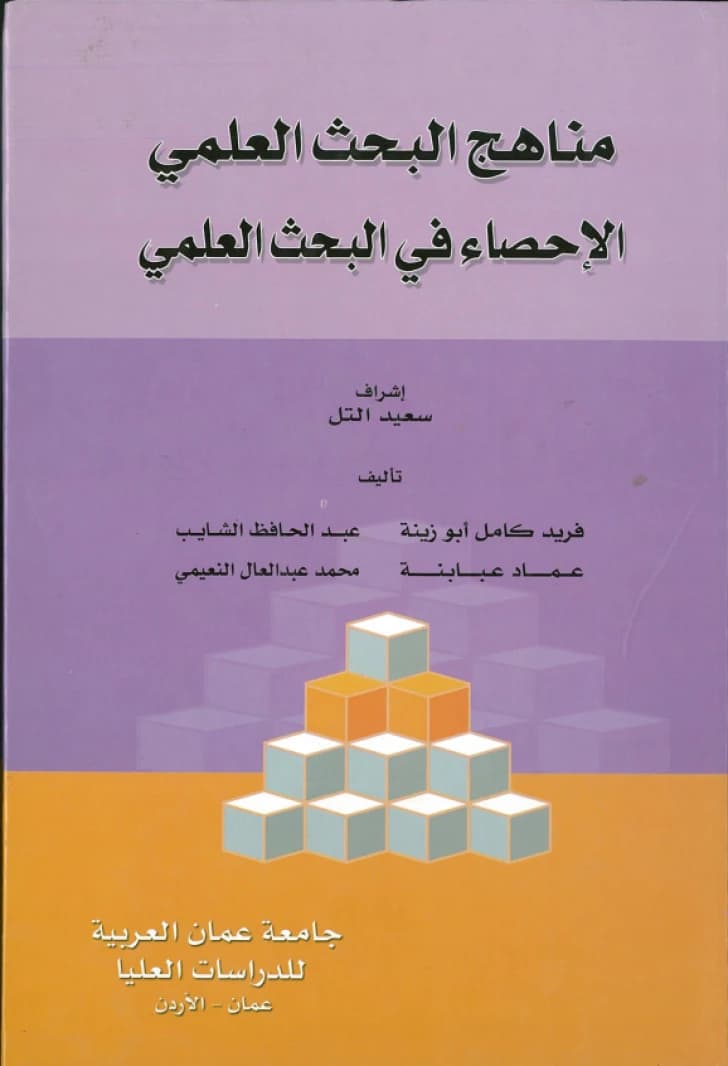
Scientific Research Methods: Statistics in Scientific Research - Saeed Al-Tal
JOD

Get it by 5 Aug | Order in 3 Hours 53 Minutes
- Return Policy
- Warranty Policy
- Shipping Policy
- Non contact delivery
- Personal Receipt
- Return Policy
- Warranty Policy
- Shipping Policy
- Non contact delivery
- Personal Receipt
Contemporary life is characterized by rapid development in various fields, particularly in informatics, scientific research activities, and knowledge production. Data and information have become more vital than ever, flowing massively from different sources. This requires individuals to make decisions and form stances on numerous issues using the information they hear, see, or produce. Expressing variables quantitatively using numbers according to specific rules to facilitate understanding and comparison has become a science linked to the progress of various disciplines. Given the rapid changes in educational, political, economic, social, and cultural fields, individuals and institutions have sought to acquire the necessary techniques and means for data collection and processing to facilitate understanding, judgment, and decision-making with accuracy and speed that align with the demands of modern life. Statistics is a branch of science concerned with using and applying the most effective methods and means for collecting, organizing, and analyzing data on educational, social, economic, political, and other phenomena. This is done in an attempt to reach specific conclusions, relationships, and generalizations in the form of probabilistic statements about the characteristics of a statistical population through a subset of it. As postgraduate students are in dire need of a statistics course to rely on for all data collection, analysis, and conducting field research, the course "Statistics in Scientific Research" was developed to meet this need. The book "Statistics in Scientific Research" is the second in a series of books on scientific research methods published by Amman Arab University for Graduate Studies. This book is composed of twelve chapters. The first four chapters cover data collection and presentation, measures of central tendency, and measures of dispersion, noting that most students have studied these topics in previous academic stages. Since generalizing from a sample to a population primarily depends on distributions and probabilities, the fifth chapter deals with the concepts of probability, events, probability distributions, and the laws of probability. The sixth chapter covers correlation and its coefficients: Pearson, Spearman, Phi, and Point-Biserial. This chapter also addresses regression and the standard error of estimation or prediction. Inferential statistics, which focuses on hypothesis testing, requires knowledge and understanding of normal distribution and statistical estimation, which are the topics of the seventh and eighth chapters. The final four chapters cover hypothesis testing based on F, χ², t, and z in all the detail a student needs to deeply understand the subject. We have provided a sufficient number of examples to clarify the laws, rules, procedures, and necessary calculations for dealing with the subject of statistics, and each chapter concludes with an adequate number of exercises and drills. We hope we have succeeded in preparing this book, which we will be keen to continuously develop and improve.
- Number of Pages: 392
- Year of Publication: 2007
- Binding Type: Hardcover
- Edition: 2
- Print Color: Black
- Dimensions (cm): 17x24
- Weight (kg): 0.750
- Barcode: 9789957066758







