
Download Our App
Shop your way




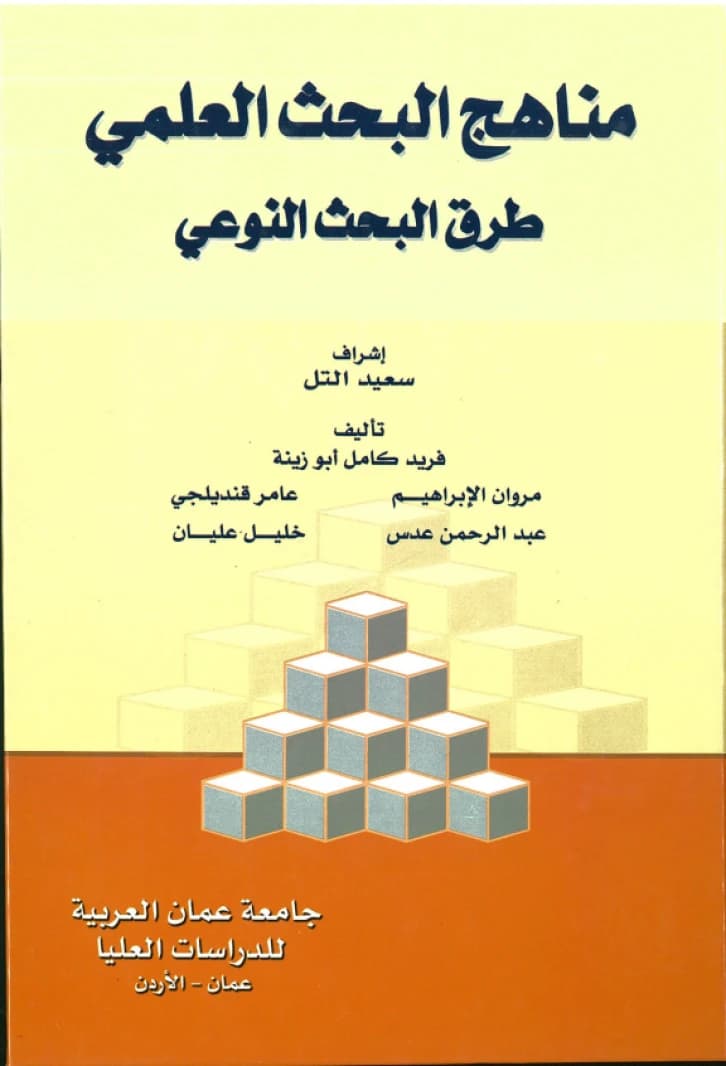
Scientific Research Methodologies: Qualitative Research Methods - Supervised by Prof. Dr. Saeed Al-Tal - 2007
JOD

Get it by 5 Aug | Order in 5 Hours 18 Minutes
- Return Policy
- Warranty Policy
- Shipping Policy
- Non contact delivery
- Personal Receipt
- Return Policy
- Warranty Policy
- Shipping Policy
- Non contact delivery
- Personal Receipt
Mental abilities are distributed among the nations, peoples, and tribes of the world with justice and equality. No nations, peoples, or tribes are distinguished from others by their mental abilities. The increased percentage of creative individuals in some nations and peoples is not attributed to their superior mental abilities, but rather, primarily, to their educational systems. Traditional education systems do not develop creative minds but rather imitative ones, and if a creative mind emerges within a traditional educational system, it is because its owner was able to overcome the system's constraints and limitations.
Modern education systems are those that develop thinking, researching, and creative minds. Indeed, the development in educational theories and educational psychology, the rapid advancement in human knowledge in all its fields, and the tremendous progress in natural sciences and their technological extensions have established the principle of making the primary and fundamental goal of education, especially higher education, the development of creative thinking, with the acquisition of knowledge being a secondary goal and a result thereof.
Making the primary goal of education the development of a student's ability to think, research, and innovate has necessitated a fundamental change in curricula in general and teaching methods in particular. The method of teaching based on rote learning and memorization is no longer suitable for achieving the aforementioned goal. It has been replaced by a teaching method based primarily on dialogue. A dialogue-based teaching method is one that develops a student's ability to think and enhances their competencies in scientific research and their aptitude for creativity.
Furthermore, developing a student's creativity by enhancing their thinking ability cannot be achieved to the required extent and sufficient degree without developing this student's competencies in the scientific research methodology, its techniques, means, and tools. The scientific research methodology, its techniques, means, and tools, is the path that enables the student to use their mental capacity to its fullest potential in creativity, following the steps and rules recognized in the philosophy of science.
Although scientific research is the second main function of a university, it also constitutes an important aspect of its first function, which is education. Modern teaching methods in contemporary universities rely, among other things, on providing opportunities for students to practice scientific research to develop their competencies in planning, execution, analysis, and writing.
Based on these principles and others, Amman Arab University for Graduate Studies has worked on producing these four books on scientific research methodologies to provide university students in the Arab world, especially graduate students, and researchers with suitable references in this increasingly important and critical field, with the hope that these books will find their place in a society that respects and practices scientific research.
Moreover, a distinguished elite of university professors, who have written on scientific research methodologies and taught its courses, have contributed to the preparation and review of these books. They are, listed alphabetically: Professor Dr. Khalil Aliyan, Dr. Adel Hado, Professor Dr. Amer Qandilji, Professor Dr. Abdullah Zaid Al-Kilani, Dr. Abdul Hafiz Al-Shayeb, Professor Dr. Abdul Rahman Adas, Professor Dr. Abdul Razzaq Bani Hani, Professor Dr. Adnan Al-Jadri, Dr. Imad Ababneh, Professor Dr. Farid Abu Zeina, Professor Dr. Kayed Abdel-Haq, Professor Dr. Muhammad Abdul-Aal Al-Nuaimi, Professor Dr. Muhammad Walid Al-Batsh, Dr. Marwan Al-Ibrahim, Professor Dr. Mowaffaq Al-Hamdani.
- Number of Pages: 416
- Year of Publication: 2007
- Binding Type: Hardcover
- Edition: 2
- Printing Color: Black
- Size (cm): 17x24
- Weight (kg): 0.800
- Barcode: 9789957066741







