
Download Our App
Shop your way




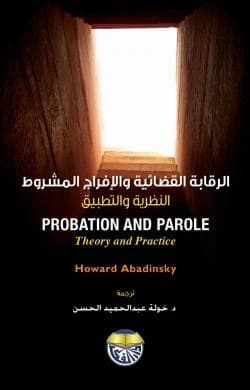
Probation and Parole: Theory and Practice by Howard Abadinsky
JOD

Get it by 5 Aug | Order in 3 Hours 47 Minutes
- Return Policy
- Warranty Policy
- Shipping Policy
- Non contact delivery
- Personal Receipt
- Return Policy
- Warranty Policy
- Shipping Policy
- Non contact delivery
- Personal Receipt
Probation and parole are a unique part of the American criminal justice system, where conflicting goals and competing expectations are reconciled in a whirlwind of politics. Americans desire maximum protection from crime while insisting that efforts to achieve this do not infringe upon fundamental constitutional rights. We want a system that intimidates criminals and disrupts illegality, without imposing an exorbitant cost (Dilulio, 1993). Therefore, both probation and parole serve as a lifeline in the difficult situation we face in meeting these competing expectations. When an offender on probation or parole commits a serious crime that captures significant media attention, questions arise as to why that person was not incarcerated. A single case can lead to changes that make policies ideal but weak in application. Due to various reasons related to justice (appropriate punishment for each crime) or financial cost (as it is very expensive to imprison all criminals indefinitely), many convicts are not incarcerated, and more than 90% of imprisoned convicts are eventually released. Convicted offenders can be placed on probation; imprisoned and then released after serving their full sentence; or placed on parole or released early under community supervision.
- Author: Howard Abadinsky
- Translator: Dr. Khawla Al-Hassan
- Number of Pages: 592
- Year of Publication: 2018
- Binding Type: Hardcover
- Edition: First
- Print Color: White
- Dimensions (cm): 17*24
- Weight (kg): 1
- Barcode: 9789957921828







