
Download Our App
Shop your way




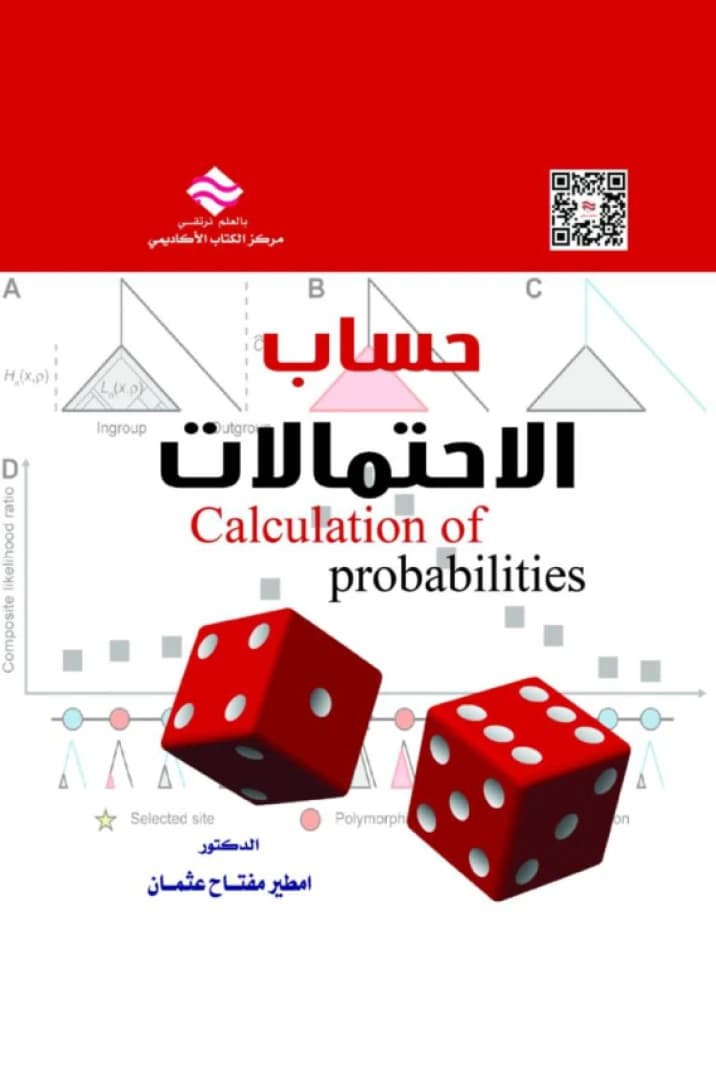
Probability Calculation
JOD

Get it by 5 Aug | Order in 5 Hours 8 Minutes
- Return Policy
- Warranty Policy
- Shipping Policy
- Non contact delivery
- Personal Receipt
- Return Policy
- Warranty Policy
- Shipping Policy
- Non contact delivery
- Personal Receipt
The book consists of nine self-contained, sequential chapters, where each chapter builds upon the previous one as needed. Each chapter concludes with theoretical and practical exercises to reinforce understanding from both theoretical and applied perspectives. The content of the book is designed to cover two academic semesters, and its study requires a prerequisite of one semester of General Mathematics, covering differentiation, integration in one and two variables, and series.
The first and second chapters are dedicated to presenting the essential foundational methods necessary for understanding the subsequent chapters. Chapter one introduces the concept of sets, their types, and operations on them as a basis for understanding simple and compound random events, the set function, and its properties. Chapter two presents the theory of combinations and its various methods, which is a crucial foundation for calculating the number of elements in a sample space and the events of a random experiment.
From chapter three to chapter nine, the core material of the book is presented. Chapter three covers random experiments and the resulting concepts such as sample space and random events. Chapter four introduces the concept of probability, its definitions, and its various rules on an applied mathematical basis. Chapter five discusses probability distributions for random variables, defining both discrete and continuous types, probability mass and density functions, cumulative distribution functions, and marginal and conditional distributions, in addition to joint probability distributions and various applications.
Chapter six covers mathematical expectation and its different methods for calculating various moments such as the mean, variance, and the moment-generating function with its applications. Chapter seven presents the concept of random independence, its conditions, applications, and implications. Chapter eight introduces a set of important special discrete and continuous distributions, along with their moments and generating functions. Finally, chapter nine presents statistical applications of the cumulative distribution function, probability density and mass functions, as well as applications of mathematical expectation represented in calculating moments, the moment-generating function, and probability inequalities.
The book concludes with a collection of Arabic and English references used in its preparation.







