
Download Our App
Shop your way




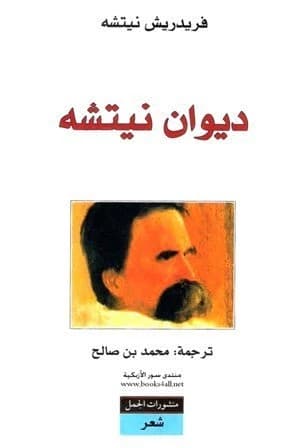
Nietzsche's Diwan by Nietzsche
JOD

Get it by 5 Aug | Order in 3 Hours 32 Minutes
- Return Policy
- Warranty Policy
- Shipping Policy
- Non contact delivery
- Personal Receipt
- Return Policy
- Warranty Policy
- Shipping Policy
- Non contact delivery
- Personal Receipt
Rarely has a thinker and philosopher, from either the West or the East, left such a profound impact as the German philosopher and poet Friedrich Nietzsche. Known for his famous book "Thus Spoke Zarathustra," Nietzsche caused a genuine seismic shift in prevailing concepts and values, with repercussions still felt across generations worldwide. Arab readers' familiarity with Nietzsche often focuses on his philosophical side, but many remain unaware of his contributions to music, theater, and especially poetry. This poetry book, published by Dar Al-Jamal in Germany and translated into Arabic by the Tunisian poet and writer Mohamed Ben Saleh, fills a significant gap by introducing us to the multifaceted creativity and complex personality of Nietzsche.
Nietzsche began experimenting with poetry in his early teenage years during the mid-19th century, a journey that extended until the period just before his madness in the years leading up to his death. His philosophy, centered on strength, individuality, and self-exaltation, naturally aligns with poetry as a unique art form. Nietzsche even considered existence itself a sublime aesthetic phenomenon, urging poets and artists to explore its meanings. Mohamed Ben Saleh introduces the translated poems with an insightful and extensive preface that sheds light on Nietzsche's view of language—not merely as a tool for communication and creativity but as a means of inquiry and discovery, a dialogue with self and existence. This concept of language bridges poetry and philosophy in Nietzsche's work, rejecting the Apollonian rationality linked to abstract analysis in favor of the Dionysian embodiment, encouraging action and creativity as the ultimate expression.







