
Download Our App
Shop your way




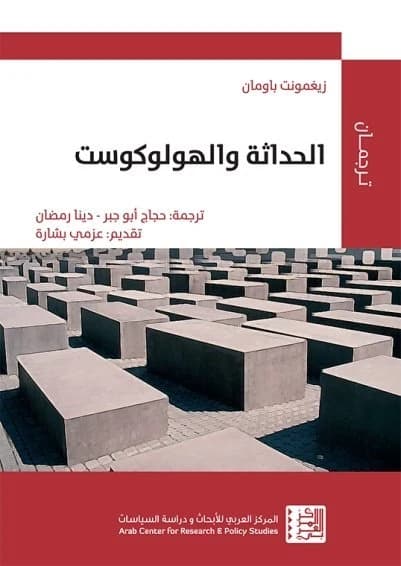
Modernity and the Holocaust
JOD

Get it by 5 Aug | Order in 2 Hours 44 Minutes
- Return Policy
- Warranty Policy
- Shipping Policy
- Non contact delivery
- Personal Receipt
- Return Policy
- Warranty Policy
- Shipping Policy
- Non contact delivery
- Personal Receipt
Modernity and the Holocaust is a detailed sociological study on the essence of Western modernity through a critique of the Holocaust. It makes a serious attempt to deconstruct prevailing frameworks for understanding modernity, drawing on thinkers like Max Weber, Max Horkheimer, Theodor Adorno, Hannah Arendt, and other pioneers in critiquing Western modernity. It also deconstructs the West's attempt to define the meaning of the Nazi genocide of the Jews by reducing it and imposing its narrow logic by stripping it from its political context. The book consists of an introduction by Azmi Bishara and eight chapters. In the introduction to the Arabic translation, titled "Modernity and the Mechanisms of Moral Neutralization," Bishara states that Bauman started from the "discovery of an illusion he fell victim to, which is the belief that the catastrophe of the extermination of Europe's Jews (the Holocaust) is an exception or aberration in modernity's process, or perhaps in history in general, or a fit of madness that struck classes of modern society. The book as a whole is an attempt to establish a sociological approach to the Holocaust as a part or aspect of modernity and not a case of deviation or madness resulting from a departure from modernity and its nature." According to Bishara, if the Holocaust were merely an exception or an anomaly of modernity's nature or a temporary ailment it experienced, "there would be no need to absorb it into sociological theory; the theory implies an existing, recurring structure that requires a theoretical model to understand and interpret it." In the first chapter, "Introduction: Sociology after the Holocaust," the author provides a general survey of the sociological responses or rather the glaring scarcity of sociological studies on some of the issues raised by Holocaust studies. The author treats the Holocaust as a test of Western modernity, the processes of urbanization or Western civilizing process, the social production of moral indifference, and the social production of moral blindness, and the moral consequences of the civilizing process. In the second chapter, "Modernity, Racism, and Extermination (A)," Bauman explores aspects of anti-Semitism, the anomaly of Jews from the Christian world to modernity, the Jewish community as glass publications, modern dimensions of Jewish anomaly, non-national groups in a world of nationalities, and the modernity of racism. In the third chapter, "Modernity, Racism, and Extermination (B)," he examines the transition from pathological fear of the different other to racism, and racism as a form of social engineering, and the transition from segregation to extermination. In these chapters, Bauman studies the tensions and disorders arising from tendencies to set boundaries and define identities; in new conditions brought by modernization, the collapse of the traditional system, the empowerment of modern nation-states, and the relationships between certain features of modern Western civilization (especially the role of scientific jargon in legitimizing social engineering ambitions), and the relationship between racism and extermination projects. Here, he posits that the Holocaust was a thoroughly modern phenomenon, not understandable without the context of cultural tendencies and the technical achievements of Western modernity. In the fourth chapter, "The Holocaust: Between Monumentalization and Humanization," Bauman attempts to confront the problem of the dialectical merging of the naturalness of the Holocaust and its uniqueness among other modern phenomena. He suggests, at the end of this chapter, that the Holocaust was the outcome of an unexpected convergence of factors that in themselves were entirely ordinary and familiar, and that the possibility of this convergence is largely due to the political state's liberation from social oversight and its monopoly of violence reasons, and its unbridled engineering aspirations, after a gradual dismantling of all sources of non-political power and institutions of social self-management. He examines genocide as extraordinary, the peculiarities of modern genocide, the effects of hierarchical and functional division of labor, dehumanization of bureaucratic objectives, and the role of modern bureaucracy in the Nazi Holocaust and the bankruptcy of modern guarantees. In the fifth chapter, "Jewish Cooperation with the Nazis," Bauman undertakes a burdensome and harsh task of analyzing one of the topics we "prefer not to talk about," meaning the modern mechanisms that allow victims to dig their cemeteries themselves, as well as the mechanisms that necessarily entail an overpowering authority perpetually stripping humans of their humanity contrary to the principles of the moral civility process that modern Western society boasts of, addressing the isolation of victims and the silence of German elites, the game of saving what can be saved, individual rationality in serving mass destruction, and rationality in self-protection from annihilation. Towards a Sociological Theory of Morality in the sixth chapter, "The Ethics of Obedience (Reading in Milgram's Experiments)," the author examines one of the modern connections of the Holocaust, namely its close relationship with a model of authority that reached perfection in modern bureaucracy. In this chapter, there is an extended analysis of the important social psychological experiments conducted by Milgram and Zimbardo, a study of inhumanity as a social dimension effect, the involvement in crime and the difficulty of retreat, technological ethical coloring, floating responsibility, authority plurality, conscience authority, and the social nature of evil. The seventh chapter, "Towards a Sociological Theory of Morality," represents a theoretical conclusion of contradictory visions, in which Bauman traces the current state of ethics in the dominating formulations of social theory and defends a radical review of this situation, a review which would focus on the ability for social exploitation revealed through social, physical, and spiritual distancing matters in exploring the following: society as a morals factory, the challenge of the Holocaust to Western modernity fallacies, pre-societal sources of morality, social proximity and moral responsibility, social repression of moral responsibility, and the social production of distancing and fading moral vision. Lastly, the eighth chapter, "Appendix: Rationality and Moral Shame," the author includes the Amalfi European Award lecture (1990) titled "The Social Exploitation of Morality" and a conclusive word for the 2000 edition of the book titled "The Duty of Remembrance, but What Do We Remember?"







