
Download Our App
Shop your way




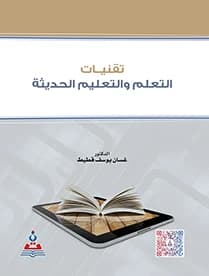
Modern Learning and Teaching Technologies - Dr. Ghassan Yousef Qutait
JOD

Get it by 5 Aug | Order in 3 Hours 53 Minutes
- Return Policy
- Warranty Policy
- Shipping Policy
- Non contact delivery
- Personal Receipt
- Return Policy
- Warranty Policy
- Shipping Policy
- Non contact delivery
- Personal Receipt
Based on the importance of learning and teaching technologies in the educational process in general, and in teaching in particular, we were keen to present a book specializing in educational technologies in the era of information and communication technology. Therefore, this book includes eight chapters, covering modern technical topics and tools related to the educational process.
Given the main role that modern technologies play in facilitating communication, the first chapter deals with: communication, its elements, patterns, skills, types, obstacles, classifications of educational communication methods, criteria for selecting educational communication methods, and the development of communication skills. This chapter also includes a set of tools for measuring communication patterns and communication skills of both the sender and receiver.
The second chapter addresses educational technologies, the use of these technologies in student activities, the classification of student activities according to educational technologies, and the roles and competencies of the teacher in light of these technologies.
Building on the second chapter, the third chapter presents: teaching aids, their classifications, selection criteria, rules of use, sources and forms of teaching aids, computer applications in the educational process, the use of computers in the classroom, employing computers to solve educational problems, and using the internet.
The fourth chapter extends the third, explaining Multimedia to the reader, its features, components, specific software, standards for multimedia programs in education, conditions for integrating multimedia into the educational process, how to use multimedia in the classroom, PowerPoint presentation software, the role of teacher and learner with multimedia, production of multimedia programs, reasons and limitations for using multimedia in education, and classroom applications based on its use.
The fifth chapter shows the teacher how to integrate tools and technology into the educational process through Blended Learning, its benefits, traditional versus blended learning, and classroom applications based on blended learning.
The sixth chapter, as an extension of the previous five, presents: e-learning, the e-learning environment and its features, distance education and e-learning, distance education technologies, characteristics and importance of e-learning, organizing the electronic curriculum, teacher competencies in e-learning, types of teacher's electronic portfolios (E-Portfolio), preparing a teacher's E-Portfolio, aspects of e-learning, using computers and the internet in the educational process, and steps for teachers and learners to follow when implementing e-learning.
Stemming from our absolute belief in the importance of authentic learning, the seventh chapter covers trips in their various forms, presented in a way that aligns with the era of information and communication technology: educational trips, the WEB QUEST, the Virtual Trip, closed and open tours, and the Online Research Module model.
The eighth chapter extends the previous one in its connection to authentic learning, presenting simulation programs associated with the Dry Lab. It provides a general idea of the Dry Lab, its importance, associated software, how to apply it in the classroom, in addition to practical applications of the Crocodile program in physics, chemistry, and technology classes.
The ninth chapter is purely research-based, presenting four recent studies for the researcher and the Arab reader, which examine the impact of educational technologies on several variables related to both teacher and learner, confirming the importance of modern programs and technologies in raising the competency level of both.
In conclusion to this presentation of the book's topics, we hope to have succeeded in offering a collection of modern subjects that facilitate the learning and teaching process for both learner and teacher. We also hope the book has provided many modern topics in the field of learning and teaching technologies, in which the reader will find the necessary knowledge and benefit to develop their various competencies.
ISBN: 9789957168803, Weight: 0.800 kg, Size: 17×24 cm, Paper: White, Pages: 344, Year of Publication: 2015, Binding: Hardcover.







