
Download Our App
Shop your way




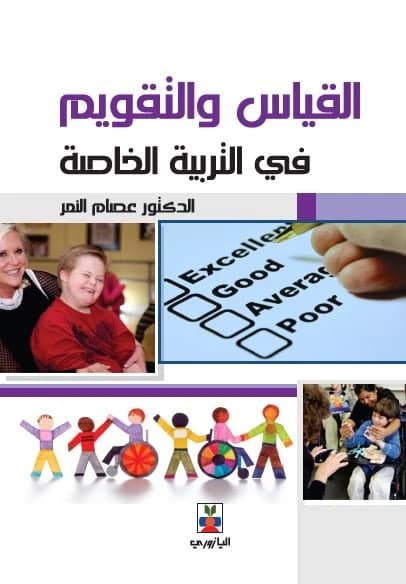
Measurement and Evaluation in Special Education - Dr. Essam Al-Nimr
JOD

Get it by 5 Aug | Order in 3 Hours 16 Minutes
- Return Policy
- Warranty Policy
- Shipping Policy
- Non contact delivery
- Personal Receipt
- Return Policy
- Warranty Policy
- Shipping Policy
- Non contact delivery
- Personal Receipt
The book addresses the general foundations of diagnosis in special education, with a detailed look at some aspects of diagnosing certain categories, such as intellectual and hearing disabilities and learning difficulties. This edition adds the diagnosis of autism cases, which are among the most prevalent categories, with the exception of hearing impairment. The material in this book is the result of a series of lectures delivered while teaching the course on measurement and diagnosis in special education at community colleges and teacher colleges in the Hashemite Kingdom of Jordan and the Kingdom of Saudi Arabia. It also includes working papers presented at seminars, lectures, and conferences on the education of exceptional individuals, with some other additions and modifications to suit those interested in the field.
Interest in the psychometric movement began with the influence of mental measurement on what is known as individual differences. Many scholars, including Binet, have pointed this out, noting that the complexity of mental processes indicates an increase in individual differences. In the field of individual differences, Thorndike also indicated that they are more complex in humans than in animals. The interest in psychological measurement dates back to the nineteenth century through scientific studies in psychology, although its origins are much older. Previously, it relied on what was called physiognomy to determine intelligence, a practice based on human facial features and the skull, with Lavater and Darwin being among its most famous proponents.
Cattell (1890) conducted studies to understand the relationship between intelligence and certain sensory-motor aspects (e.g., speed of movement, hand grip, distinguishing between similar weights, remembering color names, etc.). The results of his studies and those of Gilbert (1897) indicated a weak correlation between these sensory stimuli and intelligence. The first attempt to measure mental abilities based on mental activity was Münsterberg's experiment (1891), which focused on aspects such as identifying and naming colors, counting angles, and measuring lengths. In contrast, the attempt by Binet and Henri (1896) measured intelligence through what are known as mental faculties, such as imagination, attention, memory, mental visualization, comprehension, spatial dimensions, and willpower.
General Concepts: In the field of measurement and diagnosis, multiple terms and concepts are used that are so closely related they are sometimes used interchangeably. For instance, some may use 'measurement' to mean 'evaluation' or vice versa, which can diminish their educational value in achieving objectives.
- Weight: 0.72 kg
- Dimensions: 17 × 24 cm
- ISBN: 978-9957-12-787-9







