
Download Our App
Shop your way




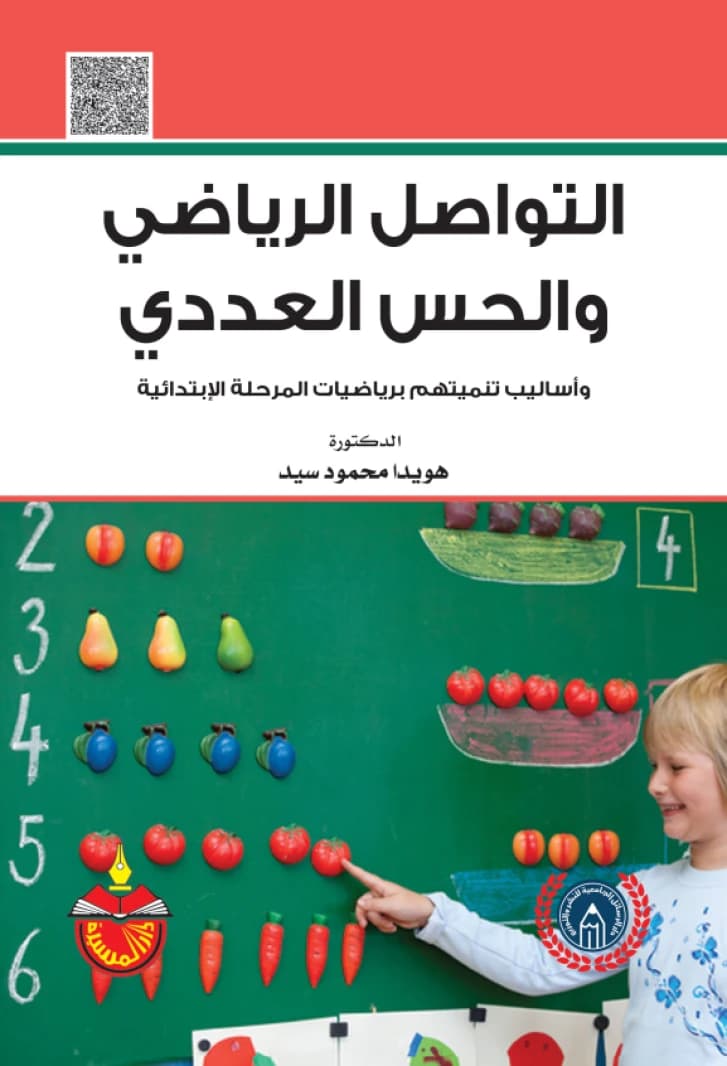
Mathematical Communication, Number Sense, and Methods for Their Development in Elementary School Mathematics - Dr. Howayda Mahmoud Sayed
JOD

Get it by 5 Aug | Order in 3 Hours 52 Minutes
- Return Policy
- Warranty Policy
- Shipping Policy
- Non contact delivery
- Personal Receipt
- Return Policy
- Warranty Policy
- Shipping Policy
- Non contact delivery
- Personal Receipt
Communication is one of the most prominent tools humans use to help them adapt to the demands of life. The mathematical knowledge that individuals need to complete their studies in most other disciplines is also essential in their daily lives, providing them with tools for interaction and communication. This enables them to solve the daily problems they face in a scientific, objective manner, far from fanaticism, haste, and randomness. Therefore, mathematics holds a distinguished position in education due to its effective contribution to achieving specific learning goals. Mathematics is not just a means to help people think, solve problems, and reach conclusions, but also a very important tool for exchanging ideas with clarity and precision.
People live in a communicational world, viewing their communication as an entitled grant and an indispensable necessity. A person spends their day speaking and being spoken to, writing, reading, and responding to numerous symbols. The most important feature of contemporary mathematics is that it is a wonderful form of shorthand, using a unified language and symbols; mathematicians in different countries around the world use the same mathematical language and symbols, which has enabled them to communicate mathematically among themselves.
The forms and contexts of using the language of mathematics have multiplied. There is the read language for reading mathematical texts and understanding the meanings of symbols, terms, shapes, drawings, and graphs. There is the written language for expressing ideas, terms, and theories, describing procedures for solving mathematical problems, and evaluating and analyzing them. And there is the spoken language for clearly expressing what we hear, correctly interpreting what others express mathematically, and using correct oral language and mathematical formulas to express mathematical ideas.
Since learning and teaching mathematics are not devoid of opportunities for mathematical communication in its various forms, mathematics teachers, curriculum developers, and authors of school mathematics books should focus on developing the patterns and skills of mathematical communication. Mathematical communication is one of the most important goals of mathematics education in general education stages and a component of mathematical ability that enables students to use the language of mathematics when facing a written, drawn, read, or tangible situation, and to interpret and understand it through oral or written mathematical discussions.
The nature of mathematics differs from the prevailing beliefs that it is abstract and devoid of sense. It has become clear after the emergence of modern technological systems—which have taken over many tasks from humans—that viewing mathematics in light of modern trends has transformed it from this abstract system into a coherent system aimed at developing thinking, communication, and the ability to face problems. One of the most important characteristics of this system is continuity in growth and interpretation as one of the important human characteristics.
Looking at reality, we see that learning mathematics faces negative attitudes, reluctance, and low achievement, which teachers clearly express at all educational stages. This is also recognized by parents, supervisors, and mathematics educators. This decline is evident in the branch of arithmetic based on numbers and operations on them. There are many interrelated reasons for this problem, some of which may be due to the teaching style followed by teachers, which is based on meaningless drill and repetition without understanding and conscious knowledge. This leads to students relying solely on mechanical procedures and skills, neglecting understanding, thinking, and reflection, and ignoring number sense, contenting themselves with mechanically memorizing facts and concepts without meaning.
- Number of Pages: 288
- Year of Publication: 2017
- Binding Type: Hardcover
- Edition Number: 1
- Printing Color: Black
- Dimensions (cm): 17x24
- Weight (kg): 0.600
- Barcode: 9789957643010







