
Download Our App
Shop your way




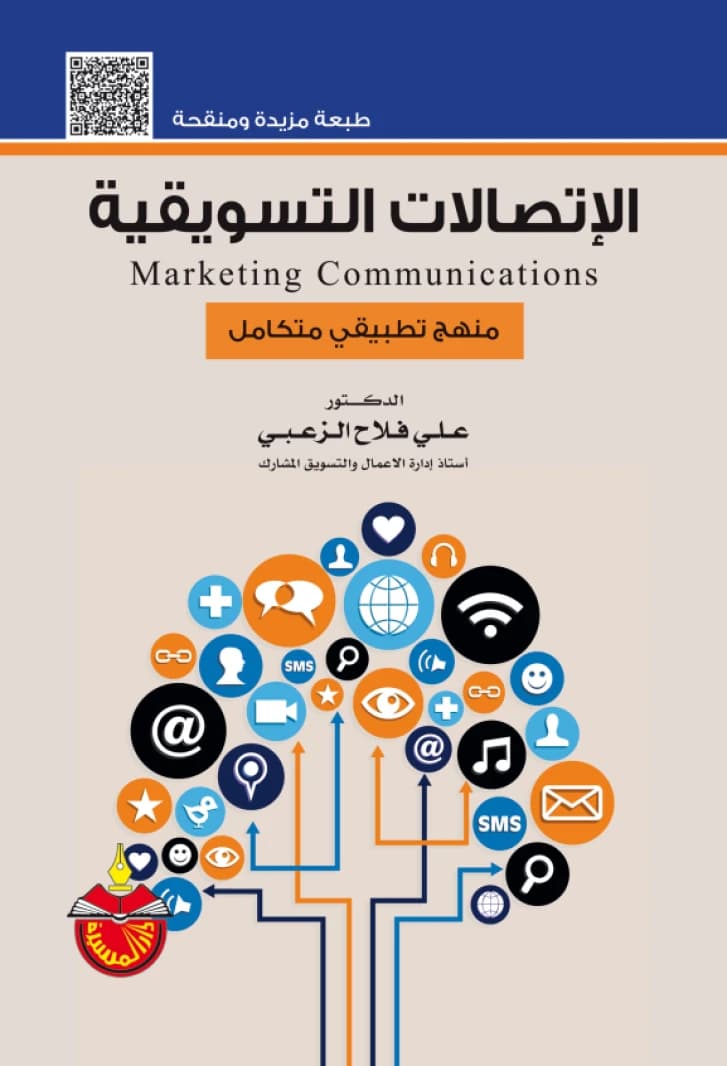
Marketing Communications - Ali Falah Al-Zoubi
JOD

Get it by 5 Aug | Order in 3 Hours 19 Minutes
- Return Policy
- Warranty Policy
- Shipping Policy
- Non contact delivery
- Personal Receipt
- Return Policy
- Warranty Policy
- Shipping Policy
- Non contact delivery
- Personal Receipt
Communication is one of the most prominent factors that have established social relationships among individuals. The need for it has led it through several stages of continuous development, enabling individuals to organize and coordinate their work and activities by exchanging information and ideas, which ultimately form the content of communication. In this context, to influence the habits and behaviors of various target groups, companies adopt this interaction and exchange of information and ideas using specific means to achieve their desired goals according to the nature of each group.
The need to define the concept of communication is essential for any organization. To address this, we decided to explore its various related concepts, then delve into marketing communication as a part of this communication and as a concept based on conveying information or an idea to another party. Finally, we discuss the stages and necessary elements of marketing communication.
Promotion represents the part of communications that aims to inform, persuade, and remind the consumer of the product or service produced by the company and to influence them to accept and use it. Promotion is the organization's marketing communication tool because it consists of several activities of a communicative nature represented in the promotional mix (advertising, personal selling, sales promotion, and publicity). However, the role of the marketing mix (product strategy, pricing strategy, distribution strategy) should not be overlooked, as each sub-strategy performs a specific communication task and conveys a particular meaning represented by the set of benefits the consumer will receive.
Marketing communications are a key element of the marketing mix, representing the marketing function concerned with informing, persuading, and influencing the customer's purchasing decision. It is a complementary part of the social and economic systems of any society. This book is considered the first of its kind in the Arabic language, as it presents, analyzes, deduces, and models the topic of communications in general and marketing communications in particular.
What makes this book unique is its strategic, analytical, and applied approach. It discusses topics directly related to information and communication technology (ICT) and its role in enlightening and accelerating traditional business models, as well as innovating business models built entirely on modern technologies like the internet and mobile devices, both wired and wireless, with their terminologies and applications. The reader will notice the author's focus on clarifying the most prominent and recent developments in the field of ICT and the role of these technologies in formulating effective marketing communication strategies, and how business organizations have come to use these technologies in the field to achieve their desired objectives.
It is indeed a unique book that encompasses the sphere of innovative marketing communications. It is hoped that the book will provide readers, students, and researchers in its field with a fountain of specialized knowledge, and practitioners with a field to rely on in formulating effective strategies in the age of the digital and knowledge economy.
This book, with its chapters, serves as a roadmap for marketing communications, aiming to clarify the important and vital role and to highlight the basic concepts, intellectual frameworks, and main functions in a serious attempt to build a coherent, integrated structure that enables researchers and specialists to grasp the content of this contemporary scientific and intellectual subject. It is the fundamental pillar for the efficiency and effectiveness of performance in all business companies, whether small or large, national or global, for-profit or non-profit, in order to achieve success and prosperity, ensure survival and continuity, build a competitive advantage, reputation, and fame, and ultimately achieve market leadership.
Embodying these objectives, and because this book is not just a tool but a comprehensive applied methodology for marketing communications, its structure consists of eleven chapters. Chapter One provides an introduction to communications, Chapter Two covers marketing communications foundations and concepts, Chapter Three discusses promotion and the communication process, Chapter Four presents integrated marketing communications, Chapter Five is titled Marketing Communications, Consumer Behavior, Professional Ethics, and Social Responsibility, Chapter Six covers personal selling, Chapter Seven discusses advertising, Chapter Eight sales promotion, Chapter Nine the topic of public relations, Chapter Ten is titled commercial publicity, and Chapter Eleven is titled direct marketing.
- Number of Pages: 444
- Year of Publication: 2025
- Binding Type: Hardcover
- Edition Number: 4
- Print Color: Black
- Size (cm): 17x24
- Weight (kg): 0.800
- Barcode: 9789957066123







