
Download Our App
Shop your way




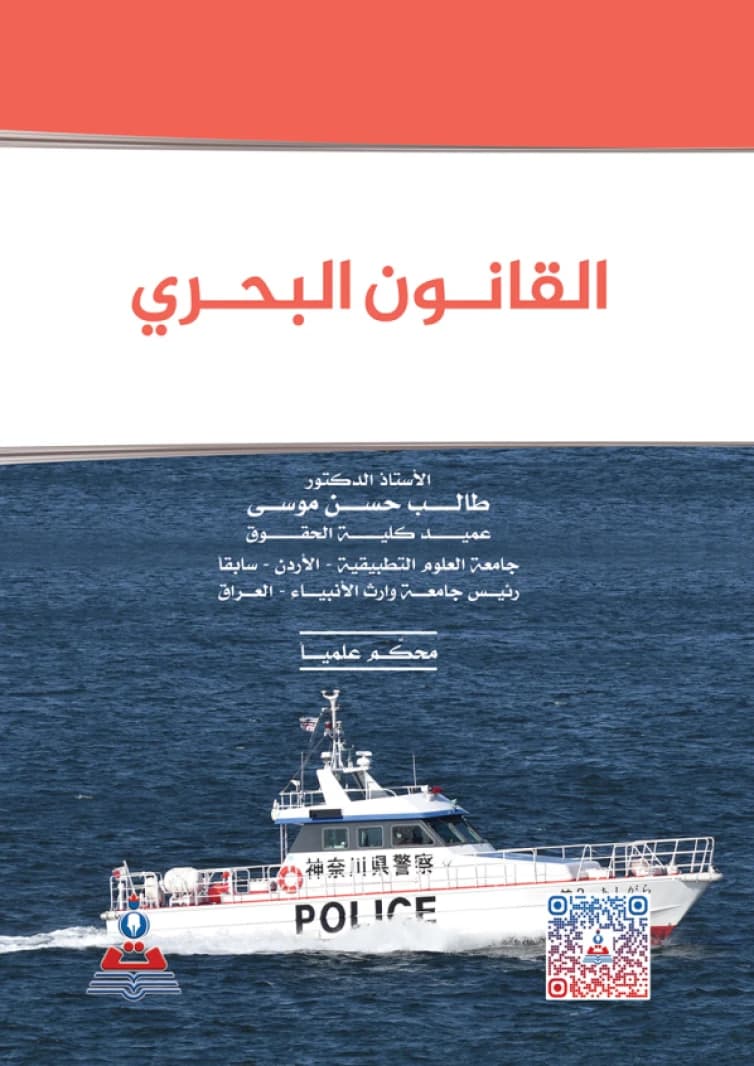
Maritime Law by Prof. Dr. Talib Hassan Mousa
JOD

Get it by 5 Aug | Order in 5 Hours 12 Minutes
- Return Policy
- Warranty Policy
- Shipping Policy
- Non contact delivery
- Personal Receipt
- Return Policy
- Warranty Policy
- Shipping Policy
- Non contact delivery
- Personal Receipt
Islamic Sharia and Maritime Law:
The Holy Quran contains the fundamentals of all matters, addressing everything. An issue might seem simple, but its reality can be profound. The Divine Legislator holds us accountable for not returning a greeting with at least its equivalent, so how much more for other aspects of life? If the reader reflects upon it, they would find all branches of contemporary law, such as commercial, civil, international criminal, and maritime law. Regarding the latter, the Quran shows us the importance of the sea, its wealth, and the means of navigation. The reader will find references in more than one verse to the sea, ships, and their construction, as mentioned in Surahs such as Luqman, Ar-Rahman, Al-Jathiya, Al-Mu'minun, Fatir, and many others.
Islamic jurisprudence is rich with maritime legal rules. There are records dating back to the ninth century AD, including the rulings of the Maliki and Hanafi schools of thought that were applied in Tunisia regarding maritime carriers, ship chartering, and contribution to losses from jettisoning cargo at sea—what is known today as general average. Moreover, Muslim jurists did not single out maritime law with separate rules but addressed it within their jurisprudential encyclopedias. They discussed ship leasing and maritime transport contracts in the book on leasing, maritime collision in the book of liability, assistance and salvage in the book of lost property, and the limitation of the shipowner's liability in the book on the Mudaraba contract.
It has been noted that collections of maritime law, such as the Rolls of Oléron and the Consolato del Mare, which appeared in the Middle Ages and were applied in the Mediterranean basin, were inspired by the principles of Islamic Sharia. This is reinforced by the terminology used in those collections, such as:
- Amiral
- Avarie
- magasin
- Mahaunne
- Reis
- Recif
Furthermore, many Islamic maritime jurisprudence rules were translated in Sicily, such as the Al-Mudawwana al-Kubra, a primary reference of Maliki jurisprudence. It consists of sixteen books in eight volumes, with its eleventh book containing a section dedicated to land and sea transport.
Book Details:
- ISBN: 9789957166045
- Weight: 0.700 kg
- Dimensions: 17×24 cm
- Paper: White
- Pages: 304
- Year of Publication: 2022
- Cover Type: Hardcover







