
Download Our App
Shop your way




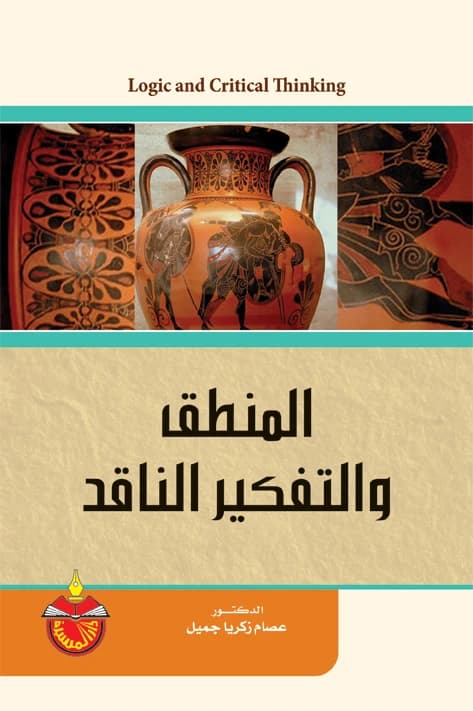
Logic and Critical Thinking - Dr. Essam Zakaria Jamil
JOD

Get it by 5 Aug | Order in 3 Hours 51 Minutes
- Return Policy
- Warranty Policy
- Shipping Policy
- Non contact delivery
- Personal Receipt
- Return Policy
- Warranty Policy
- Shipping Policy
- Non contact delivery
- Personal Receipt
Although man is naturally inclined to think, which distinguishes him from other beings, he needs to know the rules and laws of logic to correct his thinking in terms of style, form, content, and substance. Otherwise, he will not be able to think correctly, distinguishing truth from falsehood, and will fall into error and intellectual deviation without knowing the cause.
Accordingly, this science is used to correct the thinking process in other fields of science. A person with no scientific knowledge cannot use the rules of logic at all; he is like a diver without a sea or a carpenter without wood. Similarly, if one were an ocean of knowledge but unfamiliar with or disregarded the laws of logic, there would be no guarantee of the validity of their thoughts.
Hence, logic studies the methods and principles that enable us to distinguish between sound and unsound arguments. In other words, logic is the science that examines correct and flawed thought and establishes laws that protect the mind from falling into error. Its subject is human thought, but it examines it from a specific aspect: its validity and corruption. This is done by studying the general mental laws that the human mind follows in its thinking. Thoughts that conform to these laws are correct, and those that violate them are flawed.
Logic has two aspects: First, the study of human thought to discover its laws and the conditions upon which its correctness depends. In this respect, it is a science with a specific subject and a particular purpose. Second, the application of these laws to different types of thought to distinguish right from wrong. In this respect, it is an art or a craft, as the Arabs call it.
The scientific value of logic is to cultivate the faculty of correct thinking—that is, the faculty of criticism, evaluation of ideas, weighing of arguments, and judging them as complete or incomplete, right or wrong, whether in scientific, literary, philosophical, or political thinking.
It may be said that man thinks by nature and to some extent perceives errors in his and others' thinking naturally, without being familiar with the laws of logic. If so, what is the use of learning logic? The answer is that we might not need to learn logic if our thinking were always correct and we could perceive errors in our and others' thinking. However, we err even in the simplest types of thinking, without knowing the type of error we made or its cause. We explain events with the weakest reasoning without realizing the weakness in our explanations. We defend our ideas, beliefs, and actions with various arguments that we force upon our opponents, while they are fundamentally weak, flimsy, or fallacious. We often draw the broadest conclusions from the narrowest premises or take popular sayings and common proverbs as self-evident propositions that we compel our opponents to accept. We also often let emotion and the logic of emotion rule in the domain of reason and the logic of reason.
All these reasons justify the existence of a science that governs the laws of thought, distinguishes right from wrong, and cultivates in the mind the faculty of criticism and evaluation. Therefore, the goal of this book is to present a picture of the nature of logic as a powerful tool for developing the human faculty of thinking, especially critical thinking. Critical thinking is not innate in humans; its skill is learned and requires practice and training. Critical thinking is not tied to a specific age; every individual is capable of it according to their level of mental, sensory, conceptual, and abstract abilities. Critical thinking is achieved by using other thinking skills, foremost among them being logic.
- Number of Pages: 288
- Year of Publication: 2012
- Binding Type: Hardcover
- Edition Number: 1
- Printing Color: Black
- Size (cm): 17x24
- Weight (kg): 0.650
- Barcode: 9789957068394







