
Download Our App
Shop your way




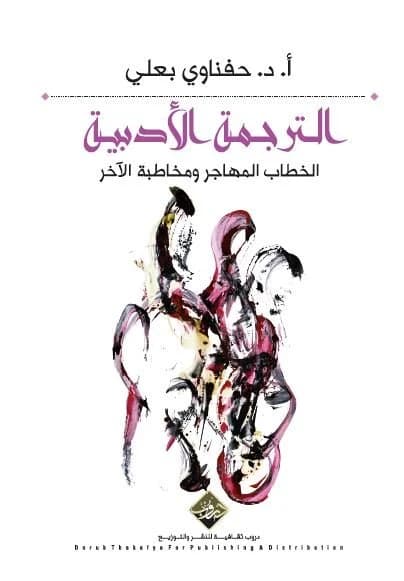
Literary Translation: The Migrant Discourse and Addressing the Other - Prof. Dr. Hafnawi Rashid
JOD

Get it by 5 Aug | Order in 3 Hours 7 Minutes
- Return Policy
- Warranty Policy
- Shipping Policy
- Non contact delivery
- Personal Receipt
- Return Policy
- Warranty Policy
- Shipping Policy
- Non contact delivery
- Personal Receipt
Translation is not merely a superficial handling of structures and vocabulary, but a deep dive into meanings and an exploration of symbols and imagery. It is a multifaceted linguistic process involving language, and within language, the imprints of environment and culture. In this environment, humans are influenced and affected by culture, whether it is native or foreign. Consequently, translation must bear a special and distinct character that differs from one language and culture to another.
The translation of theatre is particularly challenging. Perhaps the most significant writings on theatrical translation, applicable to both performed and read texts, are by George A. Wellwarth in his brief essay “Special Considerations in Drama Translation.” He proposed a set of criteria as foundations for theatrical translation: first, a style that gives the impression the play was originally written in the target language; second, tight dialogue; and third, eloquent brevity that portrays the dramatic conflict and maintains the authenticity of expression in the new text.
Several issues relate to the translation and Arabization of theatrical texts, such as standardizing translated terminology and avoiding redundant efforts in translating a single play. Theatrical translation holds importance and prevalence compared to other forms of translation, highlighting the significance of its complex elements, described as the contextual nuances of the text. Indeed, a theatrical text is written specifically to be performed within these contexts, always serving an audience that embodies them. It understands indirect situations: the literary context, representing the entire theatrical tradition of the country where the play is written; the geographical and historical contexts; and the context of each civilization that presents every point of the text on stage and in the hall.
Studies in the field of theatrical translation are few, if not rare, due to a lack of interest today, especially with the rise of playwrights in the Arab world and their intellectual independence in responding to their local societies, alongside their preoccupation with reading new world literature in its original languages.
What is the nature of translation, adaptation, and preparation in theatre? It becomes necessary to define the concepts of adaptation and preparation to avoid confusion in theatrical work. Through this inquiry, we will understand that theatre is not pure literature, not pure art, not pure literal translation, and not merely adaptation. Translating theatre is not as simple as many people imagine.
The movement to translate masterpieces of world theatre has played a major role in the flourishing of the Arab theatrical movement. Thanks to it, theatre enthusiasts have witnessed and had translated into Arabic many gems of French, English, and German dramatic literature, and a few from other peoples' literatures. This aimed for cultural communication, exploring these peoples' literatures, and learning about their experiences in this refined literary art. The number of translated theatrical works grew day by day, especially with the proliferation of theatre groups in the Arab world, which required translation to fill the gap in local texts.
In this book, “Literary Translation: The Migrant Discourse and Addressing the Other,” I have delved into these topics. Its letters have taken years of my life and strained my dear eyes, causing a weakening of my vision through editing, analysis, explanation, clarification, reading, revision, and reconsideration. In this work, I have followed a path that combines theoretical and applied translation, delving deeper into the sea of applied translation—a challenging, deep, and ascending path in length, width, and height, whose shores we could only reach with great difficulty. This is the “Applied Analytical Translation” of the literary work.
My study focuses on the translations of creative texts and world masterpieces into global languages and into Arabic—be they classical, modern, or contemporary (epics, poetry, novels, plays, general literature). I approach them through presentation, definition, classification, criticism, study, analysis, comparison, historicization, dissection, and interpretation. We find difficulty in critical literary translation, and creative translation is even more arduous. Its problem differs from that of scientific translation; the issue of the creative literary text is highly thorny and complex to navigate. This is due to the breadth of discourse on the nature, understanding, and function of literature, which is linked to the social, cultural, religious, and historical life of humans everywhere. It has expressed their concerns, translated their feelings and interests, embodied their victories and defeats, conveyed their needs and issues, and revealed their ambitions and aspirations. Therefore, its existence has not known stagnation but has seen development, growth, and ascent.
This progression—in proximity and distance, in difference and similarity, in beginning and ending, in presentation and delay, in modification and editing, and in various dimensions—presents a formidable obstacle whenever a researcher tackles translation. A translator cannot translate a text without understanding the characteristics of the enunciative discourse as determined by its contexts, components, and backgrounds. Furthermore, the creative literary text relies on imagery, emotion, impact, and affect. Literature is not literature unless words transcend their lexical meanings and are charged with imagination and emotion. The translator of creative works is not satisfied with anything less than a literary translation that highlights the beauty of the translated text, so the reader can appreciate the beauty of the original. The difficulty in translating literary texts is that, in addition to what has been mentioned, they rely on imagery, emotion, impact, activation, reading, and interpretation, alongside the ideas and various perspectives the translation may contain. A translator of literary masterpieces, if they fail to convey the imagery, splendor, passion, and all that is wonderful, along with the feelings that suggest the heart's stirrings and all that is hidden, latent, and widespread, in addition to the aspects of rhetoric, beauty, and permissible magic, and what is possible and impossible in creative translation, will undoubtedly be deficient to a greater or lesser extent depending on their ability. Achieving this correctly in translation is extremely difficult.
Weight: 0.8 kg
Dimensions: 17 x 24 cm
ISBN: 978-9957-12-759-6







