
Download Our App
Shop your way




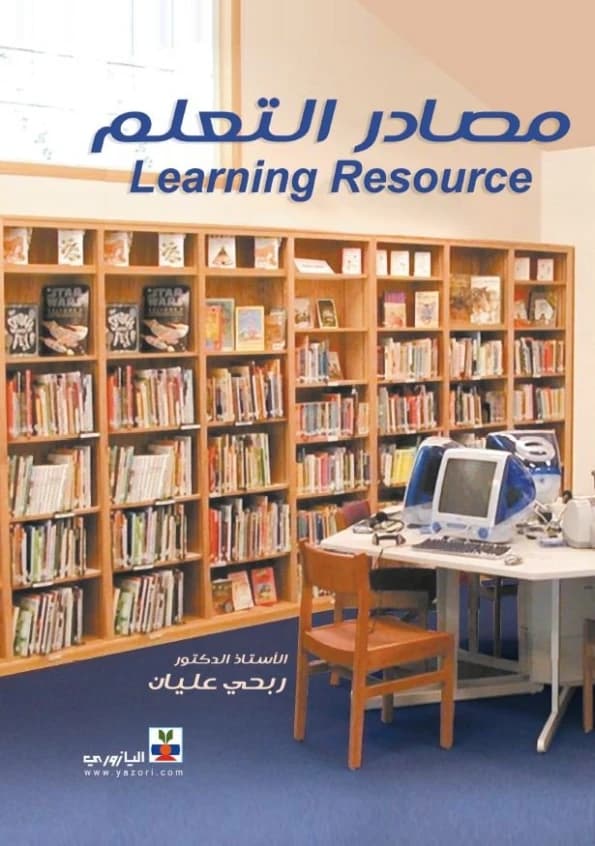
Learning Resources - Dr. Ribhi Alian
JOD

Get it by 5 Aug | Order in 3 Hours 26 Minutes
- Return Policy
- Warranty Policy
- Shipping Policy
- Non contact delivery
- Personal Receipt
- Return Policy
- Warranty Policy
- Shipping Policy
- Non contact delivery
- Personal Receipt
A Learning Resource Center is defined as an integrated system or a specific design for a comprehensive educational environment affiliated with an educational institution (the school). It aims to achieve its objectives by performing a set of functions, processes, and activities, and providing a series of library and information services that serve the learner first and the teacher second. This is accomplished by offering a rich collection of learning and information resources in all their forms, integrating them with the materials, tools, devices, and advanced technologies that technology has provided to develop the teaching and learning process.
Despite the significant role that school libraries of various types have played throughout their long history in supporting the educational process in general and school curricula in particular, they have long relied on traditional vessels of learning and information, especially books and other publications. Attempts to develop and move them beyond this framework faced many administrative and financial difficulties within the educational institution. Even when the school library grew, its growth was cumulative rather than integrative, and it did not play a positive role in introducing modern educational resources, systems, and technologies, which prevented their use by students and teachers. Additionally, the traditional school library overlooked the most important element in the educational process: the learner.
The educational process has recently evolved, with new ideas, theories, and methods in teaching and learning emerging. These emphasize that the best type of learning is one that occurs through experience, creating a desire and motivation in the learner to search for information independently from multiple sources. The school library had to evolve to keep pace with these modern educational developments, theories, and the technology that has entered the educational institution rapidly and forcefully, leading to the idea of developing school libraries into Learning Resource Centers.
It is important to know that the idea of Learning Resource Centers, despite its modernity as a product of the twentieth century, has much older roots. The successive and rapid educational and technological developments of the twentieth century, and the many problems facing the teaching and learning process, led to various parties calling for the establishment of Learning Resource Centers to keep up with these developments, improve the educational process, and create effective learners capable of facing different situations and problems and finding appropriate solutions in a practical and correct manner based on new and diverse sources of information. It must be acknowledged here that both librarians and educators have called for the establishment and development of Learning Resource Centers.
This book addresses the topic of Learning Resource Centers from two main dimensions: the general dimension and the administrative dimension. The book includes ten chapters covering the topic of Learning Resource Centers from all its theoretical and administrative aspects as follows:
- Chapter One: Learning Resource Centers: A Comprehensive Overview.
- Chapter Two: Educational Technology and Instructional Technology.
- Chapter Three: Classifications of Educational Media and Communication Tools (Learning Resources).
- Chapter Four: Planning for Learning Resource Centers.
- Chapter Five: Information Resources in Learning Resource Centers.
- Chapter Six: Organizing Learning Resource Centers.
- Chapter Seven: Staffing in Learning Resource Centers.
- Chapter Eight: In-service Training and Performance Evaluation for Staff in Learning Resource Centers.
- Chapter Nine: Public Relations in Learning Resource Centers.
- Chapter Ten: A Model for a Learning Resource Center.
I hope to have succeeded in presenting a new book to the Arabic library in general, and specifically in the field of libraries and learning resource centers, and that this book fills a genuine gap in both the general Arabic library and the educational library in particular.
Weight: 0.5 kg
Dimensions: 17 x 24 cm
ISBN: 978-9957-12-289-8







