
Download Our App
Shop your way




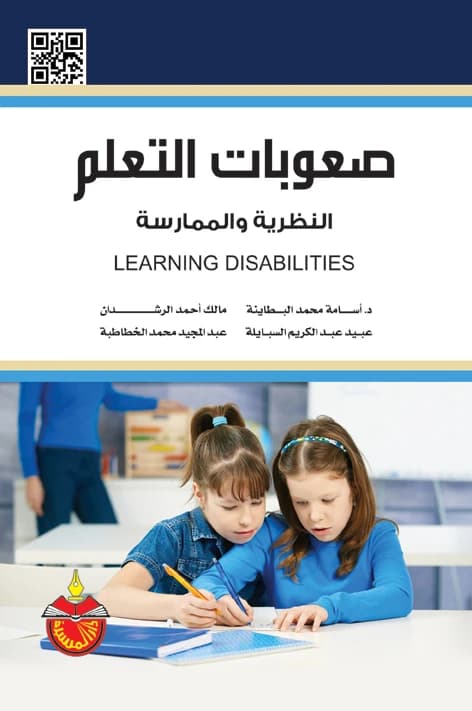
Learning Disabilities: Theory and Practice - Osama Mohammad Al-Batayneh (2018)
JOD

Get it by 5 Aug | Order in 3 Hours 56 Minutes
- Return Policy
- Warranty Policy
- Shipping Policy
- Non contact delivery
- Personal Receipt
- Return Policy
- Warranty Policy
- Shipping Policy
- Non contact delivery
- Personal Receipt
The concept of learning disabilities has been influenced by many medical and other terms that prevailed before its current understanding came into existence. The term evolved through several definitions to the 1990 definition, which states that learning disabilities is a general term referring to a heterogeneous group of disorders manifested by significant difficulties in the acquisition and use of listening, speaking, reading, writing, reasoning, or mathematical abilities. These disorders are intrinsic to the individual and are presumed to be due to central nervous system dysfunction.
Given the importance of this concept and the help it provides to children, parents, and teachers, this book presents the most crucial issues in the field. It covers the historical development of the learning disabilities field and its primary physiological, psychological, organic-chemical, environmental, and educational causes. The book also addresses the concept from a neuropsychological perspective, discussing the functions of the central nervous system and the key characteristics that distinguish children with learning disabilities in cognitive, linguistic, social, and motor domains.
The book also discusses the main types of developmental learning disabilities (attention, memory, perception, thinking, language) and academic disabilities (reading, writing, spelling, written/oral expression, mathematics). It further details methods for detecting, assessing, and diagnosing these difficulties across different school stages, from preschool to high school. The book presents educational strategies and special techniques for teachers to help students overcome learning difficulties in reading, writing, language, math, memory, attention, and thinking, in addition to the important educational services that can be provided.
- Number of Pages: 302
- Year of Publication: 2018
- Binding: Paperback
- Edition: 8
- Printing: Black and white
- Dimensions (cm): 17x24
- Weight (kg): 0.550
- Barcode: 9789957062538







