
Download Our App
Shop your way




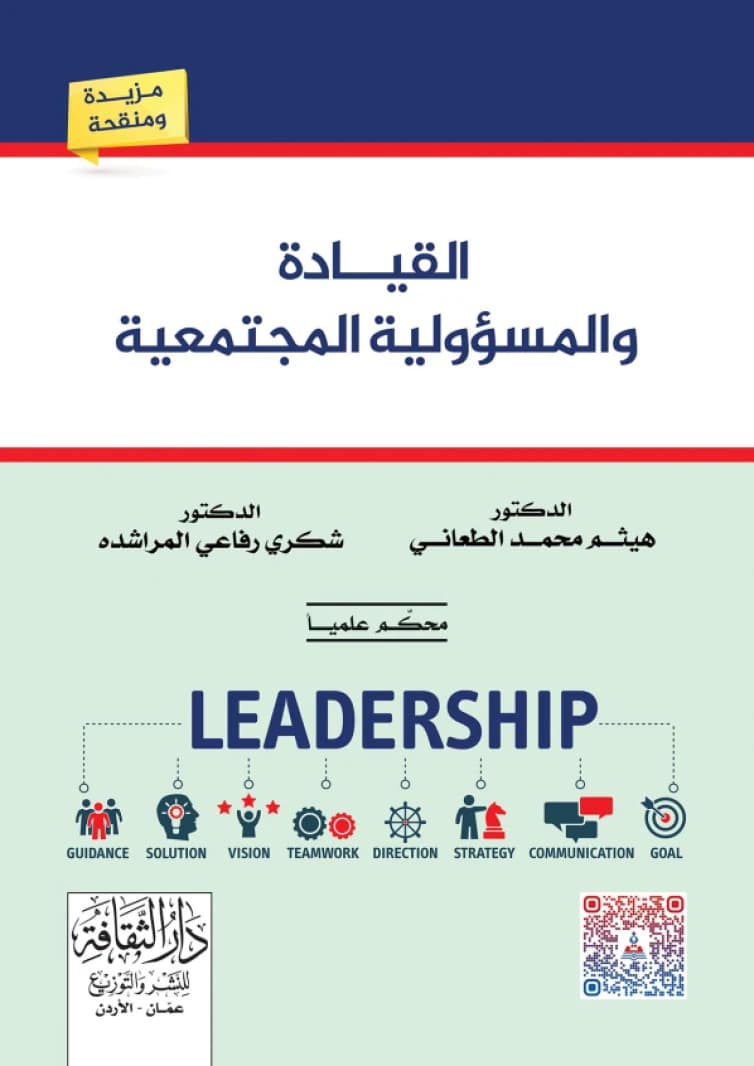
Leadership and Social Responsibility by Dr. Haitham Mohammed Al-Ta'ani
JOD

Get it by 5 Aug | Order in 3 Hours 18 Minutes
- Return Policy
- Warranty Policy
- Shipping Policy
- Non contact delivery
- Personal Receipt
- Return Policy
- Warranty Policy
- Shipping Policy
- Non contact delivery
- Personal Receipt
Leadership is a form of social process that has existed since ancient times and is considered a vital part of life for all humanity. Previous nations, from their inception, had leaders who guided individuals, planned actions, and led the community. It is one of the most complex and enigmatic human phenomena. Leadership forms a crucial axis upon which various public and private activities depend. Thus, the need for leadership arose to achieve aspirations and prevent injustice, chaos, and the loss of rights. All of this is realized when a leader possesses the necessary qualities, an enlightened mind, and conscious thinking, free from dogmatism and close-mindedness, enabling their thinking to lead to the right decisions, and with balance and moderation guiding their leadership of a diverse society with varied cultures.
From this perspective, leadership has attracted the interest of many scientists, philosophers, and writers who began to study it and everything related to it. In light of the interest in the topic of leadership and its branching complexities, definitions of leadership have varied. Some researchers see it as a set of personal traits, others as authority and formality, while others view it as behavior, interaction, and influence on others. Based on this, some researchers emphasized the necessity of a consistent structure according to a specific system to explain this leadership. From here, what is known as leadership theories emerged, which became a guide and director for the leader, an interpreter and supporter of their work, and an aid in achieving their goals and desires, helping to arrive at more accurate predictions and expectations about the work of groups.
Leadership is a topic that has occupied the world since antiquity. Despite the agreement of many researchers and scholars on efficient and effective leadership strategies, what was suitable in the past may not be suitable in the present or the future. Therefore, the interactive and changing business environment has compelled business institutions to continuously adapt to environmental changes, adjust their situations, and experiment with new innovations and creations to ensure their survival. This has required a search for new leadership models that align with these developments, abandon traditional hierarchical structures, and adopt flexible organizational designs characterized by efficiency and a future-oriented approach. Organizations no longer need managers, but leaders who work to persuade those around them of their groups' visions and missions to bring about appropriate change.
In this unit, we will explore leadership in all its detail. This word, common in both ancient and modern times, was famously associated with wars and battles, through which a leader emerges and their personality is highlighted. In our modern era, the world has witnessed significant development in the study of leadership from all its aspects. Many historical figures who demonstrated a high capacity for leadership have been studied, foremost among them the best leader known to humanity, our master Muhammad, peace be upon him.
- ISBN: 9789923152843
- Weight: 0.600 kg
- Dimensions: 17×24 cm
- Paper: White
- Pages: 184
- Year of Publication: 2026
- Cover Type: Paperback







