
Download Our App
Shop your way




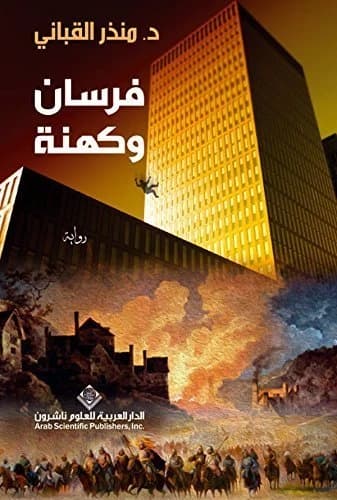
Knights and Priests • Author: Monther Al-Qabbani • 2013
JOD

Get it by 5 Aug | Order in 3 Hours 49 Minutes
- Return Policy
- Warranty Policy
- Shipping Policy
- Non contact delivery
- Personal Receipt
- Return Policy
- Warranty Policy
- Shipping Policy
- Non contact delivery
- Personal Receipt
Few literary works demonstrate the role of literature in history by connecting it to a living human experience and crafting it artistically to achieve both enjoyment and benefit. Dr. Monther Al-Qabbani, however, went further by reviving individual, spatial, and societal memory with elements of reality, documentation, narration, and imagination. He gathered all the elements that define the dialectical relationship between humanity on one hand, and history and narrative creativity on the other.
The 'Knights and Priests' trilogy is a novel project whose temporal structure, spatial setting, and characters are as close to reality as possible. The author built his events from the core of a real historical event (the existence of Genghis Khan) to an imagined, supposed event woven to either realize this reality or create its parallel world (the existence of the physician Murad Qutuz in life and his transition to the afterlife).
The narrative unfolds like a film where the reader is not bound by the constraints of time and place. Instead, the novelist grants them the freedom to view events from any angle and move between them. At one moment, the reader faces the barbarism of the Mongols in the 12th century; at another, they follow a web of intricate social relationships in the high society of masters and slaves in a Riyadh palace in the 21st century.
This narrative technique allows the author to move his characters through time, or have time move around them. Murad Qutuz, the main character, sees his past as if it were happening in the present, leading him to wonder: 'Can I do the same thing? Can I re-watch the events I've been through as if they were live before me?' The answer comes from the novelist, spoken by a character, through a scientific fact proven by experience but often unrealized: '...Reality as a person sees it and reality as it is may not be the same thing.'
Author: Monther Al-Qabbani
Year of Publication: 2013







