
Download Our App
Shop your way




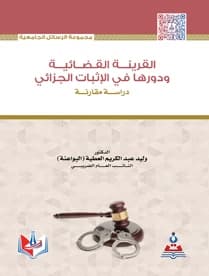
Judicial Presumption and its Role in Criminal Evidence - A Comparative Study by Dr. Walid Abdul Karim Al-Atiyya
JOD

Get it by 5 Aug | Order in 3 Hours 8 Minutes
- Return Policy
- Warranty Policy
- Shipping Policy
- Non contact delivery
- Personal Receipt
- Return Policy
- Warranty Policy
- Shipping Policy
- Non contact delivery
- Personal Receipt
In the name of God, all praise is due to God, and may peace and blessings be upon our master Muhammad bin Abdullah, the trustworthy advisor, the seal of the prophets and messengers, and upon his wives, family, and all his companions. To proceed:
Presumptions have always occupied a significant place in evidence and constitute one of the fundamental pillars for the judiciary to reach a just verdict. Obtaining evidence that directly pertains to the matter under investigation can often be difficult, if not impossible. A judge cannot always arrive at the facts directly, so they resort to their intellect, using the principles of inference and logic to discern the greatest possible amount of those facts in their true form, conforming to reality and truth.
The importance of presumptions in evidence has increased in the present time due to scientific and technological advancements. These advancements have contributed to the discovery of many judicial presumptions, especially scientific ones, which have become the most relied-upon means in criminal justice in our current era. This is particularly true as criminals have resorted to using the most sophisticated means and modern scientific methods to commit their crimes and tamper with the fabric of society without leaving behind traces that could identify them.
Recognizing the importance of judicial presumption and its role in criminal evidence, the researcher has undertaken this topic. The rules of evidence hold immense importance in the branches of law, for a right without supporting evidence is tantamount to nothing. Evidence is what supports a right and makes it prevail, and presumptions hold this importance as they are one of the means of proof stipulated by the legislator and adopted by the judiciary and jurisprudence.
Judicial presumptions are numerous and varied in the field of proving facts. This study focuses on Jordanian law, comparing it with Egyptian and Lebanese law. The researcher intended to address the topic of judicial presumption and its role in criminal evidence due to its great importance in the field, which prompted me to choose this subject, seeking God's help despite the difficulties involved. Researching judicial presumptions involves some risks because exploring the unknown is a matter where opinions and viewpoints may differ, making the work arduous, complex, and in need of precise controls that require intelligence and foresight. However, believing, as the Arabs used to say, that 'pleasure is only attained by the bold,' I have worked as a researcher and scholar to bring this work into existence.
- ISBN: 9789957169749
- Weight: 0.550 kg
- Size: 17x24 cm
- Paper: White
- Pages: 224
- Year of Publication: 2017
- Binding: Hardcover







