
Download Our App
Shop your way




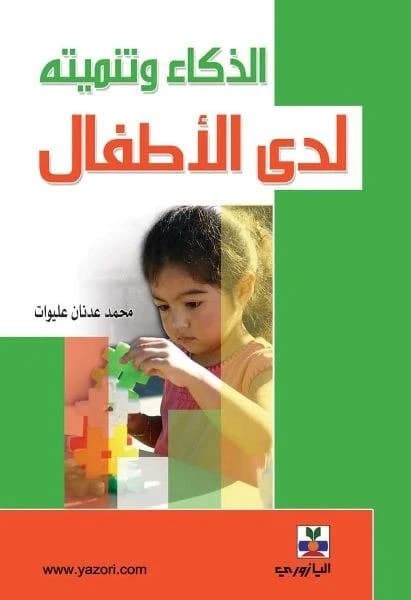
Intelligence and Its Development in Children - A. Mohammad Adnan Aliwat
JOD

Get it by 5 Aug | Order in 3 Hours 36 Minutes
- Return Policy
- Warranty Policy
- Shipping Policy
- Non contact delivery
- Personal Receipt
- Return Policy
- Warranty Policy
- Shipping Policy
- Non contact delivery
- Personal Receipt
The mind is the foundation of righteousness and glory, a guidance from God Almighty to humanity. God has blessed man by guiding him to the two highways, and the mind is what distinguishes humans from all other creatures created by God. Taking care of this mind with what benefits and develops it, increases its perceptions, and broadens its horizons, is a fundamental pillar for building a scientific and cultural renaissance, which is the cornerstone of the desired reform, as well as strength and prestige among the nations of the earth. Knowledge is the path to power, and the required power is all kinds of power, just as the required knowledge is all kinds of knowledge.
From now on, obtaining information will not be a problem for people most of the time, and possessing information will not be a fundamental difference between nations and individuals in the future. The major differences will come from people's skills in using, analyzing, and employing information. Therefore, developing children's mental skills will gain additional importance.
Developing the Mental Aspect in Children:
- Although intelligence and the strength of the mind are a gift from God, it is the attention given to this gift that develops, refines, and brings it forth. Neglecting this gift causes it to diminish and fade. How often have we seen in our lives an intelligent person who is a burden to himself and his nation because this intelligence was not directed in a way that could develop it on the right and righteous path.
- The mental aspect of a child can be developed by providing appropriate stimuli for mental growth and fostering the motivation for it.
- Paying attention to answering a child's questions in a manner appropriate to their mental age, teaching them how and when to ask, and training them to formulate good questions.
- Focusing on purposeful educational stories, preferably realistic ones, and not exaggerating with fantasy stories - despite their importance in expanding a child's imagination - so as not to distort the surrounding realities and to strengthen their mental growth.
- Developing diverse experiences and utilizing them to enhance the child's various abilities, while providing opportunities to practice different and similar things to perceive their similarities and differences.
- Nurturing and encouraging thinking, creating a conducive intellectual atmosphere, and providing real-life experiences and sound guidance often help a child form correct concepts about things and help this formation to be clear, organized, and effective, leading to a strong approach to problem-solving.
- Starting with tangible things with children and gradually moving to abstract concepts.
- The family can lay the first foundation in the child's mental construction by teaching the child to develop their mental skills through play, through their relationships with family at home, as well as during outings, and with neighbors' children and schoolmates.
The Mosque and its Role in Developing a Child's Intelligence:
The mosque has a very significant role in the mental development of the child. It is linked to memorizing the Holy Quran, the child's attempt to understand some meanings, asking about some stories, and trying to benefit from some Quranic guidance, which has the greatest impact on the child's serious mental growth. It is also linked to the issue of prayer, its order, knowing its times, how to perform it, and trying to understand the words of the speaker and the teacher, which develops good and important faculties in the child. It also positively affects their cultural and moral development, especially if the mosque has a library that includes the biographies of the Companions and the Prophet (peace be upon him) and clarifies the decisive battles of Islam and some morals and ethics.
The Importance of the Mind in Islam:
In Islam, the mind is a condition for bearing responsibility and being commissioned. Whoever lacks a mind is not responsible for their actions. The Messenger of God (peace be upon him) said: (The pen has been lifted from three: from the sleeper until he awakens, from the child until he grows up, and from the insane until he regains his sanity or recovers). Islamic education, to achieve its ultimate goal of worshipping God Almighty, submitting to Him, and contemplating His power and greatness, urges the nurturing, shaping, and development of the mind to benefit from everything God has created in this universe and to develop it.
Children and Intelligence:
Intelligence is the ability to perceive the relationship between things, the ability to be creative and innovative, the ability to learn, think, understand, comprehend, remember, feel, solve problems, and perform a task of some difficulty or complexity. As we mentioned, intelligence is innate and inherited, but the environment and surrounding conditions also play a role in increasing intelligence levels, as well as through acquired experiences, information, and knowledge.
Intelligence can be increased through the following:
- Education: With continuous schooling, the degree of practical ability increases more than in those who do not learn, do not complete their education, or who obtain an intermediate qualification. Education has a clear effect on the extent of a person's intellectual understanding.
- Healthcare: There is a correlation between the child's health status and their mental level. Mental growth depends on the health and flexibility of the nervous and endocrine systems.
- Nutrition: Proper nutrition containing the necessary nutrients for the body affects the growth of cells in the brain and elsewhere, especially during childhood.
- Sports: Some studies have shown a positive relationship between high intelligence and better physical growth in children, from early childhood to the end of adolescence, due to care factors such as nutrition and playing sports. On the other hand, some studies have revealed an inverse relationship between poor physical growth and academic achievement.
- Emotional Stability: Increased noise, quarrels, and violent films negatively and significantly affect mental abilities, unlike emotional stability and calmness, which provide the ideal atmosphere for mental growth.
- Encouraging Innovation and Creativity: When we encourage a child who comes up with a good idea, they will come up with a better one. This is very important, as the nation lacks this type of thinking that children should be trained on from a young age.
- Play: In early childhood, it is one of the most important areas of learning and growth, serving as an entry point for the child's activity at this stage. Play also develops our children's creative abilities. Muslims have linked play and intelligence. Al-Ghazali says: 'Forbidding a boy from playing and exhausting him with constant teaching kills his heart and dulls his intelligence.'
- Hobbies and Recreational Activities: These are the best investment of a child's free time, which affects the development and growth of their personality, providing them with many moral, health, physical, and artistic benefits. Recreational activities such as trips, camps, scouting, and team games have a great impact on acquiring experiences and developing skills and abilities.
- Reading and Study: A scientific book, in particular, helps to develop intelligence, develops the child's mind, and cultivates creative abilities. Knowledge and reading give the child a true awareness of life, nature, the self, society, history, and of God, the Creator of the entire universe.
Children have special psychological and mental characteristics, delicate feelings, and a strong desire to learn and explore. Therefore, they need educational, cultural, and recreational material that is free from religious prohibitions and presents a purposeful Islamic message. It is important for parents to set up a home library - even a small one - to help foster a love of reading in children and plant the seeds of self-learning in them. It is also necessary to take children to libraries and book fairs, spend money when they want to buy a book, encourage them to do so, and allow them to choose the stories they will read, with selection, follow-up, and guidance.
- Weight: 0.55 kg
- Dimensions: 17 x 24 cm
- ISBN: 978-9957-12-052-2







