
Download Our App
Shop your way




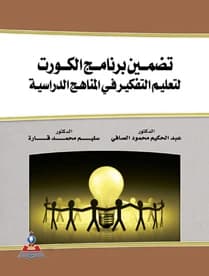
Integrating the CoRT Thinking Program into School Curricula by Dr. Abdul Hakim Safi
JOD

Get it by 5 Aug | Order in 3 Hours 48 Minutes
- Return Policy
- Warranty Policy
- Shipping Policy
- Non contact delivery
- Personal Receipt
- Return Policy
- Warranty Policy
- Shipping Policy
- Non contact delivery
- Personal Receipt
De Bono, the author of the CoRT Thinking Program, states that many teachers of CoRT lessons have noticed that some students, previously seen as academically challenged, have suddenly and surprisingly shown themselves to be effective thinkers. They astonish their teacher, their peers, and sometimes even themselves. This observation aligns with the experience that children who excel academically do not necessarily continue to do so, as the academic framework may no longer apply to their later lives. One could say that academic success requires a specific set of abilities: the capacity for understanding, connecting ideas, verbal fluency, clarity of expression, an imaginative ability to handle complex situations, address challenging problems, and a keen interest in the subject matter.
Many students who were weak in reading were found to have poor eyesight, preventing them from seeing the letters clearly. With such a handicap in the 'input', it is not surprising that some children are effective on the 'output' side. This is likely the case in most school curriculum subjects. Therefore, should the focus be solely on the input, leaving the student who lacks in this area perpetually weak in output?
Naturally, we can separate the effectiveness of the input from the output. In CoRT thinking lessons, students are asked to apply thinking processes to their own experiences or to visual experiences that stimulate the imagination of all students. Here, their thinking is not just their store of knowledge or ability. Therefore, in such situations, students who were perceived as low achievers suddenly excel. Their resulting effectiveness ('output') may appear to far exceed their input effectiveness. The difference in thinking between children with a high IQ (over 140) and those with a low IQ is not as significant as assumed when they are applying general experience.
ISBN: 9789957161286
Weight: 0.800 kg
Dimensions: 17×24 cm
Paper: White
Pages: 432
Year: 2010
Binding: Hardcover







