
Download Our App
Shop your way




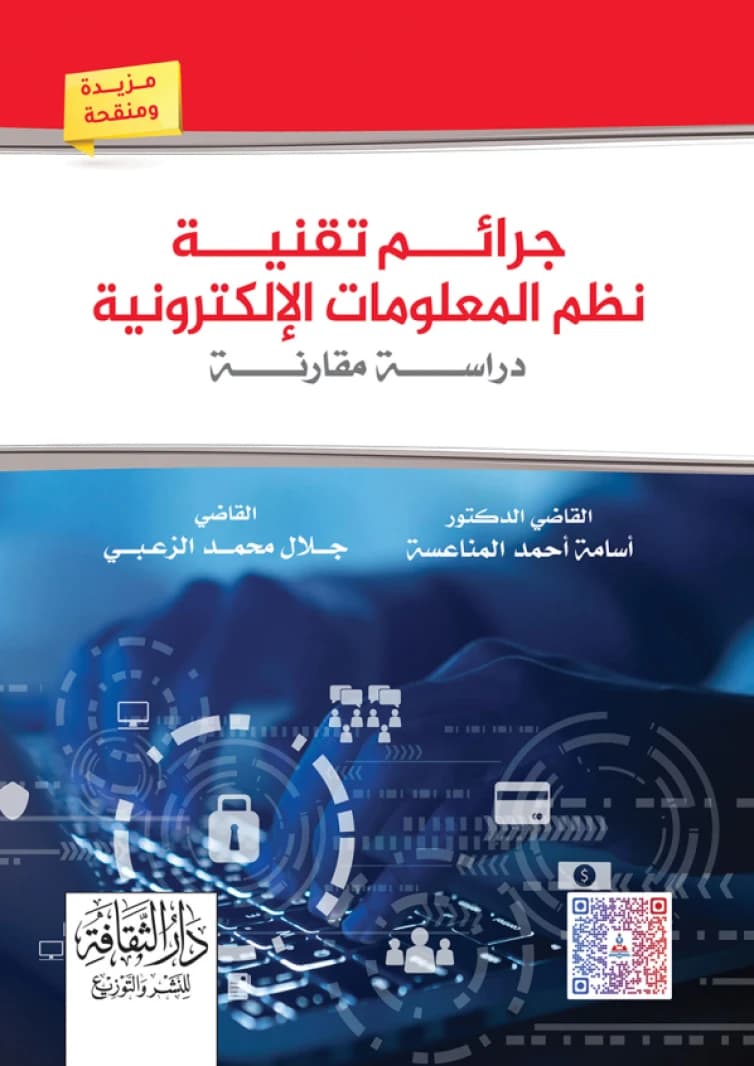
Information Systems Technology Crimes - A Comparative Study by Dr. Osama Ahmed Al-Manas'ah
JOD

Get it by 5 Aug | Order in 3 Hours 44 Minutes
- Return Policy
- Warranty Policy
- Shipping Policy
- Non contact delivery
- Personal Receipt
- Return Policy
- Warranty Policy
- Shipping Policy
- Non contact delivery
- Personal Receipt
The idea behind this work is both old and new, constantly renewing itself. Since 2002, we have conducted numerous diverse studies and research on the phenomenon of modern crime and the repercussions of the information technology revolution on the general theory of crime—whether in terms of structure, elements, or legal adaptation and the fundamentals of criminal prosecution. Last year, we were tasked by the Jordanian Ministry of Justice to study the draft Arab Convention on Combating Information Technology Crimes and to provide our opinions, both positive and negative. This was a preliminary step towards its adoption by Arab countries, positioning the convention as a legal cornerstone for Arab penal codes to evolve from their traditional, inadequate forms—which rely on the material aspects of negative behavior—to new legislation capable of understanding modern crime, its elements, nature, and characteristics within clear criminal frameworks and with deterrent penalties that address the following:
- First: Understanding the non-physical behavior upon which information systems technology crimes are based.
- Second: The immense negative impact resulting from the criminal behavior.
- Third: The existence of a new and modern environment for crime and criminal behavior, completely different from the traditional environment.
- Fourth: The inadequacy of traditional punishment and its minimal effects in comparison.
- Fifth: The weakness of the legal classification framework and its failure to accommodate new criminal forms.
Hence, the idea emerged to establish general foundations and detailed concepts for the phenomenon of modern crime, addressing its definition, nature, and its special and exceptional elements. This includes a necessary study of the crime environment, its forms, and its manifestations in practice, with a full explanation of the new concepts associated with this phenomenon, such as the cybercriminal, the cyber victim, the information environment (the crime scene), and technical criminal behavior, followed by a clarification of the forms and shapes that modern crime has taken.
The research here is based on the following principles:
- First: The belief in the existence of a new criminal phenomenon that has accompanied the massive developments in information systems technology and the global communications revolution and its tools.
- Second: The existence of a new criminal environment in all its details, which has impacted the traditional pillars of crime in terms of the criminal act, the perpetrator, or the victim.
- Third: The inability of traditional criminal frameworks to accommodate new behavioral patterns in a modern electronic environment.
- Fourth: The delay of penal legislators in Arab countries in comprehending the crime in question, recognizing its different nature, and consequently, accepting the need for a new criminal framework and the inability of traditional ones to cover and punish the new behavior.
The study's focuses were therefore as follows:
Axis One: We address the general theory of crime as a necessary preliminary introduction for a proper subsequent understanding of modern crime. We explain the technical aspects of the crime environment, including the concept of the computer, its mechanisms, components, and capabilities, followed by a detailed explanation of the global network—the internet—as a tool for crime, covering its concept, mechanisms, types, and characteristics. We also discuss communication networks and telecommunication technologies, both domestic and global. We then delve into modern crime—information systems technology crime—through the general theory of crime, explaining its concept, elements, forms, the nature of criminal responsibility and its conditions. This is followed by a discussion on the modern legal jurisprudence surrounding it and attempts to establish a general concept capable of encompassing all elements of this crime comprehensively. This is followed by an explanation of the new terminologies introduced by the information technology revolution to the theory of crime, including the cybercriminal, their characteristics and role in bringing the crime into existence, and the cyber victim and their role in the crime and its prevention.
Axis Two: This section discusses technology crimes with a financial aspect, as the most common and impactful types of information systems technology crimes are those directly or indirectly related to financial assets, whether belonging to individuals or public and private economic institutions. The discussion covers electronic currency, how it is replacing traditional currency, its transaction mechanisms, and the various criminal activities, responsibilities, and consequences involved. The technology crimes related to funds that are discussed in detail are:
- Cyber Breach of Trust
- Cyber Vandalism
- Cyber Theft
- Cyber Forgery
- Cyber Money Laundering
- Crimes against Computer Software
- Credit Card Crimes
Axis Three: Following the same approach, this axis addresses another category of modern technology crimes: telecommunications crimes. Here, we cover:
- Crimes against the private lives of individuals
- Internet crimes related to minors
- Telecommunication systems crimes
- Cyber Espionage
- Cyber Terrorism
- Cyber Defamation
In the near future, God willing, this will be followed by a complete conceptualization of criminal procedures for information systems technology crimes, in addition to the principles of presenting, extracting, and admitting criminal evidence. The discussion on information systems technology crimes is ongoing. With every delay in enacting the necessary new legislation to confront and combat this crime, the phenomenon becomes more dangerous, the negative impacts of the information technology revolution expand, and perpetrators become more audacious, while the losses of victims—be they individuals or institutions—multiply. This calls for greater efforts to combat this phenomenon and prosecute the perpetrators.
Finally, modern crime unfortunately remains captive to the traditional penal perspective of our Arab legislators. Despite research, studies, and conferences, it is still seen as part of traditional legislation, which is a direct cause for the lag in our penal laws compared to their foreign counterparts. The Jordanian penal legislation specifically is not far from other Arab legislations; it stands at the same distance from modern crime. Penal texts that show a new dimension with an effect on traditional crime are few, if not rare, and their impact remains modest given the enormous development that comparative penal laws have witnessed in proving modern crime and highlighting it with special provisions, and even special laws that consider its characteristics, methods, and new technologies, creating suitable criminal frameworks and deterrent penalties for it. Attempts by Jordanian penal legislation have not gone beyond mentioning technology crime in some texts, such as: 1. Insulting His Majesty the King committed through electronic means (Article 195 of the General Penal Code No. 16 of 1960 and its amendments). 2. Violation of communication means through illegal behaviors based on communication systems technology as stipulated in the Jordanian Telecommunications Law, such as Articles (74) and onwards. We, however, are not satisfied with this. The Jordanian and other Arab penal legislators must stop treating technology crime as a form of traditional crime and must rise to their solemn responsibilities to enact penal legislation appropriate to the nature of modern crime, its forms, and the characteristics of its punishment with provisions and laws that consider the situation. This is a goal and a modest contribution from us in this book that addresses all of this.
After all, no matter what we say, there is always more to be said. Our work, like any human endeavor, is not free from mistakes, slips, and oversights. If there are any, they are from us, and we regret them. A person is not immune to error unless God protects him with His guidance, which we hope for and strive towards. If there is any benefit in it for the researcher and the reader, however small or great, it is from God alone.
- ISBN: 9789957165574
- Weight: 0.900 kg
- Dimensions: 17×24 cm
- Paper: White
- Pages: 344
- Year of Publication: 2022
- Binding: Hardcover







