
Download Our App
Shop your way




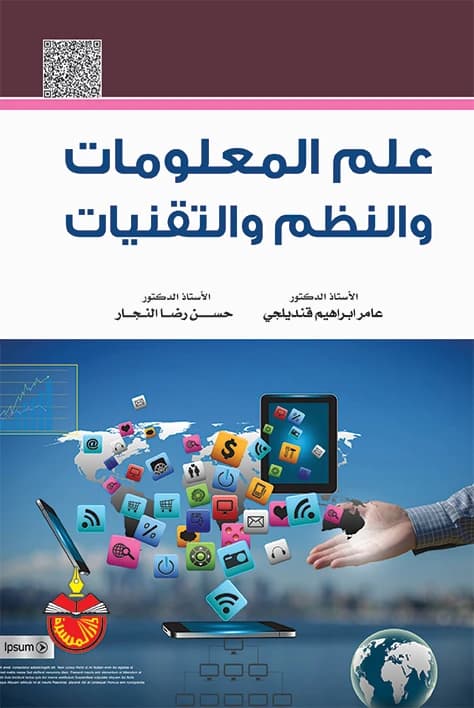
Information Science, Systems, and Technologies - Hassan Reda Al-Najjar
JOD

Get it by 5 Aug | Order in 2 Hours 39 Minutes
- Return Policy
- Warranty Policy
- Shipping Policy
- Non contact delivery
- Personal Receipt
- Return Policy
- Warranty Policy
- Shipping Policy
- Non contact delivery
- Personal Receipt
It is worth remembering, first, that information and humanity are inseparable. Since their existence on this earth, humans have needed information. They have used it to adapt their lives, on one hand, and to conquer the forces of nature that largely controlled them and their surroundings, on the other. On this basis, humans, even in caves, sought to transmit their life experiences to subsequent generations through drawings and pictorial writings on walls, depicting the natural phenomena they encountered, for example, which hindered their normal life. However, when humans decided to be an active element in building the earth and sustaining life, they emerged from their caves to become producers, after being consumers of the natural resources God bestowed upon them and other creatures, starting with agriculture to produce food. This transition pushed them into a new era, called the Agricultural Age, which required them to collect and store abundant and in-depth information about the situations they had to manage in solving the problems they faced in agriculture. On this basis, we can say that the importance of information for humanity emerged. Later, specifically in the Industrial Age, humans needed a great deal of information about management, as it is the backbone of industry. They became aware of this and began to innovate and develop many laws in the science of management, which were based on information. As for the current era we live in, it has gone even further, rightfully being named the Information Age. Information has become one of the important commodities produced by advanced societies, primarily to support their educational, research, and even economic programs. Thus, information has taken a large part of the budgets of these societies, especially in advanced countries. Based on the foregoing, the importance that information occupies in our current era has made it a science taught in many international universities. From this standpoint, we found it our duty to contribute to informing researchers, students, and decision-makers about the importance of information in various aspects of life. This book, titled "Information Science, Systems, and Technologies," includes seven chapters. The first chapter is dedicated to defining information, its importance, characteristics, types, and systems, as well as the information revolution and its positive and negative impacts. The second chapter, titled "The Role of Information in the Movement of Contemporary Society," contains several axes, including the definition of the concept of the Information Age, its features and data, the relationship of information to scientific research on one hand, and to successful management on the other. It also covers the positive and negative features of contemporary information society and information problems. The third chapter contains an extensive presentation of the concept of information technology, the internal and external elements of the information technology system, the required technological environment, and technological illiteracy and what it means for the reader and researcher, as well as the process of decision-making through leveraging the capabilities of information technology and knowledge. It also defines compact laser discs, multi-purpose containers, and their stages of development. The fourth chapter is dedicated to defining information retrieval systems, information management systems, the different forms of information retrieval systems, and their evaluation. The fifth chapter is devoted to computerized information sources, defining them, their types, trends, and the justifications for moving towards them, as well as the problems of dealing with them. Since we have entered the topic of computerized information, it is necessary to move on to the famous global information network, the "Internet," defining it, its features and limitations, the requirements for connecting to it and benefiting from its information and services, and its applications, which is the subject of the sixth chapter. The seventh and final chapter is dedicated to the topic of information marketing, including the definition of the concept of information marketing, its justifications, and the types of information that can be marketed and promoted, as well as how to build a strategy for marketing information.
- Number of Pages: 256
- Year of Publication: 2015
- Binding Type: Hardcover
- Edition Number: 1
- Printing Color: Black
- Size (cm): 17x24
- Weight (kg): 0.550
- Barcode: 9789957970055







