
Download Our App
Shop your way




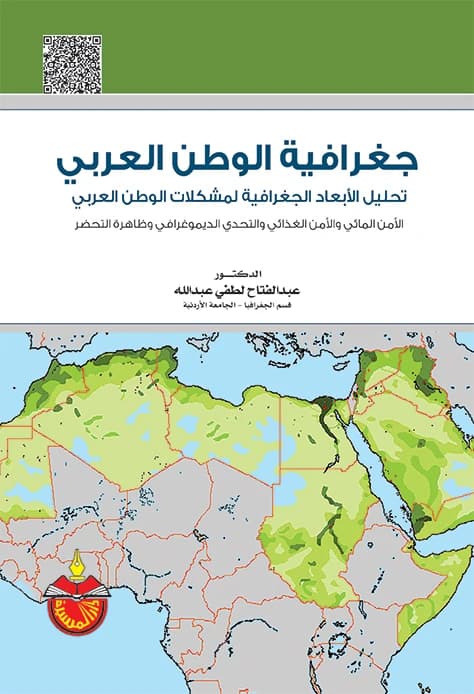
Geography of the Arab World - Abdulfattah Lutfi Abdullah - 2015
JOD

Get it by 5 Aug | Order in 3 Hours 15 Minutes
- Return Policy
- Warranty Policy
- Shipping Policy
- Non contact delivery
- Personal Receipt
- Return Policy
- Warranty Policy
- Shipping Policy
- Non contact delivery
- Personal Receipt
Most works on the geography of the Arab world have been compiled within a regional framework, where the Arab region is divided into several sub-regions to discuss or research natural geographical phenomena (geomorphological, climatic, natural vegetation, wild animals, or soil) and human geographical phenomena (demographic, urban, and economic such as agriculture, industry, trade, tourism, transport, and communications). In this book, a different approach has been followed because the author believes that the division of the Arab world into a number of regions in previous works was done arbitrarily with excessive generalization. The frameworks and components of the natural geographical regions of the Arab world are not the same as its agricultural regions, which in turn differ from the divisions of the Arab world into regions based on ethnic composition, religious affiliation, or other considerations or foundations.
The methodology used in this book focuses on studying core geographical issues (water security, desertification, food security, demographic challenges, and the problem of urbanization within the natural framework of the Arab world), which in turn leads to the crystallization of an organizational framework for the author. In each geographical topic, the relationships and interactions between the population and the natural environments in which they are concentrated have been studied and highlighted. Each geographical factor, whether natural (climatic) or human (economic), will contribute to creating a harmonious mosaic of geographical zones in the Arab world. The main focus of this work is to investigate the changes that occurred in the Arab world during the second half of the twentieth century in order to understand how the population of the Arab world affects and is affected by their natural environment.
Each chapter of this book includes the main ideas of the topic it covers, presenting relevant examples. At the end of each chapter, a summary of the most important contents is provided. A set of analytical (written) questions and multiple-choice questions (objective question model) have been prepared to analyze the most important concepts reviewed in each chapter, which will help students verify their understanding of the chapter's material. At the end of each chapter, a list of references is included, containing the most important names of books and research published in journals or scientific periodicals related to the topics of the book's chapters, which can help expand the reader's horizons when investigating the topics of the book's chapters if they wish to study them in depth later.
This book is presented in two parts, comprising eleven chapters. The first part includes six chapters focusing on the natural framework of the Arab world, its astronomical and relative location, its topographical patterns, climate, soil types, and its plant and animal composition. The second part includes chapters that address issues of water and food security, desertification, demographic development, and the dimensions of urbanization, with a focus on its varying levels and an analysis of the resulting consequences in different countries of the Arab region. The chapters of this book include a number of tables, maps, drawings, and graphs to clarify, explain, and analyze the geographical dimensions of the issues they cover. I take this opportunity to thank PhD student Ibrahim Bzazo for preparing the final draft of the figures and maps using AutoCAD and Geographic Information System (GIS) programs.
- Number of Pages: 304
- Year of Publication: 2015
- Binding Type: Cardboard
- Edition Number: 3
- Printing Color: Black
- Dimensions (cm): 17x24
- Weight (kg): 0.600
- Barcode: 9789957062934







