
Download Our App
Shop your way




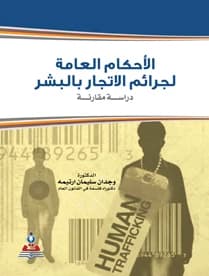
General Provisions for Human Trafficking Crimes - A Comparative Study by Dr. Wijdan Suleiman Artimeh
JOD

Get it by 5 Aug | Order in 5 Hours 12 Minutes
- Return Policy
- Warranty Policy
- Shipping Policy
- Non contact delivery
- Personal Receipt
- Return Policy
- Warranty Policy
- Shipping Policy
- Non contact delivery
- Personal Receipt
This study aimed to clarify the extent of compatibility between the provisions of crimes mentioned in the Jordanian Law for the Prevention of Human Trafficking No. (9) of 2009 and the general provisions of crime. This is examined in light of the United Nations Protocol to Prevent, Suppress and Punish Trafficking in Persons, Especially Women and Children, supplementing the United Nations Convention against Transnational Organized Crime of 2000, and some Arab and foreign national legislations.
This study addressed the nature of human trafficking, indicating that the slave trade is the historical basis for human trafficking. The study discussed the qualitative shift that occurred in international legal thought, from the traditional concept of slavery to the concept of human trafficking.
The study also covered the concept, causes, and effects of human trafficking. Under the title of the specificity of human trafficking, the study clarified the characteristics of human trafficking crimes, the distinction between human trafficking crimes and the crime of migrant smuggling on one hand, and the similarities and differences between human trafficking crimes and other traditional crimes that resemble them on the other.
The study also examined the legal model for human trafficking crimes. Within the common provisions for these crimes, the study identified the subject of the crime, the acts and means constituting the material element (actus reus) of human trafficking crimes. It addressed the provisions of attempt and criminal complicity in human trafficking crimes, pointing out that the Jordanian legislator did not include specific provisions for them and subjected them to general rules, unlike the legislations under study.
The study showed that while human trafficking crimes share the same subject of crime and material element, they differ in the forms of exploitation and criminal intent (mens rea). This was researched by the study within the special provisions for human trafficking crimes.
The study addressed the nature of the moral element (mens rea) in human trafficking crimes. It highlighted the issue raised by the phrase 'for the purpose of their exploitation' found in Article 3/b of the Jordanian Law for the Prevention of Human Trafficking, and its corresponding texts in the Palermo Protocol and the national Arab legislations under study, regarding the necessity of a special element in human trafficking crimes, which is the intent to exploit.
The study indicated that the Palermo Protocol did not define the term 'exploitation' but rather listed forms of exploitation as examples, not exhaustively, to allow national legislators to add other forms of exploitation. The study classified the forms of exploitation into three groups: sexual exploitation, labor exploitation, and organ removal.
Regarding criminal liability for human trafficking crimes, the study showed that the Jordanian legislator, in the Law for the Prevention of Human Trafficking No. 9 of 2009, considered these crimes originally as misdemeanors, which are intensified to become felonies under certain circumstances. It reviewed the penalties imposed on natural persons, and the conditions for aggravating, mitigating, or exempting from punishment in human trafficking crimes. The study also examined the liability of legal persons for human trafficking crimes, indicating that the Jordanian legislator considered the liability of a legal person for such crimes to be indirect criminal liability.
The study concluded with several findings and recommendations centered on the necessity of reviewing the Law for the Prevention of Human Trafficking No. 9 of 2009.
ISBN: 9789957168551
Weight: 0.900 kg
Dimensions: 17x24 cm
Paper: White
Pages: 408
Year of Publication: 2014
Binding: Hardcover







