
Download Our App
Shop your way




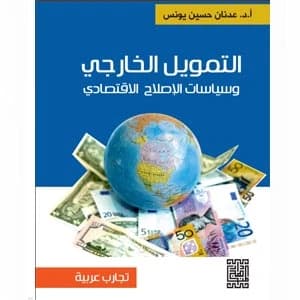
External Financing and Economic Reform Policies
JOD

Get it by 5 Aug | Order in 3 Hours 31 Minutes
- Return Policy
- Warranty Policy
- Shipping Policy
- Non contact delivery
- Personal Receipt
- Return Policy
- Warranty Policy
- Shipping Policy
- Non contact delivery
- Personal Receipt
Page count: 288, Publication year: 2020, Binding type: Hardcover, Edition: 1, Print color: White, Dimensions (cm): 17×24, Weight: 0.594 kg, Barcode: 9789957182816.
Weight: 594 grams, Dimensions: 17 × 24 cm.
Introduction
The issue of external financing is closely linked to economic development challenges and has gained prominence internationally, especially in the context of contemporary global changes affecting developing countries' economies. Despite its historical roots in dependency and unequal exchange relationships between developing and developed capitalist countries, it has acquired new dimensions in the context of financial globalization. International institutions propose economic reform policies that align with global trends to integrate developing nations' economies with the global capitalist economy, including privatization programs and attracting foreign investments.
This book explores the relationship between external financing and economic reform policies of the International Monetary Fund, examining their role in correcting economic imbalances in selected Arab countries (Egypt, Jordan, Tunisia), highlighting the increased reliance on external financing and the widening scope of financial resource gaps.
The issue for some Arab countries lies in their increased dependence on external financing, whether through loans or foreign investments, connected to reform policies as per international institutions' formulations. These contribute to stronger ties between Arab and global capitalist economies, amidst ongoing financial burdens and economic dependencies.
Built on the hypothesis that external financing and related economic reform policies in Arab reform countries exacerbate development problems and impact national development strategies, the book seeks to evaluate the capacity of external financing and reforms to correct economic imbalances, and their impact on the development status and dependency in these countries.
The book combines the deductive approach regarding theoretical aspects of external financing with the inductive approach focusing on practical aspects in selected Arab countries, using economic facts and statistical data to offer conclusions and recommendations.
The book comprises three chapters: The first chapter addresses (Basic Approaches to External Financing in Developing Countries) through three sections dedicated to the conceptual framework, the relationship with capitalist economy correction mechanisms, and the connection with economic reform policies. The second chapter discusses (External Financing in Some Arab Reform Countries), examining loans and foreign investments in Egypt, Jordan, and Tunisia. The third chapter analyzes (Effects of External Financing and Reform on Economic and Social Variables in Arab Reform Countries) through four sections, focusing on economic indicators, external debt, financial resource gaps, and social effects.
Prof. Dr. Adnan Hussein Younis
International Economics Professor
Technical Education Commission – Iraq







