
Download Our App
Shop your way




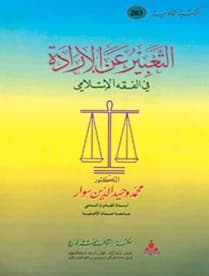
Expression of Will in Islamic Jurisprudence by Prof. Dr. Muhammad Wahid al-Din Suwar
JOD

Get it by 5 Aug | Order in 5 Hours 11 Minutes
- Return Policy
- Warranty Policy
- Shipping Policy
- Non contact delivery
- Personal Receipt
- Return Policy
- Warranty Policy
- Shipping Policy
- Non contact delivery
- Personal Receipt
Modern legal systems are divided between two tendencies: a subjective tendency that prioritizes the personal element in commitment, celebrates the contractor's inner will in actions, and relies on subjective criteria that depend on hidden intent. And an objective tendency whose laws run contrary to this, prioritizing the material element in commitment, celebrating the contractor's apparent will in actions, and relying on objective criteria that depend on custom and common practice. Our concern in the following research is to determine the position of Islamic jurisprudence (Fiqh) on these two tendencies regarding the expression of will. Does it align with the theory of apparent will, as can be inferred from the explanatory memorandum of the draft Egyptian Civil Code (the origin of the Syrian Civil Code) during its justification for the project's bias towards apparent will? Or does it, on the contrary, lean towards the inner will as stated by some researchers? The importance of this answer becomes clear when we know that the issue addressed in this thesis is one of the fundamental issues over which there has been intense disagreement in the field of civil law, with the conflict extending beyond theoretical jurisprudential debate to practical application in legal systems.
Also evident is the importance of this answer in the field of comparative legislation. Islamic jurisprudence has become a subject of interest for legal professionals in the West ever since Professor Lambert, the renowned French jurist, declared his great appreciation for Islamic jurisprudence at the International Congress of Comparative Law held in The Hague in 1932. Subsequently, the resolutions of the 1937 Hague Congress of Comparative Law recognized the vitality of Islamic Sharia, its capacity for development, its independence from other legislations, and its suitability as a general source of legislation. Similarly, the resolutions of the International Bar Association conference held in The Hague in 1948 also acknowledged the flexibility and importance of Islamic legislation, recommending that the International Bar Association adopt and encourage the comparative study of this legislation. Finally, this interest is manifested in the conferences organized by the Eastern Law section of the International Academy of Comparative Law under the name "Islamic Jurisprudence Week." The last of these was held on July 23, 1952, at the Faculty of Law, University of Paris, chaired by Professor Millot, a professor of Islamic jurisprudence at that faculty. The conference issued a resolution recognizing the undeniable legislative value of the principles of Islamic jurisprudence, and the wealth of legal concepts and admirable craftsmanship embodied in the diversity of jurisprudential schools within this great legal system, enabling this legislation to meet the demands of modern life and adapt to its needs.
Research Methodology: In this thesis, we have adopted an objective, historical, and comparative approach. It is objective because it relies primarily on the texts. Accordingly, we do not start with a theory to guide the interpretation of the texts; rather, our starting point is the texts themselves, from which we derive our understanding. Through them, we extract the Islamic jurisprudential system we are studying. Thus, our goal is not a quick reconciliation between systems; instead, we will study the Islamic jurisprudential system according to its own spirit, preserving its unique starting point. This sound approach was previously followed by our esteemed professor, Dr. Abd al-Razzaq al-Sanhuri. It is a historical method where we did not limit ourselves to the commonly circulated books of later scholars but extended our view to the seminal works of jurisprudence from the distant past to draw texts from their pure and original sources, before they could be altered or changed by transmission. We will see the fruits of this method particularly when we investigate the condition of permission in offer and acceptance. It is a comparative method that is not limited to Islamic jurisprudence but also covers positive law, and it is not confined to one school of thought but encompasses all schools. This is because limiting ourselves to one school does not, in our view, provide a complete picture of the reality of Islamic jurisprudence. To clarify this reality, all schools must be studied to understand the vast legislative shade under which the Islamic world sought refuge, meeting its needs in the best and most complete way. We will rely on the school of thought closest to the spirit of the two main sources, the Quran and the Sunnah, as closeness to these sources provides salvation from the occasional deviation from the principle of justice and excessive reliance on the stability of transactions that can affect jurisprudential craftsmanship. We will not neglect the science of Usul al-Fiqh (Principles of Islamic Jurisprudence) as some researchers before us have done, as we believe it is not without benefit in studying texts, and we have indeed seen this benefit in more than one topic in this research. We must also mention the renewal we have introduced to some legal terms, with our excuse being that these terms have not yet been established by custom and should not be settled before undergoing criticism and scrutiny.
- ISBN: 9789957160000
- Weight: 1.200 kg
- Size: 17×24 cm
- Paper: White
- Pages: 780
- Year of Publication: 1998
- Binding: Paperback







