
Download Our App
Shop your way




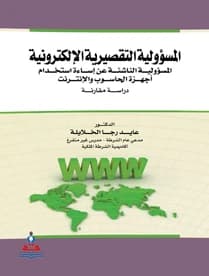
Electronic Tort Liability: A Comparative Study by Dr. Ayed Raja Al-Khalayleh
JOD

Get it by 5 Aug | Order in 3 Hours 55 Minutes
- Return Policy
- Warranty Policy
- Shipping Policy
- Non contact delivery
- Personal Receipt
- Return Policy
- Warranty Policy
- Shipping Policy
- Non contact delivery
- Personal Receipt
Liability, in general, is defined as holding a person accountable for an impermissible act or omission. In other words, it is a penalty for a person's violation of one of the duties incumbent upon them, which can be duties sourced from the law or duties imposed by society on an individual as a being living within it.
If a person breaches a social duty, the resulting liability is moral, and the penalty for this type of liability does not exceed societal disapproval. If the breach rises to an assault on society, the resulting liability is criminal, and the penalty is deterrence through punishment. However, if the breach affects the rights of others, the resulting liability is civil, and the consequent penalty is the reparation of damages, either by restoring the situation to its previous state or by compensating for the harm suffered by the other party.
Civil liability, in turn, is divided into two types: contractual liability, which occurs if a debtor fails to perform their contractual obligation or performs it in a manner that harms the creditor (e.g., in a sales contract, if the seller does not deliver the goods to the buyer, the seller has breached the delivery obligation). Tort liability, on the other hand, occurs when a person breaches the legally imposed obligation not to harm others, which is a single, unchanging obligation (e.g., if a person damages another's property, they have breached a general legal obligation that dictates they should not harm others).
The purpose of this study is to compare Jordanian, French, and Egyptian law to determine the extent to which the provisions of tort liability arising from the use of modern technology, primarily computers, are subject to the general rules governing tort liability. The use of modern technology has led to the emergence of new legal issues that require research, study, and an assessment of their subjection to existing legal rules. Therefore, through this study, we pose a central question about the adequacy of current legislation to govern liabilities arising from the illicit use of modern technology. This question is justified, as most existing legislation was enacted before the pivotal transformation brought about by the invention of computers and the marriage of information technology with wired and wireless communication tools, which produced a new entity called the "Internet."
Since this is a comparative study with the general rules of tort liability, we must discuss these rules in some detail as we address each part of this study.
However, it must first be noted that the phrase "general rules of tort liability" in this context refers to the rules that address all three branches of tort liability: liability for personal acts, liability for the acts of others, and liability for things, not just the rules governing liability for personal acts as is common in jurisprudence.
I would also like to point out the confusion that some people have between the title of this study and other similar titles. I encountered this confusion while searching for references and sources, where some, including specialists in civil law, directed me to research and studies on the legal protection of computer programs or online publications, considering them previous studies on the liability discussed here.
The truth is that the difference is vast. The subject of this study is the civil liability that arises from the illicit use of computers and the (Internet) that has caused harm to others, and the adequacy of current legislation—the subject of comparison—in governing this liability due to its specificity and its distinct set of features not found in traditional liability, if we may use that term. The other similar titles discuss how to protect computer programs or other materials from infringement. Although this partly constitutes a harmful act to the owner of these programs and thus falls within the core of tort liability and overlaps with the subject of this study, special laws—most importantly, copyright protection law—have provided this protection. Therefore, its study falls primarily outside civil law and into the domain of intellectual property laws. Tort liability is only mentioned in such research and studies as an exceptional route that can be resorted to if special laws fail to provide the required protection.
Referring to the Jordanian Civil Code, we find that it addressed the provisions of tort liability in Articles (256-292). The Egyptian legislator addressed them in Articles (163-178) of the Egyptian Civil Code, while the French legislator was content with addressing tort liability in five articles (1382-1386) of the Napoleonic Code.
Since this study is comparative, we will begin the comparison with the titles of the chapters in which the laws under study addressed the provisions of tort liability.
While the Jordanian legislator titled the third chapter of the first book of the Civil Code as "The Harmful Act," the Egyptian legislator, following the French legislator, preferred the term "The Unlawful Act." Which term is more correct?
Professor Mustafa Al-Zarqa argued that the term "harmful act" is preferable to "unlawful act" because it indicates the cause of the obligation and is more precise in signifying the effect of the act or action. This is also confirmed by the explanatory notes of the Jordanian Civil Code, which state: "The term 'harm' in this context suffices for all other descriptions and epithets that may come to mind, such as the term 'unlawful act' or 'act contrary to the law.'" Meanwhile, others have criticized the use of both "unlawful act" and "tort liability" as they are not free from imprecision or deficiency. In some cases, it is not sound to speak of tort liability for an unlawful act except on the basis of a presumption of fault or unlawfulness that cannot be rebutted, or on the basis of special cases where the harmful act is not described as unlawful but is a cause for liability, which is permissively described as liability, taking the prevailing situation into account.
Despite our agreement with the above, we believe that the Jordanian legislator's use of the term "harmful act" is perfectly consistent with the approach taken in Article 256 of the Civil Code, which bases liability solely on harm. It first defined harm as the criterion for liability, even if committed by a person lacking discernment, which is what jurisprudence calls the objective theory. This contradicts both Egyptian and French laws, as the former, and the latter before it, refrained from adopting the objective theory of liability as a general theory, although it did include some applications in special legislation. Otherwise, liability under these two laws is based on proven fault or presumed fault, which is known as the (subjective theory). Despite all this, we will use all these well-known terms.
Tort liability, whether in Jordanian, Egyptian, or French civil law, includes a person's liability for their own act, for the act of another, and for things, which I have previously referred to as the branches of tort liability.
At the end of this introduction, we conclude that the three laws being compared contain provisions governing the three branches of tort liability: liability for personal acts, liability for the acts of others, and liability for things. Furthermore, although the number of articles in the Jordanian and Egyptian laws far exceeds those in French law, their provisions do not differ much in this regard from the provisions in force in French law.
While Jordanian law has deviated from the path taken by both the Egyptian and French legislators in building tort liability on the basis of harm to others, which does not require reaching the level of fault or an unlawful act, it cannot be said that it is built solely on the occurrence of damage without any transgression or deviation. In Egyptian and French law, however, it is based on personal fault, which the injured party must prove, except in a few cases where fault is presumed, and the injured party is exempted from proving it. Jurisprudence and the judiciary then expanded the cases of presumed liability until they covered most harmful acts. There is no dispute that in some of these cases where liability initially arises, it is based on a presumed fault. For others, the basis is controversial. One group believes that, like the first, liability is based on a presumed fault. Another group believes that it is not the fault that is presumed, but the causal link. A third group believes that liability in the mentioned cases is based on risk-bearing and that it is inescapable to say in modern law that tort liability is of two types: one based on fault (or harm in Jordanian law) and the other based on risk-bearing.
After this brief clarification of the general rules of tort liability, we can now delve into the core of this study, dividing it into two parts. In the first, we will discuss the technical and legal inputs to liability arising from the misuse of computers and the Internet, and in the other, we will examine its provisions.
- ISBN: 9789957163853
- Weight: 0.800 kg
- Size: 17×24 cm
- Paper: White
- Pages: 368
- Year of Publication: 2011
- Binding: Hardcover







