
Download Our App
Shop your way




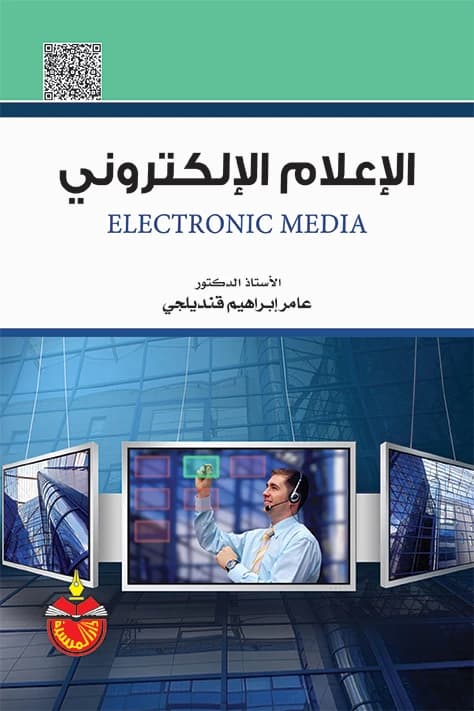
Electronic Media - Amer Ibrahim Qandilji (2015)
JOD

Get it by 5 Aug | Order in 3 Hours 51 Minutes
- Return Policy
- Warranty Policy
- Shipping Policy
- Non contact delivery
- Personal Receipt
- Return Policy
- Warranty Policy
- Shipping Policy
- Non contact delivery
- Personal Receipt
Writing on a new and contemporary topic such as electronic media is an important and interesting endeavor, yet it presents a challenge and requires double the effort, despite the author's long experience in university teaching, writing, and publishing on one hand, and professional media work for many years on the other. Encouragingly, we note that the second half of the twentieth century and the first decade of the current century witnessed remarkable development and progress in technology, especially in the field of electronic media. This progress is equivalent to all that was achieved in many previous centuries.
Perhaps one of the most prominent manifestations of technology is the integration and interaction that has occurred between the phenomena of information technology development and the communication and media revolution, leading to electronic media. The notable development in information technology, represented by computers, and the parallel development in communication technology, represented by satellites, have given rise to new communication means resulting from the connection between various tools and technologies, such as linking television and computers. The connection between the telephone, the computer, and the television has had a significant and direct impact on the electronic media we see and live today, resulting in new and vast possibilities in the world of communications, especially in contemporary social and media communications represented by Facebook, Google, Twitter, and other modern networks, which will be detailed in the book.
The author has paid attention to the integration and interaction between the phenomena of information development and the communication and media revolution, based primarily on the use of electronic computers to store the products of human thought over the ages in the smallest possible space, and then retrieve them as quickly as possible upon request. This is in addition to the new communication revolution, embodied in the use of satellite technology and its enormous potential for transmitting news, data, and images across countries and continents instantly.
The book is divided into nine chapters, distributed over fifty-six sections, with dozens of subheadings. The author has also prepared twenty-eight diagrams and tables to illustrate the texts. It addresses the reasons and considerations that contributed to the spread of electronic media, the transformations in Arab electronic media, and documented events about the development of communication means and technology.
The third chapter covers the Internet, the technology of dealing with electronic media, and the evolution of its uses. It discusses the applications of the Internet in electronic media, new developments towards a system called (Internet 2), and its media applications, as well as the features of journalistic and media activity on the Internet in Arab countries.
The fourth chapter is dedicated to electronic journalism, its characteristics, developments, technologies, and the justifications for the shift towards electronic newspapers, including a comparison between electronic and print newspapers and criteria for electronic journalism (technical, visitor-related, financial, and legal), in addition to the ethics of the profession.
The fifth chapter focuses on electronic advertising, a type of electronic media that occupies a significant space and generates large revenues. It covers various topics from the definition of electronic advertising and its evolution to methods of online advertising, key terminology, popular types of electronic ads (text, banner, pop-up, video), the development of the advertising market in the Arab world, and its challenges.
Another chapter is devoted to the electronic archive in the service of electronic media, defining its objectives, functions, benefits, and the steps to create a press archive, as well as the challenges of dealing with paper-based archives and the advantages of electronic ones.
The seventh chapter discusses electronic broadcasting (radio, television, and cinema), including features of electronic radio and television broadcasting, recorded and live broadcasting in digital radio, and experiments in digital television. It also addresses the mobile phone and its role in broadcasting, including Mobile TV.
The eighth chapter covers electronic media through blogs and social networks, their backgrounds, features, and applications, focusing on major platforms like Facebook, Twitter, Google+, MySpace, and LinkedIn, including a comparative study between Facebook and Twitter.
The final ninth chapter deals with the limitations and problems of dealing with electronic media, such as copyright issues, challenges facing Arab electronic media, cultural and media security online, electronic document security, providing a suitable technological environment, technological illiteracy, and other potential abuses like hacking, spoofing, and viruses.
- Number of Pages: 376
- Year of Publication: 2015
- Binding Type: Hardcover
- Edition Number: 1
- Printing Color: Black
- Size (cm): 17x24
- Weight (kg): 0.700
- Barcode: 9789957970048







