
Download Our App
Shop your way




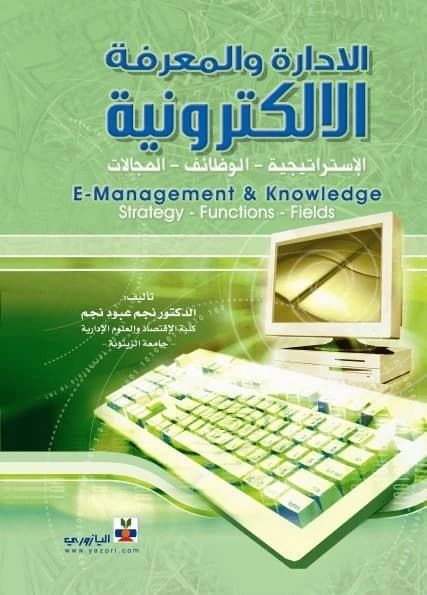
Electronic Management and Knowledge - Prof. Dr. Najm Aboud Najm
JOD

Get it by 5 Aug | Order in 3 Hours 39 Minutes
- Return Policy
- Warranty Policy
- Shipping Policy
- Non contact delivery
- Personal Receipt
- Return Policy
- Warranty Policy
- Shipping Policy
- Non contact delivery
- Personal Receipt
Specialists remain divided on the fundamental impact of the internet. In many cases, the internet's influence seems confined to a number of companies that were born from it, relying on its unique capabilities and features. Meanwhile, other companies continue to operate under the same traditional business rules. Therefore, the perception of the internet ranges between two extremes. The first is represented by electronic, digital, or virtual companies—those centered on the internet, built on its characteristics, and directed towards core internet-related capabilities, operating in a market space governed by the rules of the digital economy. The second is represented by physical, traditional companies, or those that have simply added ".com" to their name but still primarily depend on their physical operations and traditional relationships to create business value and generate revenue.
Between these two extremes lies the largest group of companies, which continue to shift their positions to varying degrees. The former group undoubtedly sees the internet not just as an economic sector, but as the new foundation for all sectors. They believe that internet-based digital management will render all traditional management schools, principles, and practices obsolete. In contrast, the latter group believes that even if the internet represents the highest form of technology, and even if it seems to be at the peak of its ascent fueled by unbridled enthusiasm, it remains merely a technology and a tool of management, which determines its areas and limits of use. There are criticisms of both extremes and their proponents.
Generally, we do not lean towards extreme points or radical ends, nor do we favor a black-and-white or an either-or approach. Instead, we are closer to multiple options and a wide spectrum of possibilities. Nevertheless, the internet has brought countless effects to society and the economy in general, and to the business sector in particular. The wealth being traded in the world of e-business, estimated in trillions, not millions or billions, has led our entire world to shift a significant portion of its capabilities, resources, and brightest minds to the internet. This alone is enough to make the internet represent the deepest and broadest change in our world, and its value will likely be enhanced for decades to come. To address this change, the book's structure across its ten chapters provides extensive coverage of the fundamental dimensions of this transformation.
- Weight: 0.82 kg
- Dimensions: 17 x 24 cm
- ISBN: 978-9957-12-195-2







