
Download Our App
Shop your way




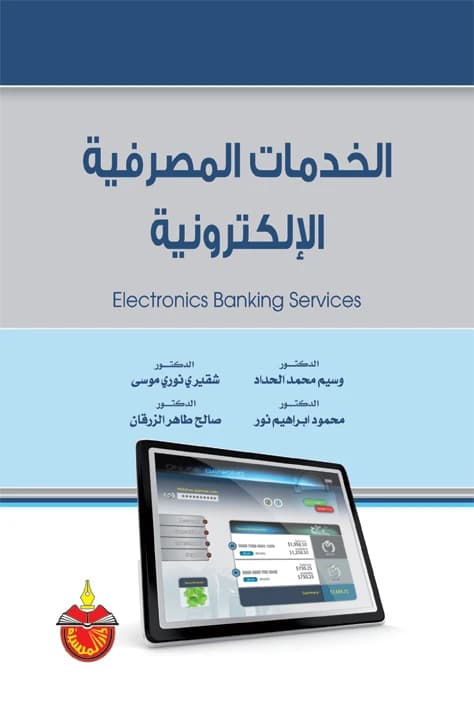
Electronic Banking Services - Shaqiri Nuri Musa (2012)
JOD

Get it by 5 Aug | Order in 3 Hours 36 Minutes
- Return Policy
- Warranty Policy
- Shipping Policy
- Non contact delivery
- Personal Receipt
- Return Policy
- Warranty Policy
- Shipping Policy
- Non contact delivery
- Personal Receipt
The successive and recurring crises affecting the world—whether financial, economic, or social—are caused by a departure from divine principles, as there is a vast difference between the economics of heaven and the economics of earth. Even non-Muslims have recognized that the only way out of these crises is by applying Islamic economics and the teachings of Islamic Sharia. Islam has focused on how to invest money, establishing rules and systems to achieve its objectives. These systems, rules, and transactions serve as an alternative to usurious investment, which is practiced by traditional commercial banks. Studies confirm a reciprocal causal relationship between investing funds through Islamic financing formulas compared to usurious systems. Many thinkers and economists have called for the interest rate on lending and borrowing to be zero or close to zero to overcome our current situation.
This book's first chapter covers the concept of banking operations, shedding light on the components of the banking system, including central banks, commercial banks, specialized banks, investment and business banks, and Islamic banks.
The second chapter discusses the concept of electronic banking in terms of its objectives and the drivers behind its emergence. The third chapter explores the forms of electronic banking, including internet banks, the mechanism of electronic banks, success factors for e-banking, transaction and information security, and payment method challenges.
The fourth chapter, titled "The Structure of Electronic Banking in Jordan," analyzes this structure, the spread of electronic channels and services among electronic banks, and the services offered through them.
The fifth chapter deals with electronic clearing and the main steps in the check collection process.
The sixth chapter covers electronic cards and their various types, while the seventh chapter addresses electronic financial payment systems and methods, smart cards, and the process of electronic fund transfer.
The eighth chapter discusses the regulatory controls for electronic banking operations, starting with a definition of these operations, the conditions for obtaining a license to provide them, the issuance of electronic money payment methods, and the risks involved.
The ninth chapter covers electronic marketing, including its advantages, disadvantages, methods, scientific principles, and the characteristics of banking services.
Finally, the tenth chapter discusses the electronic trading system, covering theoretical aspects related to the trading system, regulations for trading securities on the Amman Stock Exchange, and a guide to using the securities trading system on the Amman Stock Exchange.
- Number of Pages: 304
- Year of Publication: 2012
- Binding: Cardboard Cover
- Edition: 1
- Printing Color: Black
- Dimensions (cm): 17x24
- Weight (kg): 0.650
- Barcode: 9789957068943







