
Download Our App
Shop your way




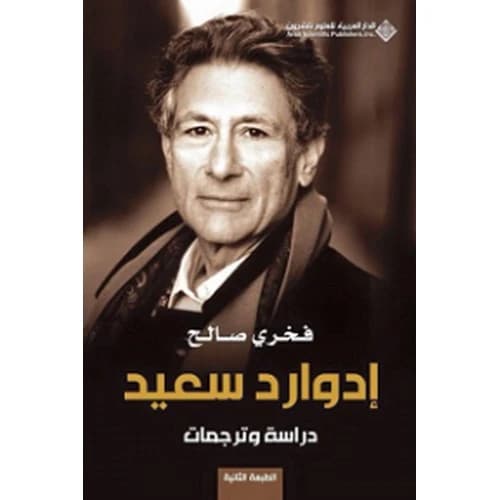
Edward Said: A Study and Translations - Author: Fakhri Saleh
JOD

Get it by 5 Aug | Order in 3 Hours 15 Minutes
- Return Policy
- Warranty Policy
- Shipping Policy
- Non contact delivery
- Personal Receipt
- Return Policy
- Warranty Policy
- Shipping Policy
- Non contact delivery
- Personal Receipt
Edward Said's critical work raises many questions about the universality of criticism and theory, and the impact of upbringing, formation, and existential experience on the ideas of influential critics and theorists. The question of an Arab critical theory has preoccupied many Arab critics and researchers, with much discussion on the possibility of blending critical heritage with contemporary theoretical currents originating from the heart of Western-centrism.
In this context of the universal versus the local, the interaction between the center and the margin, and the margin's ability to invade and change the center's perception of itself and the other, lies the experience of Edward Said. As the author of this book, Fakhri Saleh, sees it, Said was able to adapt French philosopher Michel Foucault's concept of discourse—and the relationship between power, knowledge, and its political uses—for his primary purpose: to uncover the forms of Western hegemony over the East, particularly its Muslim and Arab regions.
The author of "Orientalism" then took another advanced step by placing Palestine, from which he was displaced with his people, at the heart of the Western discursive practice that exercises dominance and reshapes the image of the Palestinian, thereby justifying the subversion of Palestinian existence and its replacement with the new Israeli entity, which belongs in its concepts and orientations to the Western center.
Because the discourse on Edward Said's critical thought cannot be summarized in a single page or book, this volume—which combines study and translation, panoramic reading, analysis, deconstruction, interpretation, and criticism—includes a special and in-depth reading of Said's intellectual and creative achievements. As the author states: "This is the second edition of 'Edward Said: A Study and Translations,' a new edition to which I have added several chapters to the first edition (2009): an introduction explaining Said's relevance and promise for contemporary criticism, a chapter on Said's vision for resolving the Palestinian issue, another on Frantz Fanon in Said's interpretation, in addition to a translation of an article by him on Nelson Mandela."
- Publishing House: Arab Scientific Publishers/Lebanon
- Number of Pages: 288
- Year of Publication: 2015







