
Download Our App
Shop your way




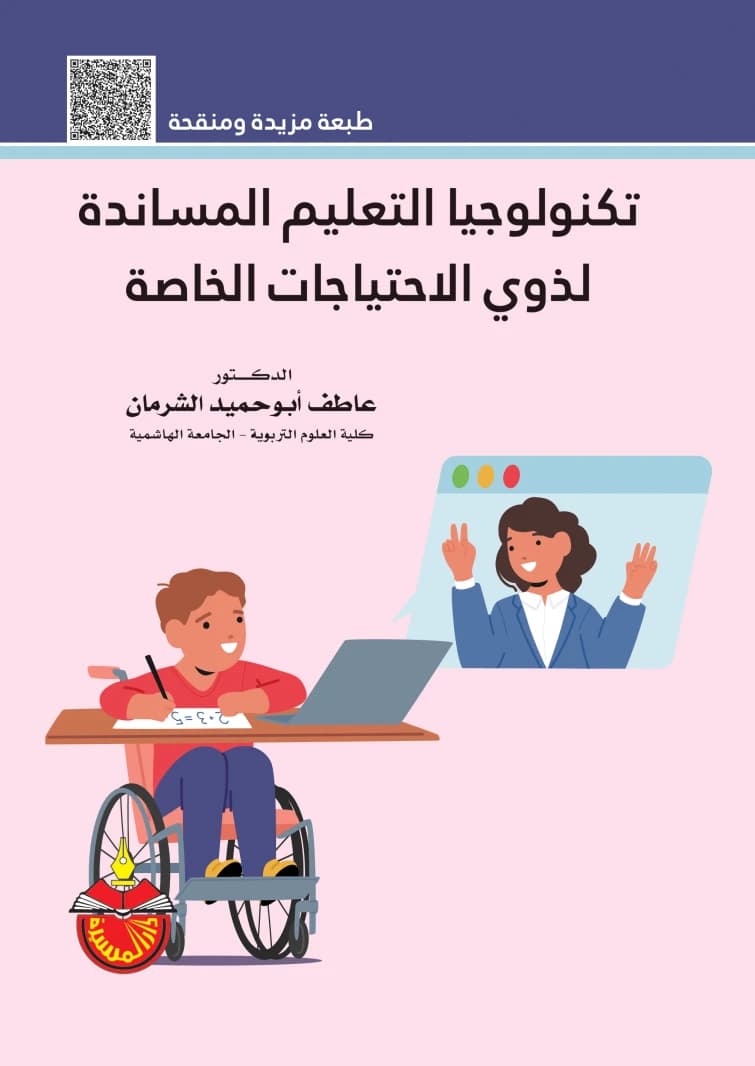
Educational Technology for People with Disabilities by Dr. Atef Abuhamid Al-Sharman
JOD

Get it by 5 Aug | Order in 5 Hours 12 Minutes
- Return Policy
- Warranty Policy
- Shipping Policy
- Non contact delivery
- Personal Receipt
- Return Policy
- Warranty Policy
- Shipping Policy
- Non contact delivery
- Personal Receipt
I always remember a situation during my undergraduate studies at Yarmouk University. I was heading to a lecture hall that was about to start when I noticed a fellow student in a wheelchair sitting at the door of her lecture hall, which was separated by just two steps. These steps were an insurmountable obstacle for her to enter the hall, which was large and resembled an amphitheater. The student looked as if she was waiting for someone to lend a helping hand to assist her in entering a space that seemed like two impenetrable barriers. I approached with another colleague and we lifted the wheelchair from the sides and helped her into the hall. However, I felt conflicted at the time; on one hand, I was happy to offer modest assistance to a student who faced many challenges to complete her studies. On the other, I felt uncomfortable and somewhat inadequate. It was discomfort from carrying the student in the chair, which surely had an impact on her psyche despite its daily repetition. I continued to think afterward that there must be a better solution for her to access the lecture hall without waiting or asking for help, preserving her dignity and independence. Eight years later, I found myself in Australia pursuing my master's and doctorate studies. It was evident the great care provided to people with various disabilities. It often captured my attention to see public transport buses equipped to lower and tilt, becoming parallel to the sidewalk so that wheelchair users could enter with ease and comfort without assistance. Inside, there was a special place for them.
Awareness of people with special needs has increased in societies over the past decades, and the interest in them has grown accordingly. Many laws have been enacted worldwide aimed at raising awareness and reminding us of this group, obligating relevant entities to provide what is necessary to integrate them positively into different aspects of life. Some have come to call this group the 'precious category' and we increasingly see special parking spaces for people with disabilities. Special ramps for wheelchairs have been added to facilitate the movement of users. Despite the achievements and rights realized for people with special needs in recent decades, much still requires effort, cooperation, and understanding from all concerned parties. To achieve this, many concepts and terms related to people with special needs must be reevaluated, and the principle underpinning services and support provided to this group must shift to one based on freedom and equality in society.
Furthermore, support efforts risk becoming lackluster over time if not rooted in laws that ensure their implementation and subsequent ingraining into society to become part of its ethics and values people believe in and defend.
Number of pages: 248
Year of publication: 2026
Binding type: Paperback
Edition number: 2
Print color: Black
Dimensions (cm): 17x24
Weight (kg): 0.600
Barcode: 9789957970581







