
Download Our App
Shop your way




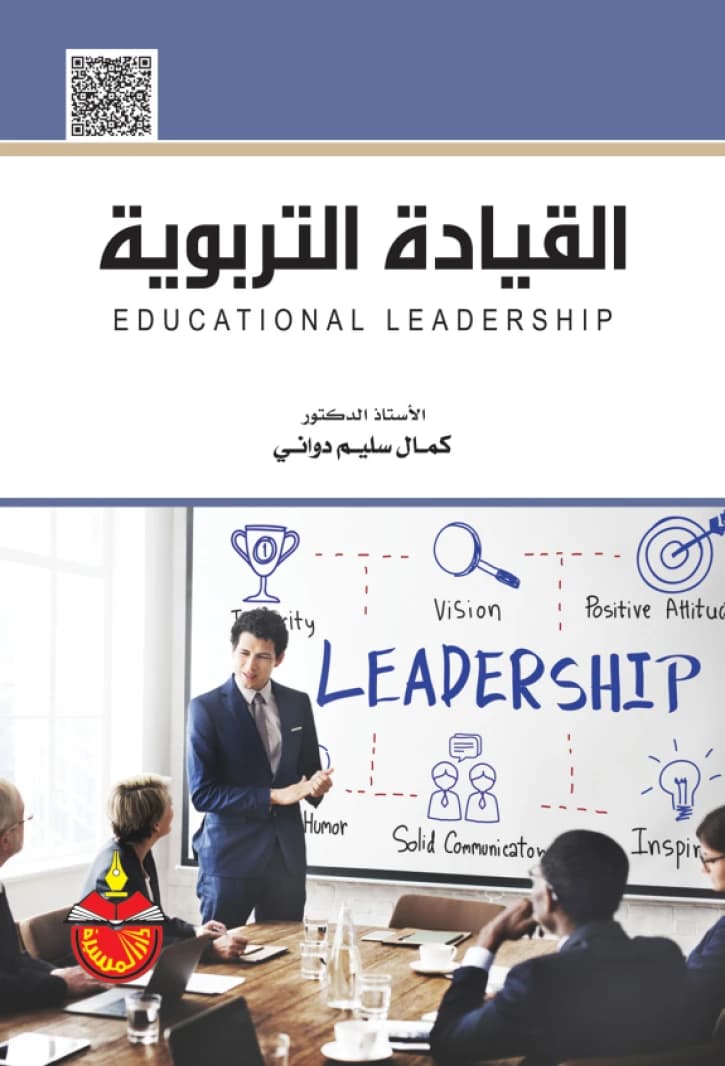
Educational Leadership - Kamal Saleem Dawani - 2017
JOD

Get it by 5 Aug | Order in 2 Hours 59 Minutes
- Return Policy
- Warranty Policy
- Shipping Policy
- Non contact delivery
- Personal Receipt
- Return Policy
- Warranty Policy
- Shipping Policy
- Non contact delivery
- Personal Receipt
Leadership has become a hot topic in conscious communities, and libraries are now rich with material on leadership and how one can become a leader. Additionally, institutes and universities have discovered a growing interest in the study of leadership, as the subject has asserted its presence and importance across various institutions. This is due to the increasing awareness of its immense benefits, which positively impact not only the institutions themselves but also the society that hosts them. However, this desire for leadership material and its effectiveness often clashes with individuals' lack of understanding of the leadership phenomenon. It is one of the most widely debated topics in terms of its goals and its intellectual and value-based methodology. Leadership can be used for noble humanistic purposes, just as it can be used for manipulation, maneuvering, and oppression. Therefore, thinking about and understanding leadership is considered a complex and difficult intellectual challenge.
The historical question regarding leadership has always been: Can leadership be taught? And can individuals learn it to become leaders? It was once said, "A leader is born, not made," but this belief has not found logical support from researchers and thinkers, who have declared it a mere personal belief not based on any scientific facts. Despite this, some ambiguity and doubt still exist among a number of thinkers about the subject. They believe that institutes and universities are responsible for clarifying the concept of leadership, crystallizing it, and defining it like any other social scientific system. What has become clear and confirmed in the field of leadership learning is that students of leadership cannot become leaders simply by studying it. Rather, they can study leadership, discuss its meaning, styles, theories, and strategies. They can also learn a great deal about its strengths and limitations, and how to distinguish between good and bad leadership. Learning about leadership also means understanding the critical relationships between the ends and means of leadership, and studying the special chemistry that sometimes develops between leaders and followers, such as that between Martin Luther King Jr. and African Americans demanding their civil rights, or between Gandhi and the Indian people demanding liberation from British occupation.
Students of leadership can learn a great deal by reading the biographies of the best and worst leaders. There are countless opportunities to learn about leadership that sharpen learners' skills in public speaking, dialogue, debate, negotiation, and planning. Gardner (1990) says that what we learn after we think we know everything is true learning. A leader is one who learns to manage their time wisely, putting aside routines of laziness, apathy, and enslaving habits. A leader learns that self-pity or self-flagellation, resentment, and indignation are toxic. A leader learns how to be truly engaged and concerned for others. A leader also continuously learns that they have more to give than they have already given.
Reflecting on past scientific research on leadership, particularly in the first half of the twentieth century, the literature suggests a pessimistic view. Research often led to similar theories without making breakthroughs that would advance leadership thinking beyond the familiar. In the second half of the same century, leadership theories emerged that differed in method but were similar in essence. Most theories from this period adopted a situational perspective, which weakened the quest for an empirical theory of leadership with a single style suitable for all conditions and situations. A common thread among most situational theories is their focus on the degree of predictability, certainty, and control the environment provides for the leader, and that success in achieving a goal depends on the level of follower support, task control, and situational alignment. However, the points of contention among the proponents of these theories centered on leadership behavior, style, and the decision-making process. That is, the leader's relative focus on the task-oriented goal versus the interpersonal interaction directed toward relationships and morale. The leader's relative use of autocratic leadership with a direct style versus democratic leadership with a participatory style. These opposing dualities have been a major part of the leadership equation since the beginning of behavioral studies in the mid-last century.
A key consideration is that differences in leaders' behaviors attributed to cultural backgrounds highlight the role of personal values in the social process of leadership when dealing with a given situation. For example, research in European countries has shown that a leader's direct, production-oriented behavior typically differs from the considerate leader's behavior, which is oriented toward human relations and interpersonal interaction. Here, it is noted that clear and distinct factors separate the two behaviors. In contrast, studies in some developing countries have revealed different leadership patterns. Leaders whose groups achieved the highest performance and satisfaction were those who combined both direct and considerate styles, meaning the two styles were positively correlated. This indicates that the difference in the two cases is due to the cultural background of the leaders and their followers in European and developing countries. It can also be understood that culture, formed through socialization processes, helps shape the needs, values, and personalities of both leaders and followers. Cultural norms also create expectations and judgments for appropriate behavior for leaders and followers. Furthermore, these studies have shown that the explanation for differences in leader behavior styles across cultures points to the strong emphasis on individualism in Western democracies and on collectivism and group values in the rest of the world. In collectivist cultures where group members share collective goals and needs, a leader can control and satisfy followers simultaneously by being both direct and supportive.
One of the most prominent contemporary leadership theories that has gained wide fame and attracted the interest of various organizations and institutions is transformational theory. It is distinguished by its effective organizational strategies and has introduced terms like charisma, vision, and inspiration into the leadership lexicon to describe the qualities of transformational and executive leadership. Transformational thinking was heavily influenced by the seminal work of James MacGregor Burns on transformational leadership. Burns was the first to describe the characteristics of traditional transactional leadership and transformational leadership and highlight the fundamental differences between them. Burns asserts that the relationships between most leaders and followers are transactional. Leaders build their relationships with followers with a transactional idea in mind—tasks and duties in exchange for rewards and personal benefits. In contrast, Burns described the transformational leader as one who looks to the motivational readiness of followers and seeks to satisfy higher needs that transcend personal interests in a joint effort under the banner of the common good.
While we observe a great need to understand leadership and sharp criticism of its absence in our societies, we also notice an aversion to an excessive focus on leadership and a fear of the maneuvers of some selfishly branded leaders. Therefore, this book aims to confront all these negatives and expose the misconceptions about the nature of leadership through the illuminating insights it presents, and the contributions of some prominent scholars and experts in the field of leadership. The following is a brief overview of the book's main purposes and the true meaning of leadership and its utmost necessity for the human condition in general, and the educational condition in particular.
- First: Leadership is central to human situations and conditions and to educational institutions of all kinds. Leadership is not a fad or an obsessive craze that captivates individuals for a period of time, but a concept for all times.
- Second: A prominent purpose of the book is to emphasize that leadership is for everyone, and that it is a domain of knowledge for all, not a privilege of the elite. The readings presented in the book do not treat leadership as exclusive, but rather portray it as a holistic process existing in all times and places, with limitless knowledge.
- Third: A main purpose of the book is to call for a correct understanding of leadership. The more knowledge about leadership and how its processes work, the more a person can realize the true purpose of leadership.
The main goal of this humble work is to enhance the reader's understanding and practice of a very important process, around which this effort is centered, to improve the upbringing of our generations, the quality of our lives, and our society, namely the process of educational leadership.
- Number of Pages: 264
- Year of Publication: 2017
- Binding Type: Hardcover
- Edition Number: 2
- Printing Color: Black
- Dimensions (cm): 17x24
- Weight (kg): 0.600
- Barcode: 9789957069513







