
Download Our App
Shop your way




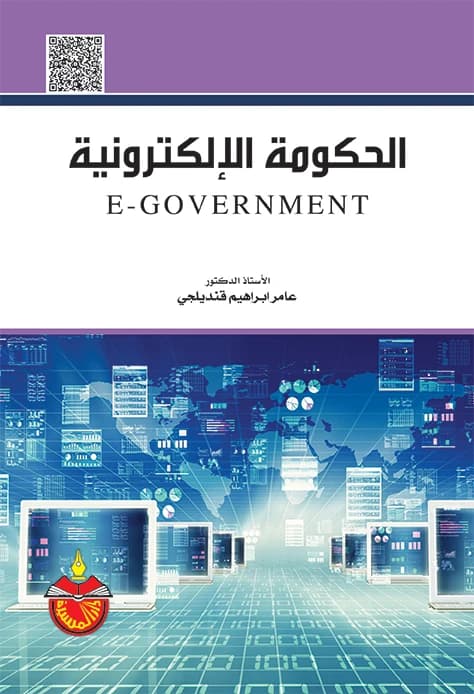
E-Government - Amer Ibrahim Qandilji
JOD

Get it by 5 Aug | Order in 3 Hours 33 Minutes
- Return Policy
- Warranty Policy
- Shipping Policy
- Non contact delivery
- Personal Receipt
- Return Policy
- Warranty Policy
- Shipping Policy
- Non contact delivery
- Personal Receipt
It is indisputable that the topic of e-government, in all its dimensions and content, has become of utmost importance not only to politicians but also to economists, sociologists, and specialists in various contemporary fields. Based on this, the author has attempted to cover all aspects and angles of this sensitive subject, starting with defining the concept of e-government, its meaning, objectives, and various stages, as well as the historical development of the concept. This is covered in the first chapter of the book.
The book also addresses a complementary topic on how to achieve the concept of e-government through necessary inquiries concerning planning, management, and evaluation in e-government, its primary objectives, the evolution of the idea, and its services. The author also discusses other topics in this chapter, such as the effects and data of e-government, including the impact on citizens, governmental institutions and organizations, and government employees.
In the second chapter, the author dedicates it to the requirements, steps, and limitations of building an e-government, including securing a strategic roadmap, its foundational needs, stages and steps of transition, required management and skills, and the positive and negative considerations in applying the concept, as well as the constraints that may face the transition.
The third chapter highlights the internet and its developments as a required cornerstone for any e-government, focusing on its nature of use, benefits as an infrastructure for institutions in managing e-government operations, requirements for connection, the World Wide Web, and technical facilities for access. It also points to the new developments towards what is termed 'Internet2' and the subsequent network capabilities and applications.
The fourth chapter, titled 'E-Management and E-Government,' addresses the common confusion between the two terms, defining e-management, its objectives, requirements for transition, expected benefits, stages of transformation, and factors for success and failure.
The fifth chapter is dedicated to e-commerce, defining it and its required stages, pillars, dimensions, basic elements, characteristics, methods of measuring its volume, the opportunities it provides, and the parties involved in its applications, in addition to its implementation effects.
The sixth chapter covers e-banking and its active role in e-government, defining it, its importance, the distinguished services it offers, its patterns, and examples of its applications within e-governments, also touching upon credit cards, smart cards, and other tools for dealing with beneficiaries.
The seventh chapter discusses other supporting applications and activities for e-government, such as e-recruitment, e-publishing, e-tourism, e-advertising, and e-reservations.
The eighth chapter addresses the shift towards electronic archives as a necessity for modern e-governments, defining the e-archive, its objectives, functions, the advantages of transitioning to it, and the steps to build it, along with its characteristics and benefits.
The ninth chapter presents e-commerce experiences at both Arab and global levels, focusing on specific experiences in Saudi Arabia, the UAE, and Jordan, with a quick review of other Arab countries and the obstacles they face. It also briefly reviews leading global e-government experiences, such as those of the USA and Britain.
The tenth and final chapter is devoted to the problems and challenges facing e-government and how to deal with them, addressing issues of piracy, financial crimes, misuse, and viruses that could threaten or disrupt e-government procedures. It also discusses challenges from weak technological environments and skills, and then covers legislation, laws, and encryption methods for protecting information systems and networks, and finally, the required control over information security across the internet and other networks.
- Number of Pages: 352
- Year of Publication: 2015
- Binding Type: Hardcover
- Edition Number: 1
- Printing Color: Black
- Dimensions (cm): 17x24
- Weight (kg): 0.700
- Barcode: 9789957970468







