
Download Our App
Shop your way




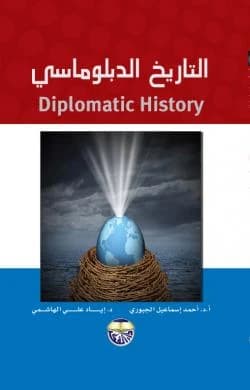
Diplomatic History - Prof. Dr. Ahmed Ismail Al-Jubouri, Dr. Ayad Ali Yassin Al-Hashemi
JOD

Get it by 5 Aug | Order in 3 Hours 6 Minutes
- Return Policy
- Warranty Policy
- Shipping Policy
- Non contact delivery
- Personal Receipt
- Return Policy
- Warranty Policy
- Shipping Policy
- Non contact delivery
- Personal Receipt
Diplomatic relations between states are the primary expression of sovereignty and independence in the international arena. As soon as a state gains its independence, it seeks to establish diplomatic relations with other countries. The level and number of its representations are determined by its political and economic interests and the role it envisions for itself on the world stage. Before Islam, Arab diplomacy was limited to commercial, military, and peaceful concepts. However, with the advent of Islam, radical and fundamental changes occurred in light of the new Islamic faith's principles in the Holy Quran and the purified Sunnah of the Prophet. After the establishment of the Arab Islamic state, this major political transformation led Muslims to organize diplomacy into rules and introduce it into the field of international political relations. It thus became an effective means of implementing the foreign policy of the Arab Islamic state, whose foundations were laid by the Prophet Muhammad (PBUH). During the era of the Prophet Muhammad (PBUH) and the Rightly Guided Caliphs after him, diplomacy became an effective tool for spreading the teachings of Islam, organizing meetings and conferences, and concluding treaties. In later eras, treaties were not limited to spreading the Islamic religion but were also concluded for other purposes such as truces, ransoming prisoners, espionage, trade, offering congratulations and condolences, reconciliation, marriage, carrying gifts, calls for aid, and forming alliances. Anyone who reads Islamic history will find an advanced system in the principles and rules of diplomacy, including how to select ambassadors, send missions, manage ceremonies and reception of foreign delegations, grant security and immunity to ambassadors, provide tax exemptions, honor delegations and ambassadors, and conduct political correspondence. Comparing modern international law with Islamic Sharia, we find that the provisions of Islamic Sharia still constitute a living system of diplomacy, keeping pace with development and growth, and deriving detailed rulings to manage the continuous and renewed relationships emerging in Islamic and human society in general. This is one of the miracles of the Holy Quran, as it proves its suitability through interpretation (ijtihad) for life and its evolution, regardless of time or place. We note that many international issues still debated in international forums were addressed with precision and organization by Islamic Sharia, as its mission is civilizational and organizational, aiming to regulate relations in an open society that included the known peoples of the world at that time. This book aims to provide a clear picture of the roots of Arab diplomacy before Islam, Islamic diplomacy during the era of Prophet Muhammad (PBUH) and the Rightly Guided Caliphs, the Umayyad and Abbasid eras, as well as diplomacy in the Umayyad state in Andalusia, and the Abbasid era, leading up to the European Renaissance, the Congress of Vienna, and contemporary diplomacy.
- Authored by: Prof. Dr. Ahmed Ismail Al-Jubouri, Dr. Ayad Ali Yassin Al-Hashemi
- Number of Pages: 304
- Year of Publication: 2015
- Binding Type: Hardcover
- Edition: First
- Print Color: Black
- Dimensions (cm): 17*24
- Weight (kg): 0.5
- Barcode: 9789957920661







